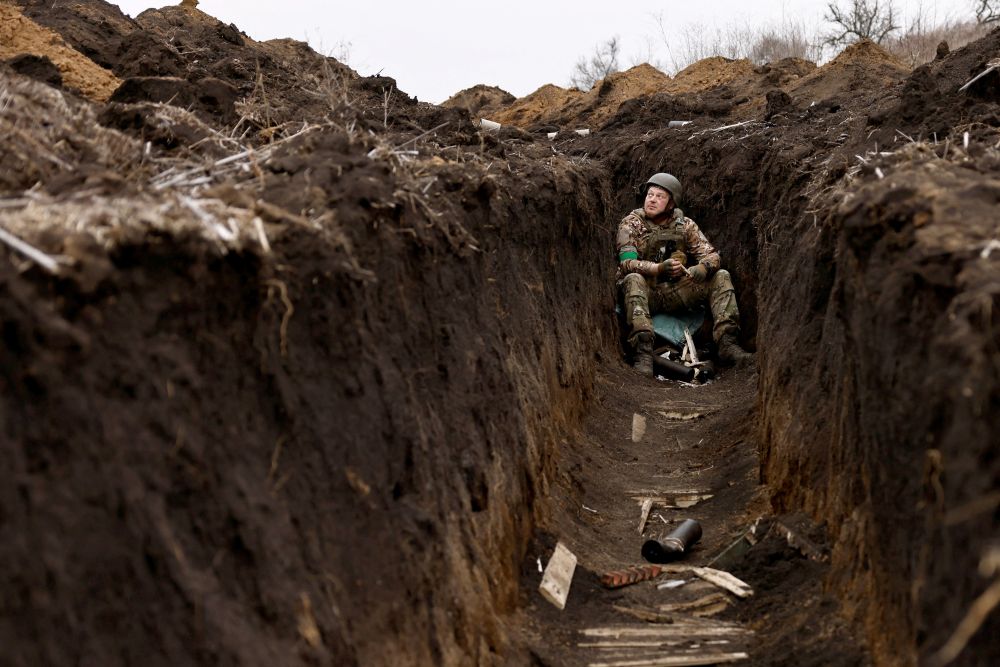
A Ukrainian soldier listens to artillery fire from his bunker at a front-line position near Bakhmut March 16, 2023, amid Russia's attack on Ukraine. (OSV News/Reuters/Violeta Santos Moura)

Join the Conversation
Send your thoughts to Letters to the Editor. Learn more
When the world's cardinals gather in Rome at the end of the week for a consistory, one of the issues they will be discussing is just war theory, whether it is outdated and, if so, what to do about that fact.
No U.S. prelate has been more outspoken on the need to correct distortions of just war theory than Cardinal Robert McElroy. He is a leading intellectual among the U.S. bishops so his words always warrant special attention. In April, at America magazine, McElroy confronted what he termed distortions of Catholic teaching occasioned by the war on Iran.
"The first distortion is the assertion that the just war tradition is the foundational stance toward war in Catholic teaching," McElroy wrote. "In reality, the fundamental stance of the church toward war is that it must be avoided."
This is true, but it misses the fact that just war theory itself is structured as an attempt to avoid war. Indeed, properly understood, war is only justified when it seeks to restore a peace that has been broken or to correct and eliminate an injustice that is intolerable. Even then, just war theory sets forth a variety of criteria to justify undertaking a war and additional criteria for the just conduct of war.
Most of us consider the Second World War to have been a just war. The news reels of people in France and other countries celebrating their liberation by allied forces make the point better than any argument. The Nazi tyranny was oppressive in the extreme, built on internalized violence against those viewed as foes, and perpetrating the grossest injustice in the history of the West, the Shoah. The Nazis were not to be stopped by fine words or diplomacy. It required a war, and that war was just.
Most of us consider the Ukrainian people's defense of their homeland to be a just war. In his recent encyclical Magnifica Humanitas Pope Leo XIV stated: "Today, more than ever, without prejudice to the right to self-defense in the strictest sense, it is important to reaffirm that the 'just war' theory, which has all too often been used to justify any kind of war, is now outdated." The clause "without prejudice to the right to self-defense in the strictest sense" defeats the conclusion that just war theory is outdated. If there is a legitimate right to self-defense, and a war fought on that basis is just, then we need a theory to explain why it is just and other wars are not. Call it what you will, that is a just war theory.
What worries me most about the push to jettison just war theory is that it betrays a deeper inability to wrestle with the fact of evil in the world.
NCR published an editorial that called for overturning just war theory. It suggested that the wars of today involve civilian casualties in ways earlier wars did not and that this fact "is one reason just war theory has become inadequate. But it is not the deepest reason. The deeper reason is Jesus." Alas, WWJD is a bracelet, not a theology.
The editorial called for "active, public, disciplined resistance" to violence, including "diplomacy, conflict prevention, unarmed civilian protection, international law, war-crimes accountability, humanitarian corridors, sanctuary for refugees, material support for victims, public protest, truth-telling, economic pressure, interreligious mediation, reconciliation and the rebuilding of civil society." Which of those laudable things would have stopped the Russian tanks on their way to Kyiv? Which would have liberated the concentration camps?
Was the U.S. Civil War just? The Constitution was being defended, but the South did not really "attack" the North. The reason that war can be considered just was because it ended the egregious injustice of slavery.
The Cold War erupted into hot wars at the peripheries of the contest between the Soviet Union and the Western democracies. Korea seems justified and Vietnam not, but it was hard to know that at the beginning of either. The Cold War involved an enormous expense but it achieved the objectives of the West, stopping the spread of communism without igniting a nuclear war. Was the Cold War just? Ask a Pole or a Lithuanian or a Romanian.
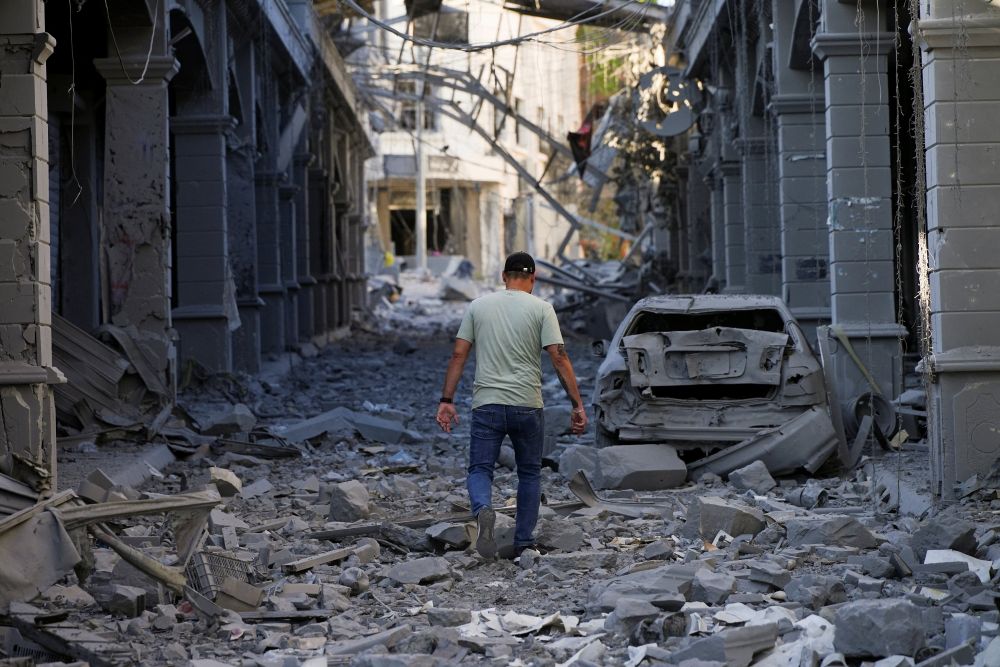
A man walks amidst rubble in the aftermath of Israeli strikes in Nabatieh, Lebanon, June 15, 2026. (OSV News/Reuters/stringer)
There is one other consideration that the cardinals cannot ignore. How would any rejection of just war theory be received? The U.S. cardinals appointed by Pope Francis — Cardinals Blase Cupich, Joseph Tobin, Kevin Farrell and McElroy — have made many contributions to the life of the church, but none more than charting a path away from the culture wars. Overturning just war theory, even in name, would reinforce the "diploma divide" that has become the primary marker of polarization in our society. Highly educated liberals might warm to the dismissal of an age-old theory, but working-class people know better.
I have noted before that the highly educated no longer fight our wars. Harvard University's Memorial Chapel honors the 373 Harvard men who died in World War I, the 697 who died in World War II and the 22 who died in the Vietnam War. No matter what qualifications are employed, a headline from the Vatican that the church has declared war to be unjust will strike veterans, and the working class from which they come, as very painful. It would be to our time what the Oxford Union's famous 1933 resolution that its members would not fight for king or country was to its time, a source of contempt against societal elites, with the church stuck standing with the elites.
That resolution was thoroughly in tune with elite and public opinion at the time. Eight years prior, the Locarno Pact had established peaceful methods for resolving conflicts among the nations of Europe. In 1928, the Kellogg-Briand Pact outlawed war. Military budgets were cut, especially when the Depression hit, and calls for complete disarmament were frequent. When Germany remilitarized the Rhineland in 1936, the governments of France and Britain were afraid to challenge this violation of international law for fear of appearing to be warmongers. We now know that the German troops were under orders to retreat if challenged. They were not challenged and Hitler was emboldened. Two years later, British Prime Minister Neville Chamberlain thought he had achieved "peace for our time" when he returned from Munich. Chamberlain was hailed as a hero. In short, the track record of those who advocate for peace above all else is a mixed one. History is a great curator of life lessons that we ignore at our peril.
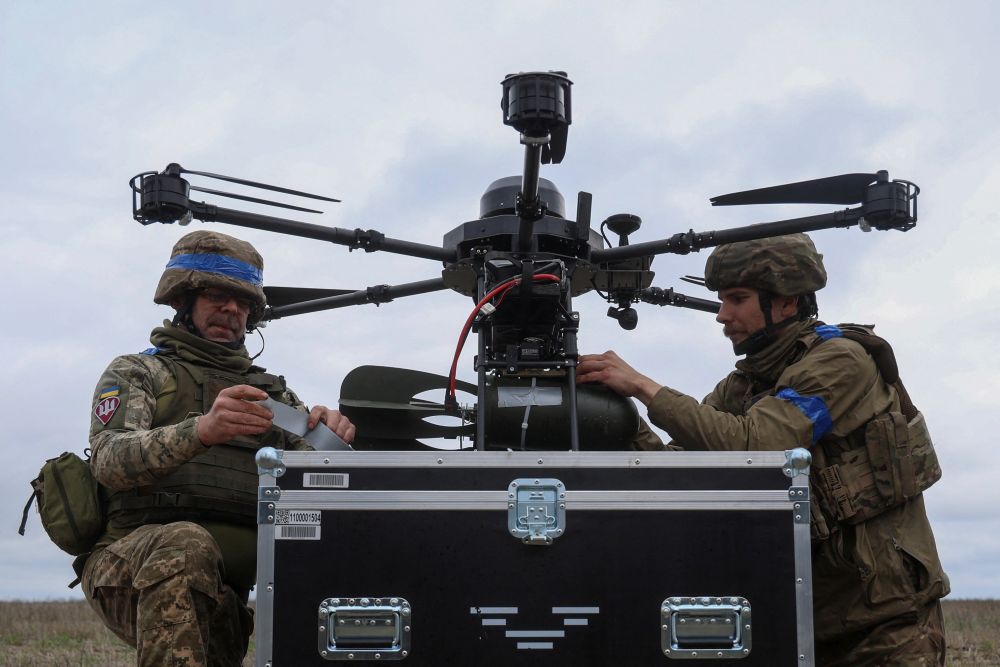
Ukrainian servicemen of the 25th Airborne Brigade attach small air bombs to a Vampire, a heavy unmanned aerial vehicle, near a front line, amid Russia's attack on Ukraine, in Donetsk region, Ukraine April 5, 2025. (OSV News/Reuters/Oleksandr Ratushniak)
Ah, you say: MSW is using a Nazi analogy which means he has already lost the argument. But the historical lesson is not about the Nazis. It is about the naivete of the well-intentioned in Western democracies.
What worries me most about the push to jettison just war theory is that it betrays a deeper inability to wrestle with the fact of evil in the world. For many good reasons, our church has embraced the medicine of mercy and the practice of pastoral accompaniment and encouragement in recent decades. But sometimes I fear we have lost a proper fear of the Lord. This, combined with the insufferable claiming of the mantle of prophetic witness, has brought us to this strange moment when an Augustinian pope is considering abandoning one of the truest theological contributions of the great Augustine himself. He understood the power, persistence and pervasiveness of sin, and became known as the "doctor of grace."
Just war theory may be unpopular in certain Catholic academic circles, but it is used extensively in our military training academies. Once on a visit to the Air Force Academy, I sat in on an ethics class and they were reading Augustine and discussing just war theory. The entire semester was dedicated to it. The future airmen were doing their part to learn how moral military matters intersect in complicated ways, and how important it was to conform military strategy to moral ideals.
In any given year, the Pentagon or one of its adjuncts hosts conferences or talks on some aspect of just war theory in or around Washington. That may have stopped under the current president, as many important things have stopped, but it was the norm before President Donald Trump, whether there was a Democrat or a Republican in the White House.
Advertisement
There is much to update about just war theory. While many focus, understandably, on the unique threat of nuclear weapons, it is strategic bombing that really broke the distinction between civilians and combatants. What is more, it never worked. Strategic bombing did not break the morale of Britons during the Blitz nor of the Germans during the payback that followed. We must grapple with the threat posed by a rogue regime with nuclear weapons, and what that threat means for our traditional opposition to a preventative war. Important work has already been done in the area of post-bellum just war theory, such as this essay by theologian Tobias Winright.
Most importantly, the Catholic Church can and should lead efforts to seek to address the things that cause war in the first place. Overcoming divisions between peoples, urging observance of the Universal Declaration of Human Rights, offering the church's services as a mediator of conflicts, pursuing development in the impoverished nations of the world, all these flow naturally, and supernaturally, from the church's commitment to peacemaking.
Pope Leo clearly aims to unite the Catholic Church. Tossing aside a 1,500-year theological tradition is not likely to aid him in that project. More importantly, while we all want peace, nothing in the Gospels frees us from the responsibility before history to protect the weak and defenseless. Some injustices cry out to heaven for redress and war, or something very much like war, may be required to end the wrong. The distortions of just war theory should be addressed, but tossing aside the theory itself is a truly bad idea. War is a terrible thing but it is not always the most terrible thing.