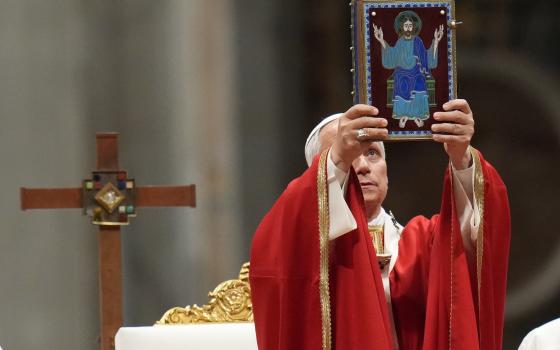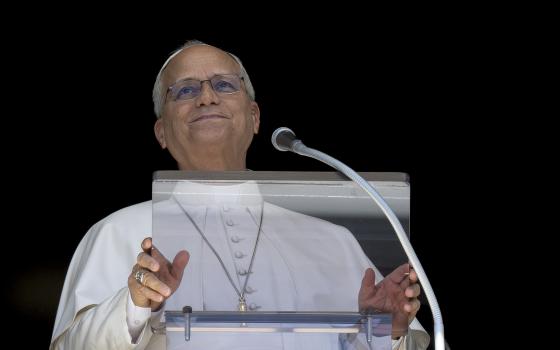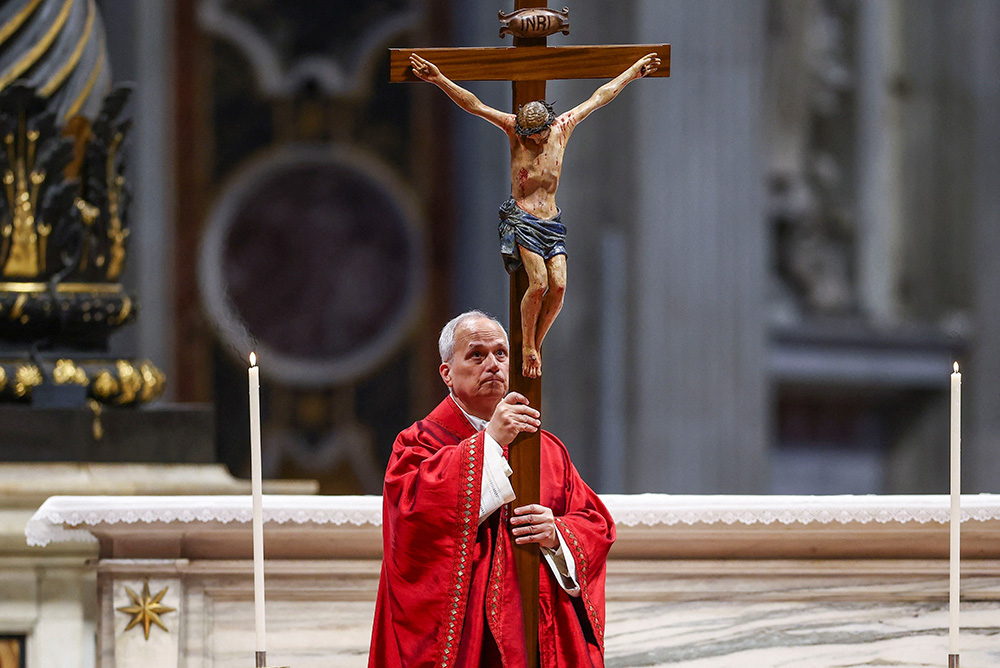
Pope Leo XIV holds a crucifix as he leads the Good Friday Liturgy of the Lord's Passion in St. Peter's Basilica at the Vatican April 3, 2026. (OSV News/Reuters/Guglielmo Mangiapane)

Join the Conversation
Send your thoughts to Letters to the Editor. Learn more
My great mentor and friend, the late Msgr. Lorenzo Albacete, once related a story about accompanying Cardinal William Baum, who was then the archbishop of Washington, to a graduation ceremony at a Catholic school. On the drive back, the cardinal asked Albacete if he noticed anything strange about the ceremony. Lorenzo said he could not think of anything. The cardinal replied, with great sadness in his voice, "There was not one mention of Jesus Christ."
I am sure the people who worked at the school loved the Lord Jesus and his church. But we should acknowledge that this was not an isolated event.
One fear is that shunning the use of Christ's name was the result of a misunderstood interreligious or ecumenical dynamic. If there are non-Christian students and parents, maybe we should leave Christ out of it? In my long life, I have never met a non-Catholic who sent their kids to Catholic schools who complained about the school being too Catholic. In ecumenical dialogues, everyone needs to show up as themselves if the dialogue is to be fruitful.
Another fear is that such instances of neglecting to mention Christ explicitly at a Catholic event was a symptom of the "moralistic, therapeutic deism" that Melinda Lundquist Denton and Christian Smith described in their 2005 book Soul Searching: The Religious and Spiritual Lives of American Teenagers. The teenagers picked it up from somewhere, and that somewhere was an ambient, pluralistic culture that was also increasingly utilitarian and secular. There was no conspiracy to omit the mention of Jesus Christ, but there was a hesitancy to place him at the center of our events. Besides, as I suggested last week, we moderns tend to place ourselves at the center of events.
Advertisement
Pope Leo XIV aims to correct this state of affairs. At First Things, Fr. Robert Imbelli looked back to three talks at the beginning of the year that highlight this same Christocentric focus. He noted that when the pope spoke at the commemoration of Nicaea last year, he warned against a "new Arianism" that saw Christ as a teacher, not a savior.
The pope has continued this Christocentric focus. At the Regina Caeli this past Sunday, May 10, the Holy Father said, "This is why the Lord commands us to love one another as he has loved us: It is Jesus' love that begets love within us. Christ himself is the standard, the measure of true love: the love that is faithful forever, pure and unconditional. The love that knows no 'buts' or 'maybes'; the love that gives of itself without seeking to possess; the love that gives life without taking anything in return."
At the previous week's general audience, while speaking of Lumen Gentium, Vatican II's Dogmatic Constitution on the Church, the pope said, "The church, therefore, does not proclaim herself; on the contrary, everything within her must point to salvation in Christ."
It is good that Catholic Christians place Christ at the center of our lives — of our words and deeds, of our motivations and consolations. And it is good that we learn again to explain why Christ is at the center to others. Leo XIV is leading the way.
You are reading a selection from Michael Sean Winters' weekly newsletter. To get the full edition — including the "In the News" link roundup — delivered 24 hours before it appears online, sign up here!