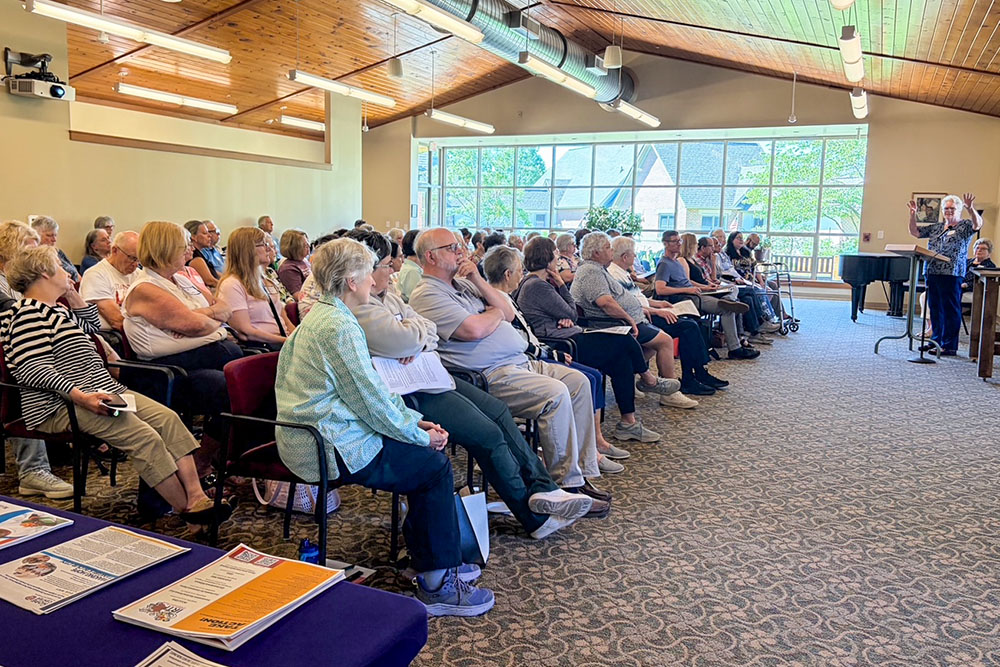
Participants attend the June 13, 2026, workshop "Neighboring the Dear Neighbor" hosted by the Sisters of St. Joseph at their center in Cleveland. (Kaleigh Tuck-Macalla)

by Sr. Christine Schenk
Join the Conversation
Send your thoughts to Letters to the Editor. Learn more
I was deeply moved by Pope Leo XIV's impassioned defense of migrants when he spoke recently at the Canary Island's notorious "Port of Shame."
"Human dignity has no passport and does not lose its value when crossing a border," proclaimed our pope. I would love to print his powerful insight on thousands of bumper stickers. What a great way to counter the deportation shame of our own country.
The pope's words arrived just in time for an innovative June 13 workshop "Neighboring the Dear Neighbor: A Catholic Response to Immigration in Cleveland," planned and sponsored by my own Congregation of St. Joseph. (Full disclosure: I was on the planning committee.) I write about it now because I hope other U.S. Catholic groups will consider sponsoring similar programs in their locale.
Cleveland St. Joseph sisters and associates are deeply distressed by increased Immigration and Customs Enforcement activity in southern Ohio, especially threats to vulnerable Haitians in Springfield, Ohio,. They face mass deportation because their temporary protection status will likely end soon following the U.S. Supreme Court's June 25 decision on the matter. This despite the fact that hard-working Haitians are responsible for a huge boost to Springfield's crumbling economy.
Since 1650, our St. Joseph charism has been all about "serving the dear neighbor from whom we do not separate ourselves." In other words, for the Congregation of St. Joseph: "Our neighbors are us." We knew we had to do something. But what?
We did not want to reinvent the wheel. Northeast Ohio is blessed with dedicated organizations that serve and advocate for our migrant neighbors. We wanted to let people know what was available and how they could help. We also hoped to develop a network of support and resistance that would connect with other like-minded networks.
Thankfully, Cleveland Mayor Justin Bibb has publicly supported migrants, yet with the recent massive increase in ICE funding we are concerned that it is not a matter of if, but when ICE would appear in our neighborhoods.
Advertisement
And so we invited people to come to our Cleveland CSJ Center on June 13, "to learn more about Catholic Social Teaching (CST) and Immigration and the work already being done in the Cleveland area to support our immigrant and refugee neighbors." The program featured speakers and information from local migrant support and advocacy groups.
An ambitious marketing effort sent registration flyers to every peace and justice network we knew of in Northeast Ohio, including our own excellent diocesan network. Many parishes promoted the program, and local religious communities publicized it. Our small-but-mighty committee had hoped for 30-40 attendees. Nearly 100 enthusiastic people arrived from all over Northeast Ohio to learn how to assist our migrant neighbors.
Attendees were invited to choose from a menu of options geared to support and accompany migrants and to resist the flouting of deportation due-process laws by federal officials. Flyers with QR codes for local refugee support and advocacy groups were distributed to everyone. In the course of the morning, attendees were urged to commit to one or more activities — including obtaining special training, volunteering and donating to the dedicated organizations serving migrants and refugees.
Patrick Kearns began with an important snapshot of the current refugee experience in Cleveland. Kearns is the executive director of Re:Source Cleveland, a nonprofit serving refugees, immigrants and asylum seekers in Cuyahoga County. He said President Donald Trump's July 2025 budget reconciliation bill contained "many, many poison pills directly targeted to immigration."
In Cleveland, his organization saw more than 3,000 lawful noncitizens removed from Supplemental Nutrition Assistance Program (SNAP). "These are families to a person that the U.S. government and the state of Ohio welcomed into our community," Kearns said. "They got on a plane after waiting for years in refugee camps across the oceans, and we said, 'You are welcome. ' "
Most refugee families include an average of four or five children. Parents need to work full time at minimum wage jobs just to get by. "In their first five years, they are working in poverty," explained Kearns. "We saw families overnight lose $900 in food benefit assistance."
Until they can get established, refugees also need health care, especially the children. On Oct. 1, 2026, another "poison pill" from Trump's bill will take effect. Re:Source Cleveland reported that 3,700 Cleveland lawful refugees — many children — will lose access to Medicaid.
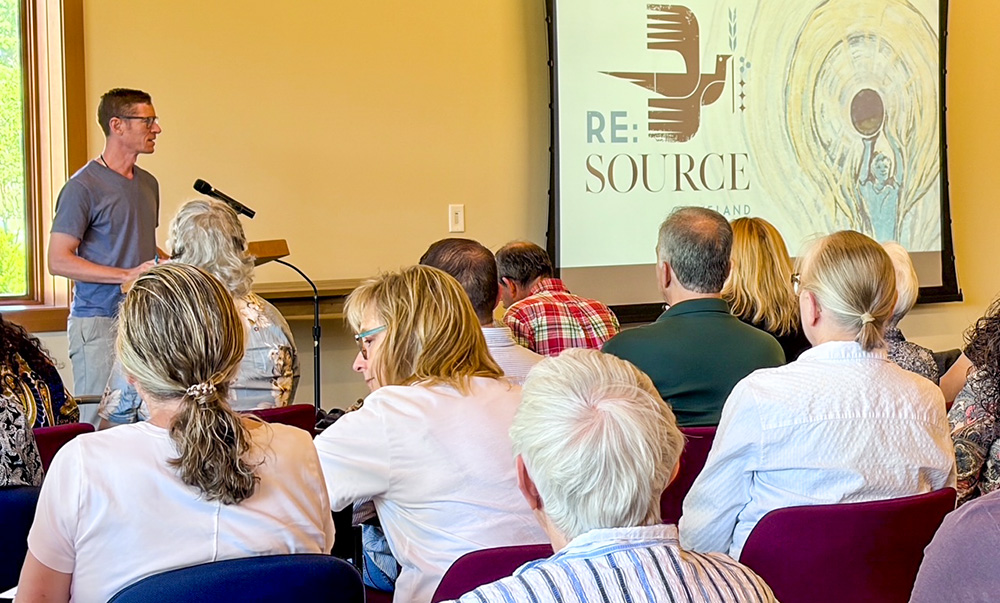
Re:Source Cleveland executive director Patrick Kearns addresses attendees of the "Neighboring the Dear Neighbor" immigration workshop on June 13, 2026, in Cleveland. (Kaleigh Tuck-Macalla)
The Trump administration has also repeatedly paused applications for legal permanent residence status — aka the green card. "We saw families that had their citizenship swearing-in oath ceremony [scheduled] just one week later, who received a notification that it was canceled," said Kearns.
Re:Source Cleveland is pushing back. With the Cleveland Food Bank, the group launched an emergency food program for more than 500 individuals who had lost SNAP assistance. It combed its files and identified 400 lawful refugees who needed to adjust their residency status by undertaking the complicated — and expensive — green card application process. Without proof of application, the government's newly rigid time constraints could rule they were out of compliance and therefore subject to deportation.
"We launched Operation Green Card that has taken a process that was over a year and shrunk it to eight weeks," said Kearns, who praised legal assistance from Building Hope in the City, a partner organization. "People got their medical screenings, got a lawyer, submitted their applications, and can now show a receipt that says, they've done everything in their power to be in compliance."
Congregation of St. Joseph associate Cindy Drennan began her career with the sisters of St. Joseph serving in El Salvador with the Cleveland Diocesan Mission team. She co-founded Cleveland's InterReligious Task Force on Central America and in subsequent years worked with numerous refugee communities.
Drennan summarized Catholic social teaching on immigration: "Catholic teaching on immigration emphasizes human dignity, the right to migrate, humane border regulation, care for the vulnerable, and solidarity, grounded in Scripture, tradition, and social principles."
Drennan clarified common misrepresentations of Catholic social teaching: "The church does not oppose all immigration laws, but it calls for humane just laws. ... Most of what we've heard today indicates where they are unjust."
Observing that too often Catholics don't speak out, she urged, "We need to be firm in our convictions. We know what those key principles are and we need to keep them in our everyday life."
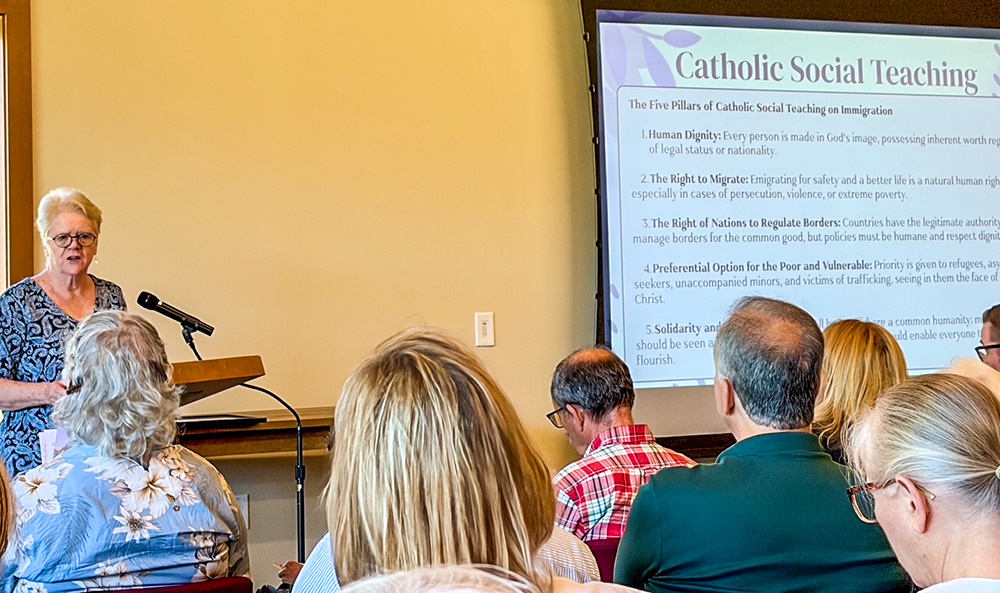
Congregation of St. Joseph associate Cindy Drennan speaks about Catholic social teaching at the "Neighboring the Dear Neighbor" workshop June 13, 2026, in Cleveland (Kaleigh Tuck-Macalla)
For more than 13 years, C. Stonebraker Martinez has served as the co-executive director for the InterReligious Task Force on Central America. The organization was founded in the early 1980s after two Clevelanders — Ursuline Sr. Dorothy Kazel and lay volunteer Jean Donovan — were martyred in El Salvador.
"These women give us an understanding of what it means to be an ally before we ever had that language," said Martinez, who described the organization's mission as one of accompaniment that is "physical, spiritual, political, and psychosocial ... through physical presence and people's homes and at protests."
The InterReligious Task Force on Central America addresses some of the root causes of migration even as it is part of an "overground sanctuary movement" in partnership with networks in Canada.
In Northeast Ohio, InterReligious Task Force members accompany migrants to their court check-ins and, because Cleveland has the only immigration court in Ohio, provide overnight hospitality for migrants from all over the state. In the past year, Martinez said the organization has trained more than 2,000 people in community defense work and "know your rights" initiatives.
A passionate advocate, Martinez is deeply sustained by her faith: "I'm just a humble person, but I know that because of the power of Spirit, that we have power collectively that is greater than any dictator or authoritarian or king on this earth..."
Paula Kampf, the founder and facilitator of Whistle Brigade Cleveland, was the last to speak. A lifelong justice advocate, community organizer, and "25-plus-year support person for the Jesuit Volunteer Corps," Kampf provided a crash course in how to use a whistle to alert your neighbors about nearby ICE activities.
After the ICE atrocities in Minnesota, Kampf and other activist friends received multiple texts and phone messages asking to organize similar whistle networks: "This whole handful of us latched onto 'Let's get as many trainings out there just for regular people in neighborhoods as fast as we can,' " she recalled.
Since last January nearly 800 people have signed up for training.
"It's a horrible topic. None of us grew up wanting to know how to observe the treachery of our federal government in the United States of America," she reflected. "But also we do the work with joy. We have the extreme privilege of being the people who can be there for these situations. A lot of this needs to be the work of white people, because we are least at risk. So there's a real call for us to show the hell up for our neighbors."
As Leo said: "Human dignity has no passport and does not lose its value when crossing a border." So let's show up. For we know that God's power at work within us is able to accomplish far more than we can ask or imagine (Ephesians 3:20).