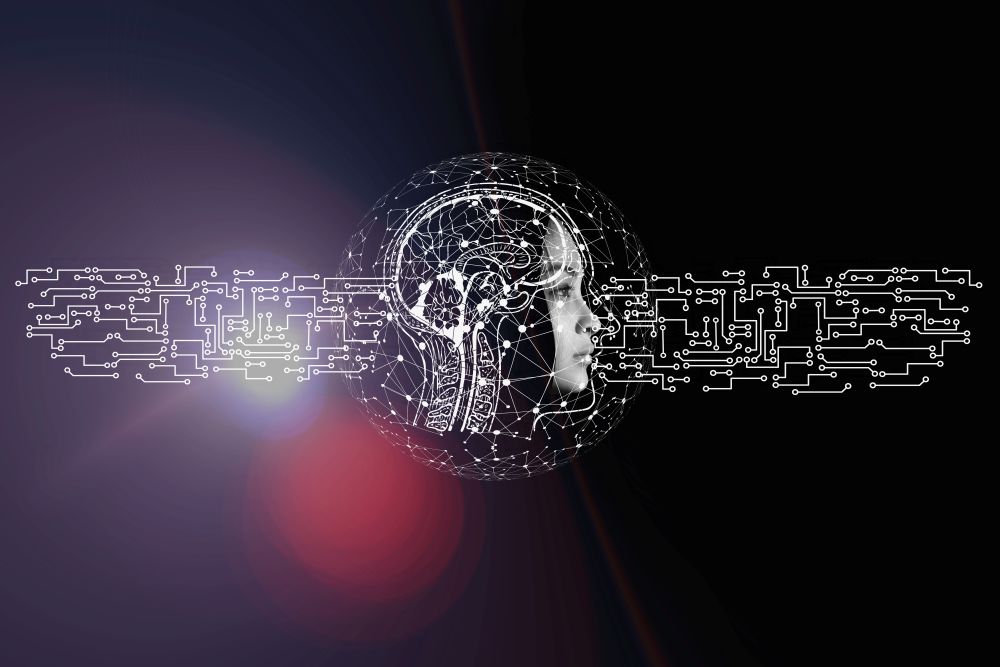
(Pixabay/Gerd Altmann)

by Meghan Clark
Join the Conversation
Send your thoughts to Letters to the Editor. Learn more
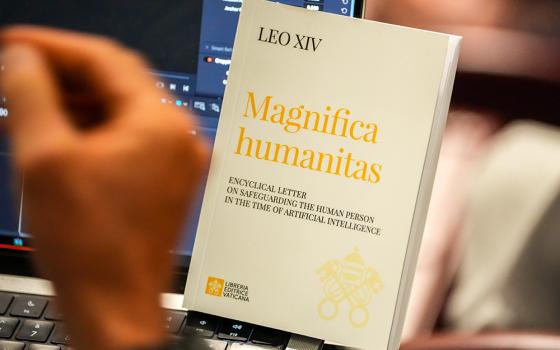
Reading Pope Leo XIV's new encyclical, Magnifica Humanitas, it seems that the pope agrees that humanity itself is undergoing a bit of an identity crisis. The COVID-19 pandemic revealed the deep fragility of life and rapid changes in technology threaten our very understanding of what it means to be a human being. In the face of human finitude and fragility, humanity is faced with a choice — slow down to focus on human relationships or speed up the quest for a kind of immortality. For its part, AI seeks speed and efficiency, its goal to remove any and all friction from human life. Grounding itself in the gift of humanity created by God, Magnifica Humanitas, however, invites us to embrace finitude to find flourishing in relationship.
Embracing finitude means acknowledging our limits and that can be difficult.
As I read the encyclical, I could not help but reflect on my own experiences of chronic illness. When I was 16 years old, I experienced a serious head trauma in a car accident. As a result, I suffer from chronic migraines. For years, migraines and dizziness set limitations of pain and fear. Luckily, I had an excellent neurological team who found a treatment plan that lessened the frequency of attacks. Today my condition is well managed, but it will never go away. It is a condition where technology may prove useful in analyzing patterns and identifying triggers. Yet, it will always remain. Chronic illness, even one successfully treated, is a constant reminder of finitude and vulnerability.
Our spending habits suggest that accepting our finitude is not a high priority for most people. The United States thrives on a culture of self-improvement as wellness. It is a $500 billion-dollar industry. Thus, "Our relationship with life seems to be in crisis today," explains the pope, where any limit is seen as a "defect to be corrected" instead of part of what makes us human. In the drive to enhance, expand and extend life, our culture seems to have forgotten that we are created and that this means our limitations will involve hardship, suffering and even death. Human flourishing is blurred as immediacy and efficiency become values in themselves. Against a culture focused on evading limits, Leo argues that "humanity flourishes not despite limitations, but often through them."
In the drive to enhance, expand and extend life, our culture seems to have forgotten that we are created and that this means our limitations will involve hardship, suffering and even death.
Throughout the encyclical, the ability of human persons to grow in wisdom and knowledge, to develop through challenges and struggle, is identified as a definitive difference between humans and generative AI. Struggle, and even suffering, are not automatic enemies to be conquered but considered as liminal spaces of possibility. Compassion and generosity "can emerge even in the midst of darkness and failure."
Embracing our finitude can offer its own rewards, Leo suggests. In difficult moments, "we can discover a new wisdom, tangibly experience the closeness of others and encounter the presence of the Lord." Accepting finitude and my own limitations required letting go of unreasonable expectations. Failure needed to be redefined as I accepted my illness was a limit but not a failing. According to Leo, "precisely because we experience limits — vulnerability, suffering and failure — we can recognize the inviolable dignity of every person, both our own and that of others" and as well as "perceiving injustice as a scandal."
Efficiency, productivity and success must be evaluated from the perspective of human dignity. "When efficiency becomes the ultimate measure of value," explains Leo, "human beings are tempted to see themselves as a project to be optimized rather than as persons called to relationship and communion."
Even if technologists argue otherwise, people are not projects to optimize nor puzzles to solve. And yet, this is precisely the logic cultivated by a culture dominated by economic measures and the quest for perfection. I see this struggle in my students. I experienced this struggle as I had to let go of things I could no longer do after the head trauma.
Advertisement
Attentiveness to my own experiences of vulnerability, I hope, makes me more attentive to the scandal of injustice. Magnifica Humanitas identifies the "moral corruption" and "extreme forms of inhumanity" with a powerful reference to Viktor Frankl, a Holocaust survivor and physician who explored the search for meaning in life. Accepting one's own limitations and finitude requires moral discernment to recognize and respond to unjust vulnerabilities or exploitation which must not be accepted.
Out of both compassion and justice, I must distinguish between my experience of chronic illness with adequate healthcare and those who suffer without access to care. "The quality of a civilization is not measured by the power of its means, but by the care it is able to offer, by its ability to recognize the other as a face," Leo writes.
Love involves vulnerability and suffering. One cannot be unaffected when a loved one is in pain. For Christians, Christ reveals love amidst vulnerability, a love that persists. "The ability to care for one another is a fundamental dimension of our humanity, one that is learned through lived experience," reads the encyclical. I love that the first example of care listed is "reading stories to a child." There is a beauty in reading to a child and accompanying their learning to read. Not all struggle involves suffering. As we learn and grow, struggle and transform, we live into our infinite human dignity. In doing so, we remember, "what saves humanity is the divine love that descends into the most fragile point of our history and renews it from within."
In some ways, it feels like AI is already everywhere, often operating without our choice or input. Leo reminds us that human beings must have a say in how we engage with this technology, as our very understanding of what it means to be human is at stake. And though it's certainly not in fashion in Silicon Valley, Leo is intent on showing the world that a proper understanding of what it means to be human includes accepting our limitations.