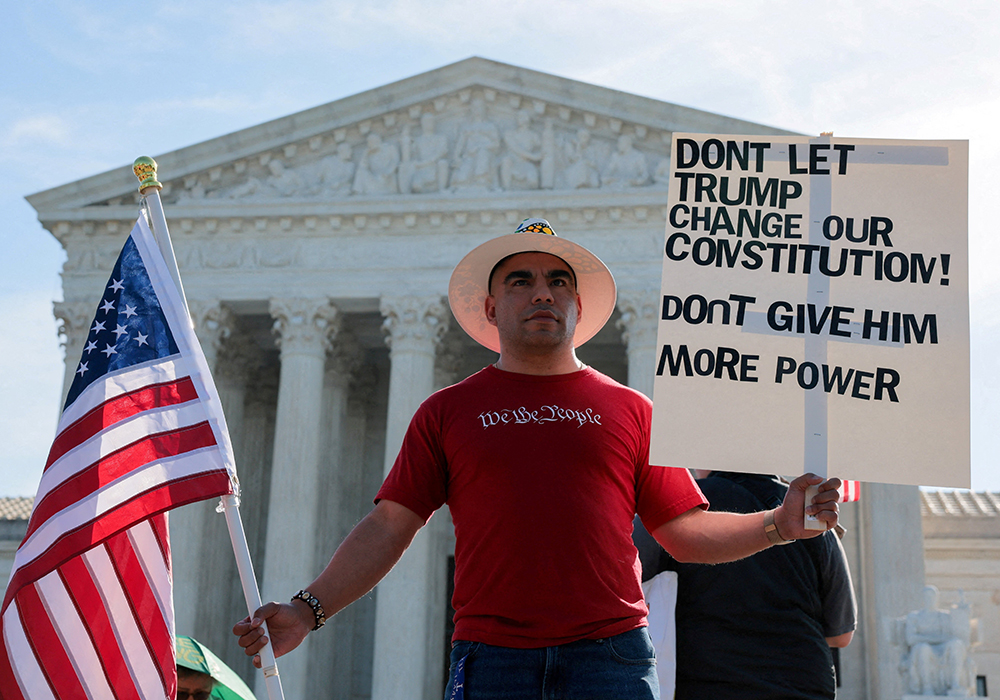
A demonstrator wearing a T-shirt with the phrase "We the people" holds a sign and a U.S. flag outside the U.S. Supreme Court in Washington April 1, 2026, on the day the court heard oral arguments on the legality of the Trump administration's effort to limit birthright citizenship. (OSV News/Reuters/Kylie Cooper)

Join the Conversation
Send your thoughts to Letters to the Editor. Learn more
The U.S. Supreme Court today (June 30) rejected President Donald Trump's executive order ending birthright citizenship. The case, Trump v. Barbara, was decided on a 6-3 vote with Chief Justice John Roberts writing the majority opinion. "Children born in the United States to parents unlawfully or temporarily present are 'subject to the jurisdiction' of the United States and are citizens at birth under the Fourteenth Amendment's Citizenship Clause," the court held.
Roberts' decision was joined by the court's three liberal justices, Sonia Sotomayor, Elena Kagan and Ketanji Brown Jackson, as well as two justices appointed by Trump: Brett Kavanaugh and Amy Coney Barrett. Justices Clarence Thomas, Samuel Alito and Neil Gorsuch dissented.
The court's decision looked at the history of the English common law as well as the plain, direct meaning of the text of the Fourteenth Amendment which reads, "All persons born or naturalized in the United States, and subject to the jurisdiction thereof, are citizens of the United States and of the State wherein they reside." Trump's lawyers tried to play a shell game to confuse the issue. A majority of the justices refused to be confused.
Advertisement
This is not the first time the high court has overturned a policy priority for the president. In February, the court struck down Trump's efforts to enact tariffs unilaterally in the case Learning Resources, Inc. v. Trump. On a 6-3 vote with the chief justice writing the majority opinion, the court undercut one of the president's principal policies. Trump was not happy, saying he was "ashamed of certain members of the court, absolutely ashamed."
As I have argued previously, it is wrong to think the conservative majority on the court is always looking for ways to give Trump more power. In the case yesterday (June 29) giving Trump the authority to fire commissioners of independent commissions, the court relied on its belief in a unitary executive. I think they are wrong, but the unitary executive advocacy has been prominent among conservative legal scholars since the 1980s so you can't just conclude their goal is to give Trump more power, even if that is the immediate effect. They believe the unitary executive theory is what the Constitution requires and all presidents will now possess the power to remove commissioners. Again, they may be wrong, they may be right, but this is not just about empowering the current occupant of the White House.
As we prepare to celebrate our 250th anniversary, the nation can breathe more easily, knowing that the Supreme Court is not going to roll over when Trump tries to do something that is clearly beyond the scope of what the Constitution allows. There will be many more decisions from the Roberts court that we may not like, but they are not going to sell the Constitution down the river. Not for Trump. Not for anybody. The chief justice of the United States will emerge from the Trump era as someone who has done his duty.