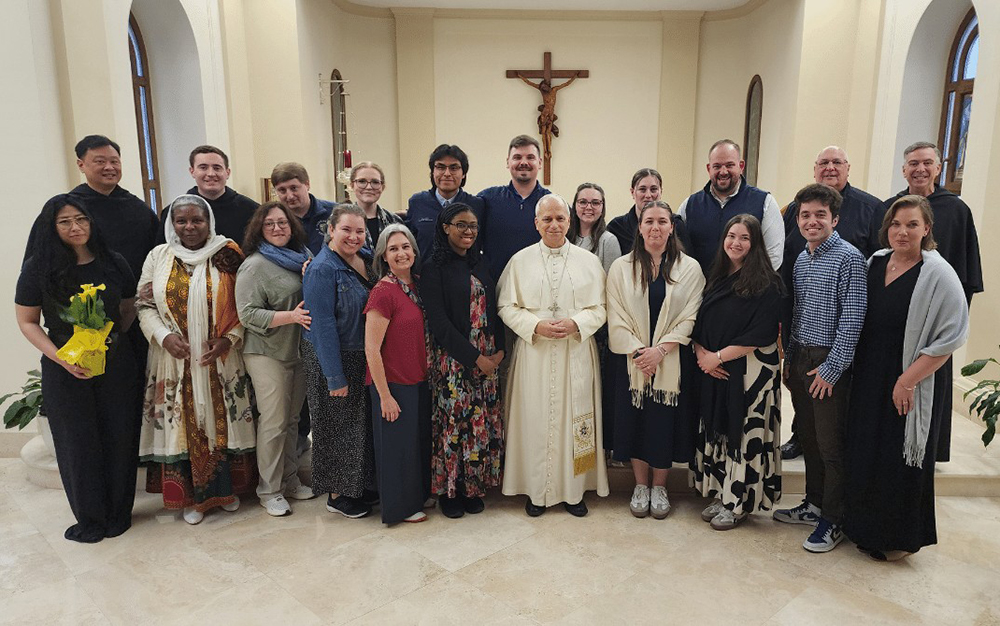
Student and employee participants in Merrimack College's Pellegrinaggio Group met with Pope Leo XIV on March 12, 2026. (Courtesy of Tonya (Adéjọké) Butler-Truesdale)

by Tonya (Adéjọké) Butler-Truesdale
Join the Conversation
Send your thoughts to Letters to the Editor. Learn more
This past March, as a member of an Augustinian pilgrimage cohort from Merrimack College, I had the grace of an audience with Pope Leo XIV in Rome. I have returned to that moment often in prayer, considering the kind of conversion the church is still called to undergo.
I came as a womanist, as a Black woman formed by faith, struggle, ancestral memory and a long tradition of moral discernment born in communities that have too often loved the church without being fully seen by it.
In the presence of the Holy Father, I found myself reflecting on the communion of lives spiritually present with me: Afro-diasporic mothers, single mothers, Indigenous practitioners, churchwomen, seekers, wounded believers, women who have sustained communities through prayer and practical wisdom, and all those who have remained faithful while wrestling with the church's failures.
No one comes to such a moment alone. That may be one of the deepest truths womanism offers Catholic life.
We come bearing worlds. We bring the dead, the living, the wounded, the hopeful, the estranged and the still hungry into the room with us. We carry histories that may never appear in official photographs but are fully known before God. We come with unfinished prayers.
Advertisement
A womanist in the presence of the pope is there as a witness to what the Gospel requires.
She bears questions such as these: Can the church hear wisdom from those she has not centered? Can she receive truth from lives marked by race, gendered struggle, poverty, caregiving, migration and moral labor? Can she welcome not only the suffering of the marginalized, but also their insight, leadership and theological authority?
These are not secular demands laid upon the church from outside; they are evangelical questions that arise from the heart of Christian discipleship.
Womanism reminds the church that some of her truest theologians have never been given that title. They are the women who made a way out of no way, who kept children near the Lord, who organized meals, wakes, prayer circles and ordinary works of mercy, who interpreted suffering without surrendering to despair. They taught many of us that doctrine means little if it does not touch hunger, grief, labor, danger and hope.
When I stood before Pope Leo, I carried the uncredentialed wisdom of these women with me. I carried a theology forged not only in books, but in kitchens, sanctuaries, hospital rooms and ordinary acts of love. I arrived as a woman ordained by her own mother, who was herself ordained by other female clergy.
Can the church hear wisdom from those she has not centered?
Again and again in the Gospels, Jesus reveals a kingdom in which those dismissed by the powerful become bearers of revelation. He listens where others hurry past. He restores those whom society has rendered invisible. He refuses to confuse religious authority with fidelity to God. Any church that would follow him must be willing to do the same.
My papal encounter did not resolve every tension I carry about faith and institution, but it did give me hope that the institutional church could still receive the moral wisdom forged in the lives of those who have had to survive her, serve her, critique her — and still pray for her sanctification.
They matter to God. Their wisdom matters to the future of the church. Renewal will not come only through decrees, statements or symbols; it will come through deeper listening, repentance where needed, broader welcome, moral courage and renewed openness to the Holy Spirit, who has never confined herself to the places those in power expected to find her.
Who is seen?
Who is heard?
Who is welcomed?
Who is believed?
Who is allowed to bear God's truth in their own voice?
A womanist brings those questions wherever she goes. Even to Peter's house.