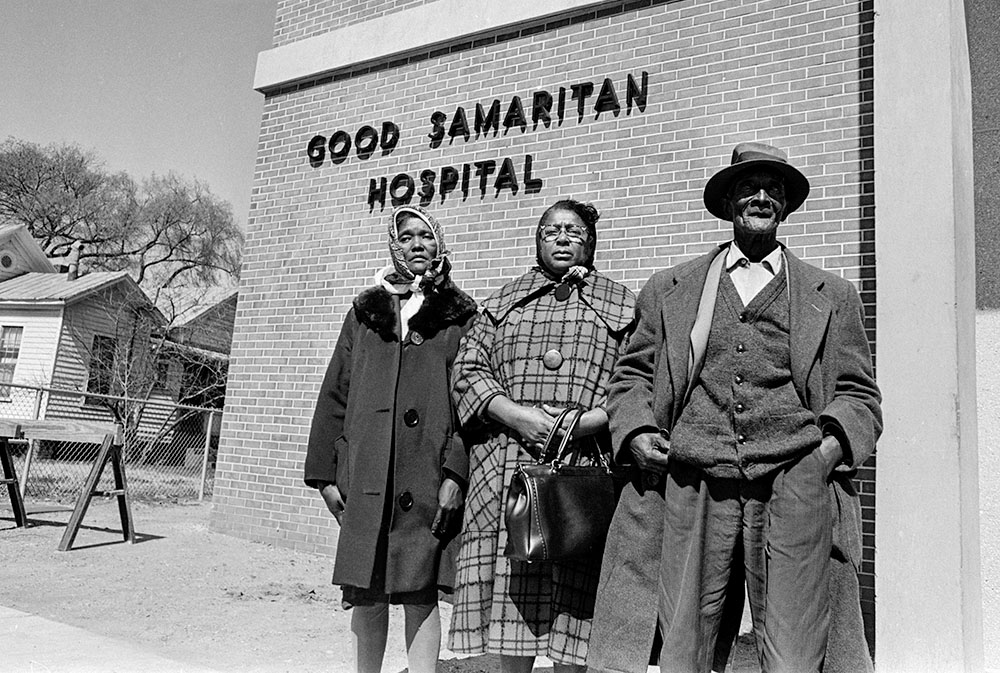
Family of Baptist Deacon Jimmie Lee Jackson are seen in front of Good Samaritan Hospital in Selma, Alabama, in February 1965, after a state trooper fatally shot Jackson during a voting rights march earlier that month. From left are Jackson's mother, Viola Jackson, his cousin Rachel Thomas and his grandfather Cager Lee. (AP/Horace Cort, File)

by Sr. Mary M. McGlone
Join the Conversation
Send your thoughts to Letters to the Editor. Learn more
In 1965, in the heat of the Civil Rights Movement, Jimmie Lee Jackson, a Baptist deacon, was fatally shot in Marion, Alabama, after being brutally beaten by state troopers for his participation in a voting rights march. As a result, ecumenical groups organized marches in Selma to support the right of African Americans to vote.
The Catholic bishop of the area forbade the priests and religious of his diocese to participate under pain of being banned from the diocese.
Sisters of St. Joseph from Rochester, New York, were staffing the only large hospital that served African Americans in Selma. While they were entirely committed to the rights of their people, they knew that following their conscience by participating in the marches would mean the end of their hospital. Their solution: offer hospitality to the visiting marchers and care for the injured. They exercised creative compassion — supporting a large number of priests and religious who came to witness to Christian values.
That sounds like today's Gospel. We hear that as Jesus moved from town to town healing and preaching, his "heart was moved with compassion" by people in need. We hear that phrase twice in Matthew's Gospel, in today's Gospel and in Matthew 15, when Jesus "felt compassion" for people who sought him out, leading him to teach and feed them.
There are three common translations of the central word here: compassion, mercy and pity. The word in Greek is splanchnizomai — not exactly part of our everyday vocabulary. In case your Greek is a bit rusty, this word refers to movement in our "inward parts" or the womb. Its Hebrew counterpart is r-ch-m, a word with the same root as the word womb. The implication is that feeling this kind of compassion is tantamount to the emotion of a mother who feels the needs of her child. It's a feeling of such intimate connection that another's need moves your guts.
That was Jesus' feeling for people seeking him. Like a nursing mother whose body responds when she hears her infant crying, his body as well as heart and mind were moved by their thirst for what he could offer. Then, as now, the need was greater than his own ability to respond.
So, he gathered his disciples and named 12 — a symbol of the 12 tribes of Israel — to share his mission. That meant that they were not only to have a share in his healing power, but that all they did would flow from the sort of compassion he felt.
This helps us understand the vital importance of his instruction to "ask the master of the harvest to send out laborers." No one can assume this vocation on their own. It's a mission, meaning that Christ sends and offers disciples the grace of sharing his own motivation — splanchnizomai.
To take on Jesus' own motivation is an awesome and costly invitation: awesome because of the intimacy it entails with him, costly because it pulls us completely out of ourselves. As Ignatius of Loyola taught, Christian disciples interiorize God's desire and therefore strive to become indifferent to the apparent success or failure of the mission and what it might give them in fame or disparagement, wealth or poverty, health or fragility.
Advertisement
Jesus knew that his disciples didn't yet understand the motive and breadth of his mission. At the same time, he knew two other important facts: He could not do everything alone and, in the process of doing his work, his disciples learn what no words would ever teach them. So, he sent them out to comprehend his mission by immersing themselves in it.
The disciples went out proclaiming, "The kingdom of heaven is at hand." That statement came true every time they healed people and confronted evil spirits, every time they gave people hope with Jesus' message.
In a very real way, the sisters from Rochester did exactly the same thing. Finding their way around ecclesial restrictions, they confronted the evils of racism and what felt like hierarchical indifference, in compassionate and defiantly creative ways.
Today, suffering and injustice surround us. African Americans are still being disenfranchised, the poor throughout the world are losing access to services that respond to their most basic human needs, and as Pope Leo XIV pointed out, the world is "being ravaged by a handful of tyrants" who have the power to undermine the progress of the kingdom of heaven. They spend billions on killing while withholding their abundant resources that could preserve life.
The verse with today's Alleluia acclamation says, "The kingdom of God is at hand." Of course, it always has been and always will be. Today's Gospel question asks how we might practice the creative compassion that incarnates it.