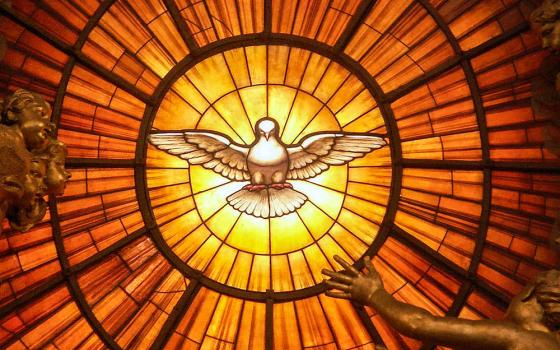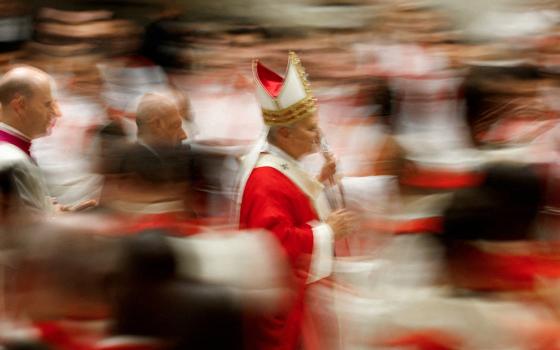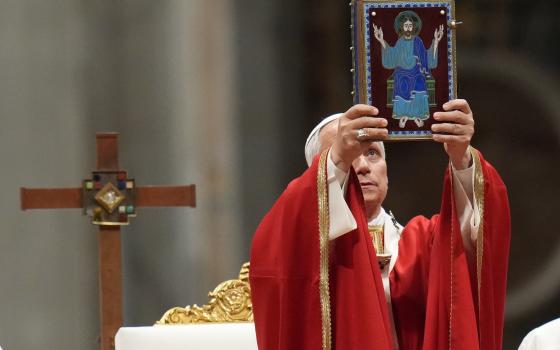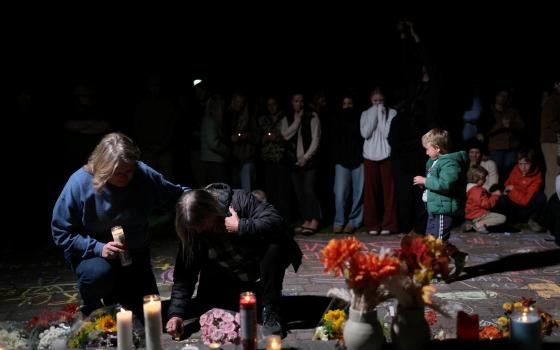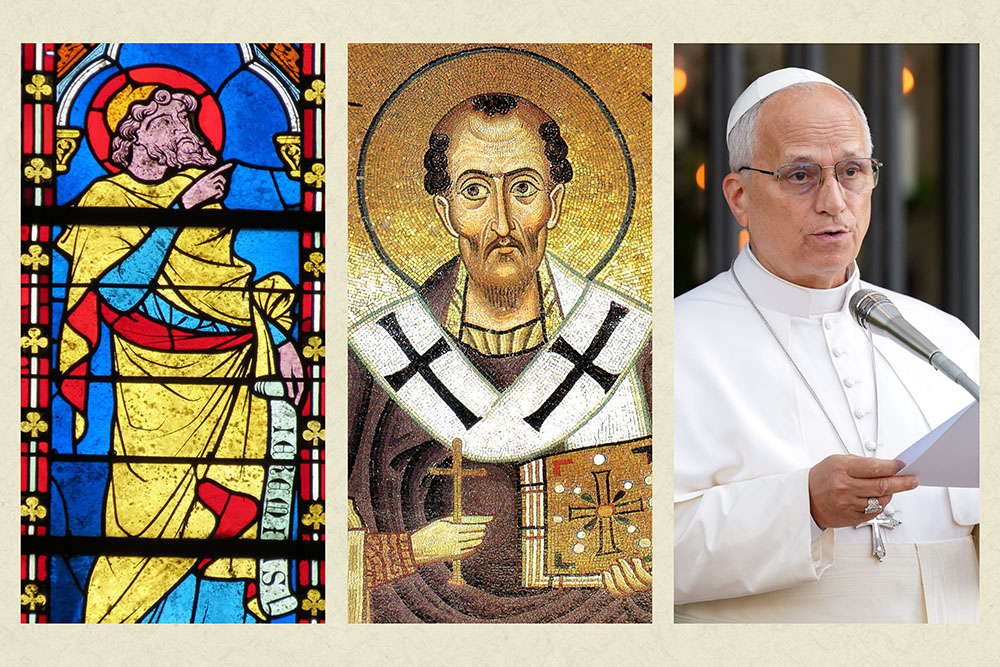
From left: The prophet Jeremiah in stained glass (Wikimedia Commons/Giogo); St. John Chrysostom in mosaic (Wikimedia Commons); Pope Leo XIV at a worldwide rosary for peace, held in the Vatican Gardens May 30, 2026 (CNS/Lola Gomez)

by Sr. Mary M. McGlone
Join the Conversation
Send your thoughts to Letters to the Editor. Learn more
"Fear no one!"
Wow. If that feels challenging to me when I have a comfortable recliner, food to spare and cable TV, what about the rest of my neighbors on this planet? The World Inequality Report tells us that if the world population were 100 people, 50 would share 2% of the world's wealth; 40 would live on 23%; and the 10 most privileged (most of us) would enjoy 75% of it. Are we scandalized? Why?
Asking why puts us in the company of Jeremiah, who heard the mutterings of priests and others who wanted to shut him up. Their problem? Jeremaiah was troublesome and terribly inconvenient. He exposed and publicly denounced Israel's unfaithfulness, warning that it was leading to their destruction. Their solution? Get rid of him!
Amazingly, Jeremiah proclaimed that the Lord was with him. That can sound wonderfully pious, but remember, it came only after he tried to wriggle out of his vocation by protesting that he was too young, complaining that no one would listen to him and, finally, accusing God of seducing him (Jeremiah 1:6-7, 6:10-11, 20:7-8).
Jeremiah proclaimed that God would rescue the life of the poor from the power of the wicked. Eighty years passed before that prophecy began to be fulfilled. How long for our world?
Jeremiah's style of faith and hope is a recurring scriptural theme. We call it hope because, as we saw last week and understand from Jeremiah, God does not parachute in to solve everything. It's not that easy. God shares this hope with us — and God's hope is that we will follow the Spirit's inspiration to resolve the world's hopelessness.
Jesus says, "Fear no one." He adds, "Don't worry if they try to kill you!"
Then, in between these two statements, we hear something puzzling about things said in darkness and light, whispered and shouted. What's that all about?
One interpretation comes to us from St. John Chrysostom ("Golden Mouth"). As bishop of Constantinople around A.D. 400, Chrysostom condemned extravagant wealth. Although he never mentioned her name, the vengeful Empress Eudoxia assumed he was speaking about her. It only got worse when he taught that to not share our riches with the poor is to steal from the poor.
St. John lived simply. He sold the cathedral's gold to support the poor. He implemented clerical reforms and criticized the lavish lifestyle of bishops. In response to these calls to holiness, his enemies orchestrated various assassination attempts against him, had him excommunicated (for a time), and exiled twice.
Chrysostom interpreted today's Gospel to say that what is now hidden and secret is the truth of God's plan for humanity. Some understand it now; eventually the world will recognize it.
Advertisement
Interpreting Christ's words about not fearing those who can kill the body, but those who can kill the soul, Chrysostom explained the idea that fear of death — or its close relatives loss of power, status, reputation, popularity, financial security, etc. — breeds the death of one's integrity. Succumbing to that fear leads people to lose touch with their personhood. They become slaves to that which they refuse to risk. Christ denies such people because they have become something they are not. They are unknowable. They have made themselves into nobodies.
We in the United States might think this tough teaching might point directly at us and the debates, policies and divisions now characterizing our country. Pope Leo XIV is standing up like Jeremiah and St. John Chrysostom. With a gentle prophetic voice, he has called the church to pray for people "who still do not recognize the urgency of caring for our common home."
Sounding more like Jeremiah, he has warned that we are growing accustomed to and indifferent toward violence. In April, he censured those who "turn a blind eye to the fact that billions of dollars are spent on killing and devastation, yet the resources needed for healing, education and restoration are nowhere to be found." He warns about becoming indifferent "to the deaths of thousands of people."
In Magnifica Humanitas, Leo calls us to build "a new spiritual, ethical and political framework" and to disarm technology that "threatens to normalize an anti-human vision."
It's no surprise that politicians and pundits — and even some of his fellow Catholics — find him inconvenient. As John Lewis would say, he's making good trouble. Leo calls all of us who have food to spare to act on the Gospel before we destroy ourselves and our world.
Of whom or what should we really be afraid?