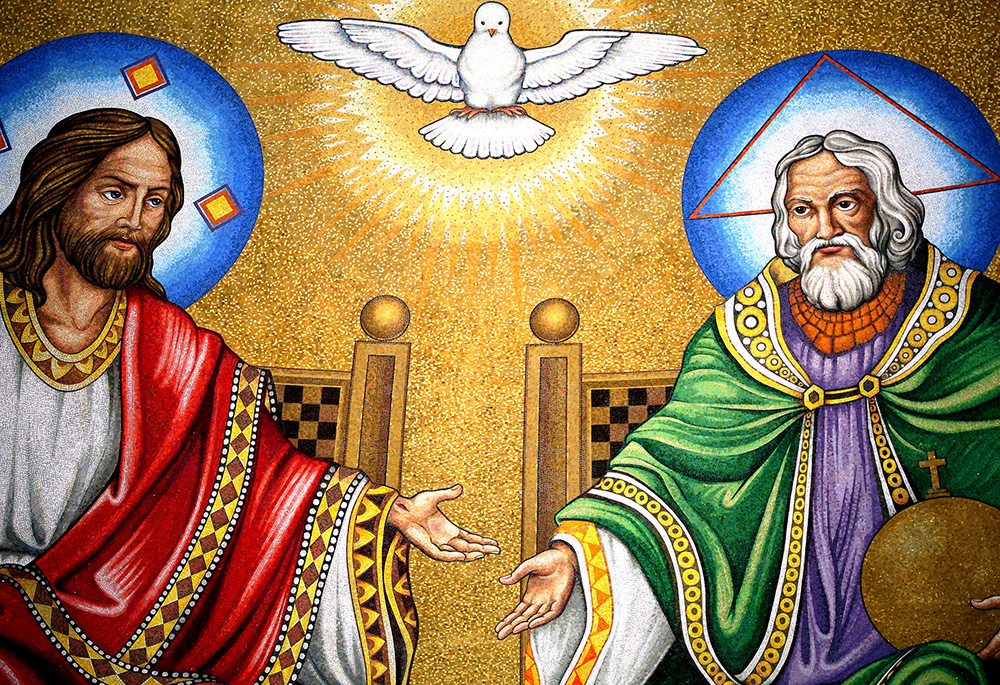
Mosaic tiles depicting the Most Holy Trinity are seen in the Trinity Dome at the Basilica of the National Shrine of the Immaculate Conception in Washington. (OSV News file photo/Tyler Orsburn)

by Sr. Carol J. Dempsey
Join the Conversation
Send your thoughts to Letters to the Editor. Learn more
The Solemnity of the Most Holy Trinity commemorates a central doctrine of Christianity, the Trinity. This doctrine, which developed over centuries, focuses on the nature of God which it defines as one God existing in three coeternal, consubstantial divine "persons." These "three persons" are said to be distinct, yet they share one essence, one substance and one nature.
The Council of Nicaea in 325 C.E. established the consubstantiality between the Father and Son, and the Council of Constantinople in 381 C.E. confirmed the consubstantiality of the Holy Spirit with the Father and Son. Although the traditional names for the triune God are God the Father, God the Son and God the Holy Spirit, titles such as Creator, Redeemer and Sanctifier — among others — can also be found within the Christian tradition.
It is important to note that the doctrine of the Trinity neither originated in the Bible nor during biblical times. The Gospel of John, however, does provide a kernel of thought that helped to shape the doctrine. Thus, the solemnity being celebrated today has a rich and long history, and the reinterpretation of the names of the "persons" of the Trinity continues to be of interest to current theologians, scholars, mystics and religious thinkers.
The liturgical readings for today's celebration hone in on three themes: identity, unity and power.
The first reading from Exodus presents us with an ancient Near Eastern image of a deity who appears as a storm god residing in the heavens and descending to earth in a cloud. Even though the image of this deity is regal — a king coming down off his throne to encounter the human community — the description of the exchange between Moses and the Divine One is both relational and intimate. This Holy One who stands with Moses is merciful, gracious, slow to anger, and rich in kindness and fidelity.
Although the metaphorical title "Lord" is imperial and reflects the existence of ancient Near Eastern overlords who owned vast amounts of property and managed a contingent of laborers who worked the land, this Holy One is benevolent and not hegemonic, self-revealing and not deceptive.
The second reading from 2 Corinthians speaks of unity, beginning with the salutation "brothers and sisters" that establishes a sense of relationship. The call to mend one's ways suggests that even within the early Christian communities, strife and disagreements existed. The end goal is to work out differences, to create a climate of encouragement, acceptance, affection and respect so that peace can take root, flourish and be sustained by the God of love and peace.
The last part of the reading is a prayer with Trinitarian overtones that expresses the hope for all divisions and misunderstandings to be healed by the grace of Christ, the love of God and the friendship of the Holy Spirit.
Advertisement
This reading brings to mind the message of Pope Leo XIV, who repeatedly calls for peace in the face of militarism and arms escalation, wars and Jihadist violence. Peace is the pope's exhortation as he traverses continents and addresses people globally. His desire is for unity to be realized.
Finally, the Gospel reading from John reminds us that Christ's mission was not the condemnation of the world but the salvation of the world. Too often Christian believers personalize this message, making Jesus their personal savior and thus divorcing the message from the mission. The work of Christ — indeed, the work of the Gospel — is the work of transformation.
The Gospel story as a whole presents Christ as a transformative leader who caused tension among the political, social, economic and religious leaders of his day. He made people in power uncomfortable because he called out their unjust and oppressive actions. The male Christ had no problem addressing unjust systems and systemic injustices created and carried out by the males in power.
Today's readings are a wake-up call to all in power, especially if they are Jewish, Christian or Muslim leaders, and in particular if they are Catholic leaders. Although the portraits of God throughout the Old Testament are oftentimes troublesome because they are violent, this God presented in today's readings is the Holy One of love and peace, whom some may call Adonai or Allah. Christ and the Holy Spirit as portrayed by the Christian Scriptures are the embodiment of peace and love.
The disconnect between what world leaders hear in the Scriptures and how they are conducting their "business," cries to heaven for justice. Furthermore, those leaders who espouse global violence ought to take a good look at themselves in the mirror and ask one simple question, "How am I embodying Christ?"
The power of the Trinity has yet to be unleashed.