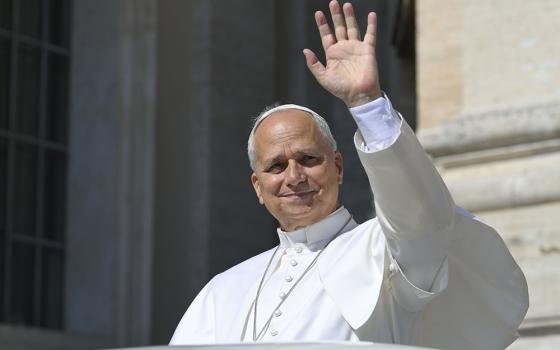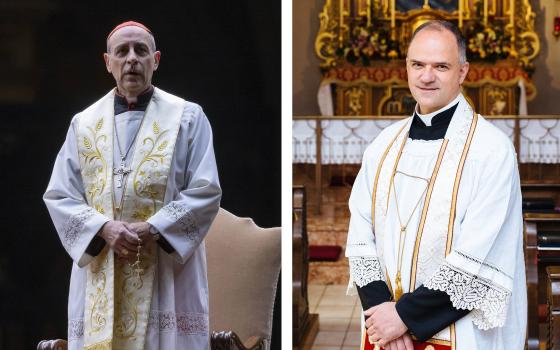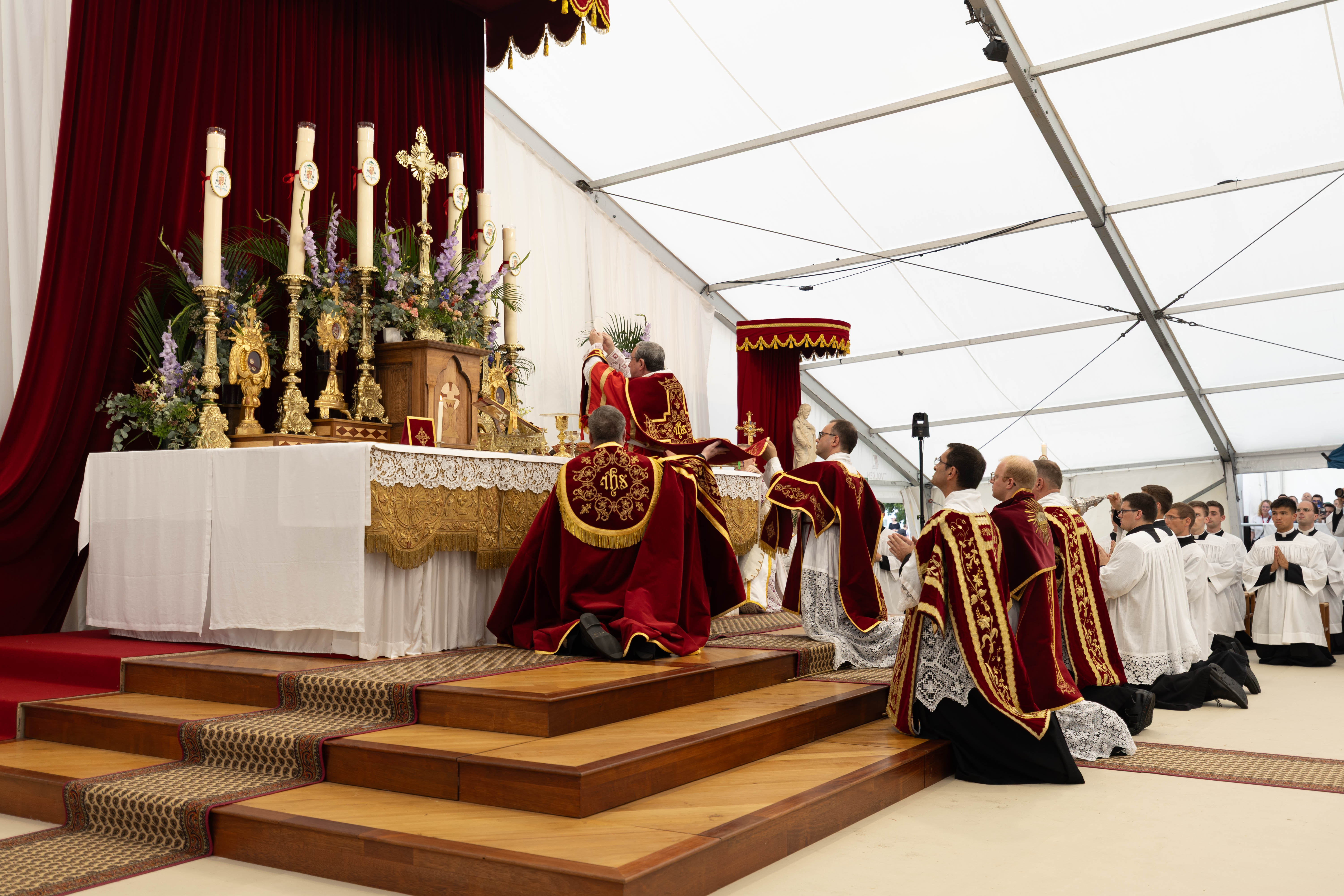
Excommunicated Bishop Alfonso de Galarreta elevates the host during an illicit consecration Mass in Écône, Switzerland, celebrated by the Society of St. Pius X on July 1, 2026. The following day, the Vatican declared the four new bishops and those who consecrated them to be schismatics, as well as all the clergy and lay faithful who adhere to the schism. (Courtesy of the Society of St. Pius X)
Join the Conversation
Send your thoughts to Letters to the Editor. Learn more
As hundreds of lace-laden priests processed into an ornate Mass July 2 on a hillside in the Swiss Alps, the bishops leading the line, their clergy and the 6,000 lay faithful bowed in prayer around them were declared members of a schismatic group no longer in communion with the Catholic Church.
Less than 24 hours after the ultraconservative Society of St. Pius X created four new bishops in open defiance of Pope Leo XIV, the Vatican declared that those bishops, the men who consecrated them and the priests and lay faithful who adhered to the schism, had been formally excommunicated from the church.
"Clerics and the lay faithful are warned not to adhere to the schism of the Priestly Fraternity of St. Pius X, as they would thereby incur ipso facto the penalty of latae sententiae excommunication," or automatically incurred excommunication, said Cardinal Víctor Manuel Fernández, head of the Vatican's doctrine office, in a statement published just as the final Mass of the SSPX's four-day mountain festival for the consecrations got underway.
The decision is a shockingly strong punishment from the Vatican and the pope, who has made church unity a hallmark of his pontificate, for a group which has long been a thorn in the side of Rome for claiming to be Catholic while openly rejecting church authority.
In a note accompanying the declaration, the Dicastery for the Doctrine of the Faith said that consecrating new bishops without papal approval "constitutes the crime of schism, with the canonical consequences for the ordained ministers and lay faithful involved."
It also stated in stark terms that the "sacred ministers belonging to the Priestly Fraternity of St. Pius X are in schism and must therefore be considered schismatics," and that lay faithful who "formally adhere" to the schism "are to be considered schismatic and excommunicated."
"The holy People of God are warned that the sacred ministers of the Priestly Fraternity of St. Pius X administer the sacraments unlawfully and that the sacrament of penance administered by them and marriages solemnized by them are invalid," it said, rolling back privileges granted to the group under Pope Francis. The decree also noted that Vatican ambassadors worldwide will establish procedures for local bishops to use in handling cases within their territory.
That ruling renders invalid the sacraments offered by the society's 751 priests worldwide. In total the SSPX claims 1,500 members — including seminarians, brothers, oblates and religious sisters — dispersed over 77 countries.
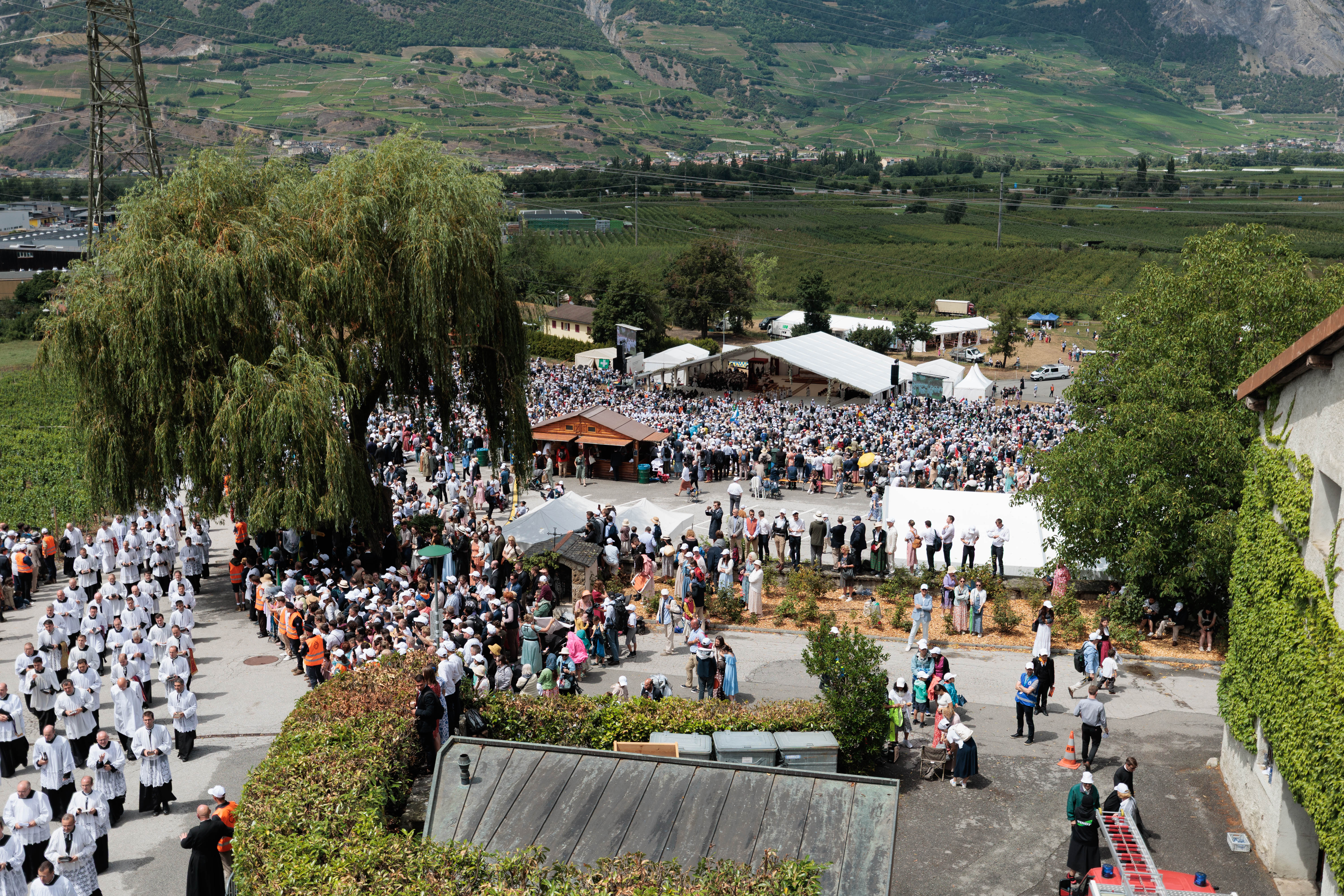
Crowds gather during an illicit consecration Mass in Écône, Switzerland, celebrated by the Society of St. Pius X on July 1, 2026 . The following day, the Vatican declared the new bishops and those who consecrated them to be schismatic, as well as all clergy and lay faithful who adhere to the schism. (Courtesy of the Society of St. Pius X)
Though the statement did not define what constitutes formal adherence to the schism for laypeople, it explicitly upheld a 1996 note from the then-Pontifical Council for Legislative Texts, which said formal adherence to the schism was comprised of two elements: consciously choosing adherence to the society over obedience to the pope, and "exclusive participation in Lefebvrian 'ecclesial' acts, without taking part in the acts of the Catholic Church," referencing the group's founder, Archbishop Marcel Lefebvre.
The statement followed the same formula as the Vatican declaration that followed the SSPX's illicit 1988 consecrations by Lefebvre, which explicitly declared excommunication only for the men who were made bishops and those presiding over the ceremony while warning priests and faithful not to "support the schism" for risk of excommunication. This time, however, the accompanying note spelled out the consequences of that act for SSPX priests and lay faithful.
Despite the Vatican warning that adhering to the schism would result in excommunication, Bishop Michael Goldade, one of the newly consecrated and now excommunicated bishops from St. Marys, Kansas, appealed to the thousands gathered for evening prayer July 1 to "keep your families faithful to these holy institutions – the Mass, the sacraments – and lever let them go."
"If the Catholic Church in her tradition brings forth life, the modernist church is a desert," he said, with his newly bestowed crosier in hand. "It kills everything that it touches."
"Today, I am excommunicated"
The weight of the Vatican declaration punctured what had otherwise been a celebratory mood during the multiday gathering of SSPX faithful at Écône.
After the previous day's consecrations, attendees gathered under large tents to feast in fields below the towering Swiss Alps. Equally long lines snaked through the crowd as people waited to approach priests for blessings or to buy drinks from a beer tent.
Yet looming in the background was the prospect of what could be, and effectively was, pronounced the following day. Still, SSPX faithful appeared set to remain undeterred in their adherence to the group.
The SSPX lay faithful "must write to their bishop and no longer come to our places of prayer, but if they don't do those two acts then they are surely excommunicated," said Marc-Andre Mabillard, a lay adherent to the SSPX who helped organize the gathering. "Today, I am excommunicated."
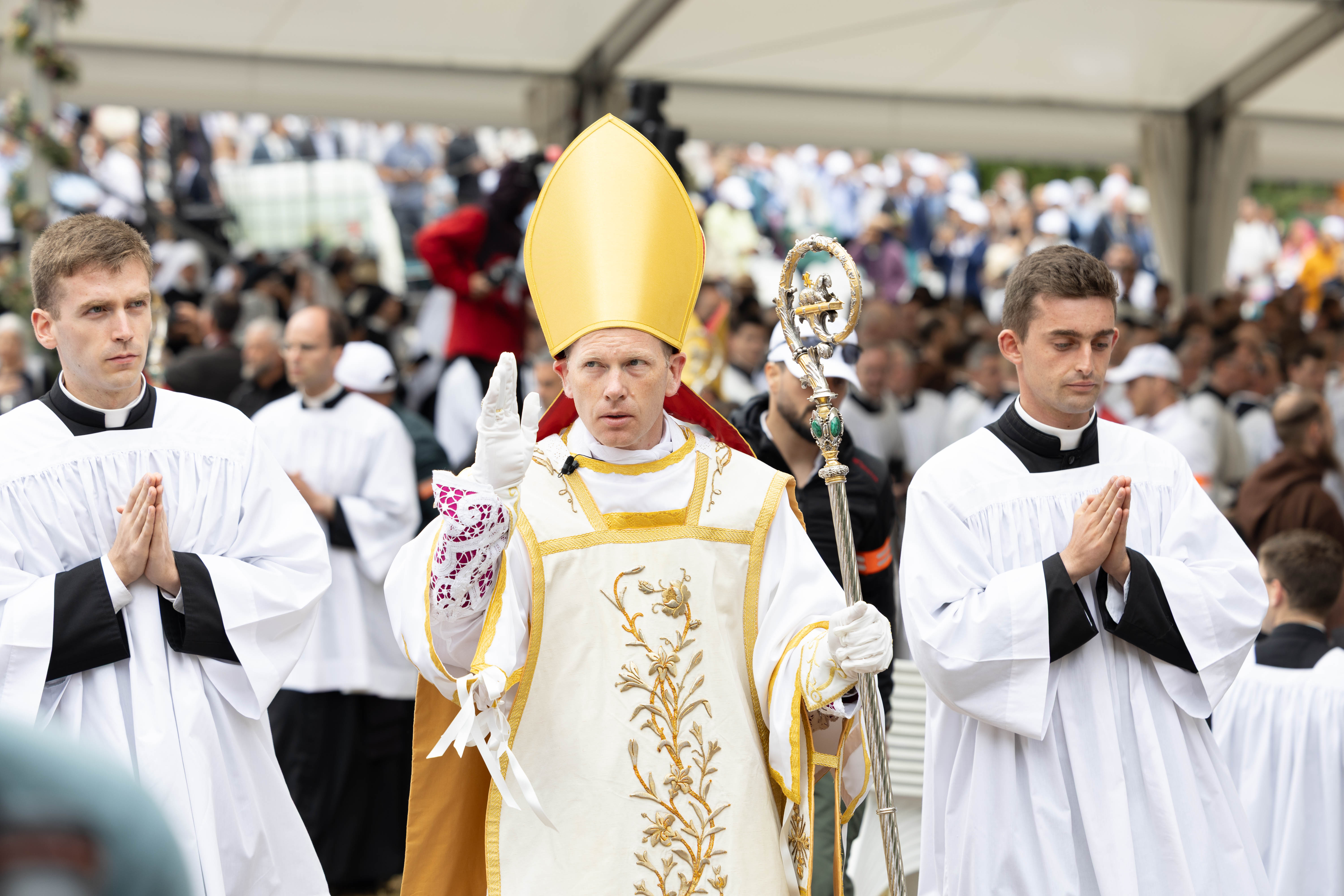
Excommunicated Bishop Michael Goldade, from St. Marys, Kansas, gives a blessing as he proceeds from an illicit consecration Mass in Écône, Switzerland, celebrated by the Society of St. Pius X on July 1, 2026. (Courtesy of Society of St. Pius X)
But not all in the society believe the penalty of excommunication will apply to them.
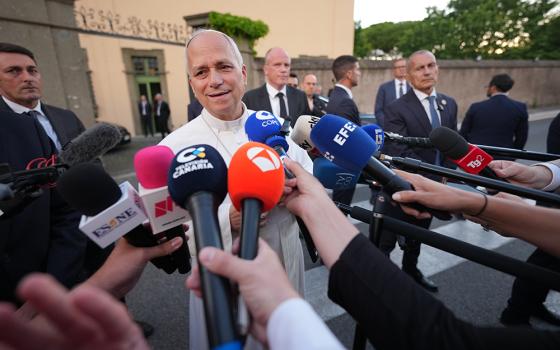
Although participation by the faithful at the consecrations could be interpreted as "formal adherence" to the society's schism, SSPX Fr. Michel Rion, the main organizer of the bishop consecrations at Écône, told reporters that "all the parishioners who are here are certain to be in the church and to be sons of the pope, and they are hurt and so sad."
"I think most of the parishioners do know that the sacraments will still be valid and licit, what is very sad is that some people may not understand and see that is the case," he said, in contrast to the note issued that morning by the Vatican. "We simply hope and pray — because we know it was the right thing to do — that they will see the importance of it."
Many of the lay faithful in attendance grew up within SSPX communities, including Goldade, the freshly excommunicated U.S. bishop.
Lillian Riddell from Ontario, Canada, 20, said she was 7 years old when her mother began taking her family to an SSPX chapel to attend the pre-Vatican II Latin Mass because "they're the best priests you can find."
The prospect of excommunication would not affect her relationship with the church or the society, she told NCR: "I'll just continue my way of life," Riddell said. "I love the SSPX, I think what they're doing is amazing for all Catholics."
Ana Sofía Ribera Sánchez, said her grandparents were introduced to the society when Lefebvre traveled to Mexico City, where her brother is now an SSPX priest. Her family traveled to Switzerland from Mexico to celebrate the moment in the SSPX's history amid the "persecution" she said it has recently been subjected to.
"It's difficult when you're told you're wrong, especially when it comes from the pope, but I think that's the struggle that all Catholics must confront, because we defend the truth," she told NCR.
But not even the pope could dissuade her from continuing her faith life with the SSPX.
"I am in a place where my ideas are aligned," she said with a broad smile. "No one is moving me from there."
After Thursday's morning Mass, priests and brothers in full black cassocks stacked chairs and disassembled scaffolding under the bright Swiss sun.
As they pushed carts of building materials uphill toward the society's general house, the Vatican flag, one rung higher than the national flags below it, waved over them in the mountain breeze.
The National Catholic Reporter's Rome Bureau is made possible in part by the generosity of Joan and Bob McGrath.
Advertisement