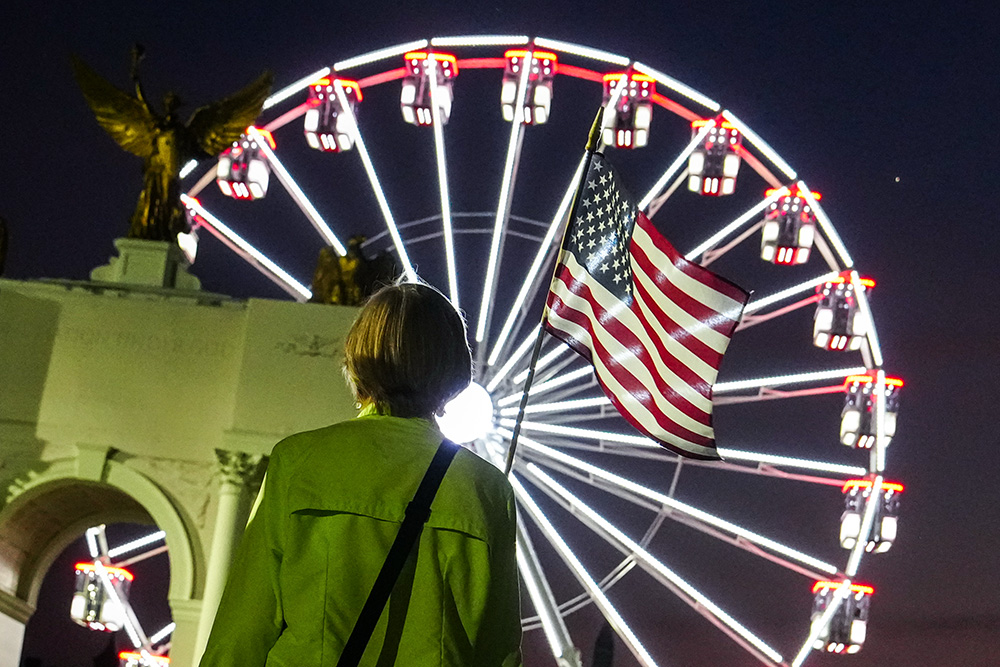
A person carries an American flag at the Great American State Fair, Tuesday, June 30, 2026, on the National Mall in Washington. (AP/Julia Demaree Nikhinson)
Ahead of the 250th anniversary of the United States, editors and writers at the National Catholic Reporter and Global Sisters Report asked a range of Catholic leaders for brief responses (100 words or fewer) to one question: "What is your hope for America at 250?"
Below you can read responses from political leaders (including two former speakers of the House of Representatives), leaders in ministry, Catholic activism, and Catholic colleges and universities.
The responses acknowledge areas where the United States has failed to extend its promise of freedom and equality to all, and some lament our nation's current political climate. But nearly all express hope that Catholics who call this nation home will be a force for justice and peace at home and around the world.
And if you're interested in hearing what Catholics thought about the U.S. bicentennial in 1976, we collected some responses from our archives.
Some answers below have been edited for length and clarity.
US politics
"As America approaches its 250th anniversary, remember that our founders believed democracy would succeed because of the goodness of the American people. Their faith has sustained our nation across generations and through moments of both triumph and trial. It reminds us that America is strongest when we are guided by faith and charity — which gives us hope. After 250 years, it is my hope that the American people remain committed to 'In God We Trust,' building a more perfect union for generations to come."
—Nancy Pelosi, speaker of the U.S. House of Representatives, 2007-2011 and 2019-2023
☆
"That we work harder at loving one another."
—John Boehner, speaker of the U.S. House of Representatives, 2011-2015
☆
"As we celebrate 250 years of progress and pain, it's impossible to celebrate this milestone without understanding the dark moment we are in. The fight for a country that celebrates diversity, engages in compassion, rejects corruption, uplifts the vulnerable, provides justice and opportunity without favor or prejudice, and is a beacon of hope for the world is our obligation and responsibility. And while this aspirational vision is still within our reach, we need Americans to reject the idea that cruelty, racism or isolationism are our future. To get there, we need to listen to one another, heal what's at the root of the anger that dominates our politics and come together as one nation, united for good."
—Veronica Escobar, Texas Democratic congresswoman
☆
"For 250 years, America has endured because its greatest strength has never been perfection, but renewal. We have survived civil war, depression, injustice and division by returning, however imperfectly, to the promise that every person is created equal and worthy of liberty. That promise still calls us forward. Hope does not ask us to ignore our differences; it asks us to believe they need not define our destiny. If we choose courage over fear, truth over grievance and citizenship over tribalism, America's finest chapters remain unwritten. Our Republic's greatest inheritance is not its past, but the character We the People summon to shape its future."
—Michael Steele, former chair of the Republican National Committee, 2009-2011
☆

Detail of what became known as the Rising Sun Chair, used by George Washington when he presided over the 1787 Constitutional Convention (Wikimedia Commons/National Park Service)
"In his Notes on the Constitutional Convention, James Madison relates that, in the closing moments of the convention, Benjamin Franklin confided he had worried for months whether the figure of the sun painted on Washington's chair was rising or setting. As the last few delegates rose to sign the Constitution, Franklin averred he now knew it to be a rising sun. But is it still? I remember the euphoria of 1976, celebrating the bicentennial with my new fiancée in Philadelphia. We knew then, with the clear eyes of youth, that was indeed a rising sun, full of promise. Now, darkened by the ugly nationalism and demagoguery of America's last decade, I worry. Does it still rise?"
—Stephen Schneck, former chair of the U.S. Commission on International Religious Freedom
Ministry
"As I reflect on this anniversary, I recall an address Pope St. Paul VI delivered to representatives of the U.S. Congress in 1976 for our nation's bicentennial. Expressing his hope for a 'rededication' to the principles of our founding, he said: 'May your land be indeed a land of upright conduct in personal and public life — a land where truth is respected, and where brotherly love is the criterion of greatness.' My hope for the United States at 250 is that we hold fast to those values, that we remember that all peoples form one human family, and that we act accordingly, in love."
—Cardinal Blase Cupich, archbishop of Chicago
☆
"As I travel the country visiting our 169 local Catholic Charities agencies, I am struck by the diversity of the beautiful topography but also the consistency of the virtues we share: service, empathy, love of neighbor, hospitality, innovation, faith and hope. My hope for our wonderful country is that we focus more on all that we have in common rather than what divides us. May the next 250 years be marked by compassion, care for each other, especially the most vulnerable among us, and care for our beautiful common home. May we be people of hope."
—Kerry Robinson, president and CEO of Catholic Charities USA
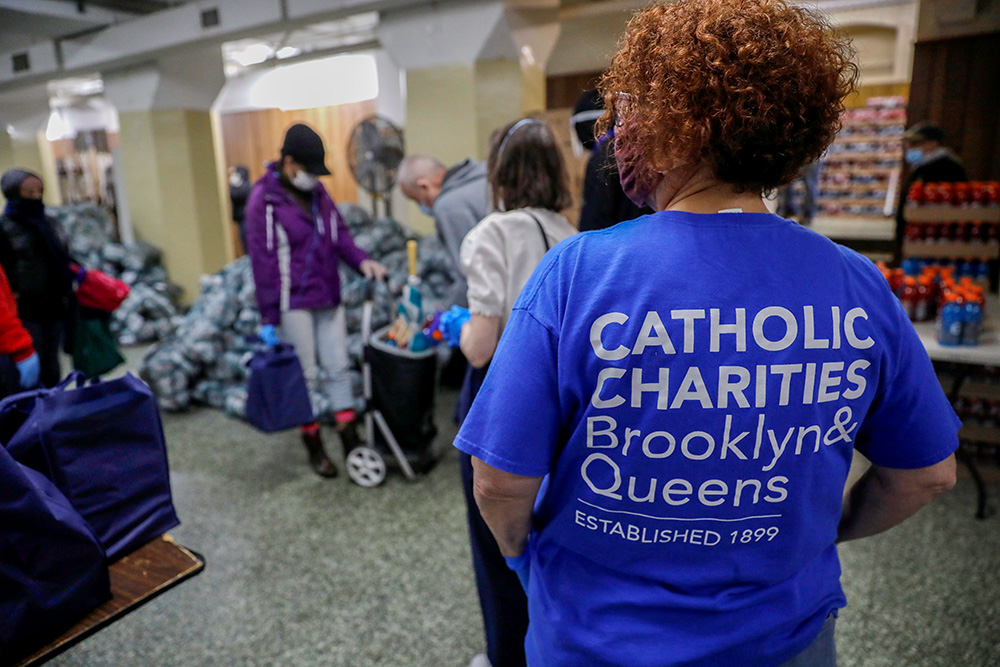
A volunteer in New York City looks on as people receive free food at a food pantry for needy residents run by Catholic Charities Brooklyn and Queens April 24, 2020. (OSV News/Reuters/Mike Segar)
☆
"When I think of John Winthrop's idealistic notion of the Massachusetts Bay Colony as a 'city on a hill,' I assume that he wished that other peoples, other nations, would look up to us. And I would hope that others look up to us not because of our economic or military power, but because of our compassion toward those who are most in need. My hope for America at 250, then, is that we be known for our compassion."
—Jesuit Fr. James Martin, author and editor at large, America Media
☆
"In my work along the U.S.-Mexico border, I meet families who have endured extraordinary hardship yet still believe in the possibility of a better tomorrow. I see volunteers who give generously, communities that welcome strangers and neighbors who respond to suffering with compassion. My hope is that America continues its journey toward greater compassion, justice and unity. That we choose faith over fear, encounter over division, and hope over despair. Because when we recognize that we belong to one another, we discover what has always made America strong: the belief that every person matters and that together we can build a future worthy of the generations to come."
—Missionary of Jesus Sr. Norma Pimentel, executive director of Catholic Charities of the Rio Grande Valley
☆
"My hope is that we could all walk each other home to an unwavering belief that we are indeed created equal. Anchored in the sure and certain knowledge that each of us is unshakably good and that we belong to each other, we walk each other home to wholeness and the kinship of community. Together, we imagine a circle of compassion and then imagine no one standing outside that circle. United, we choose to dismantle the barriers that exclude. We stand at the margins, in order to erase them. A more perfect union."
—Jesuit Fr. Gregory Boyle, founder of Homeboy Industries
Advertisement
☆
"At 250, I hope America is remembered not only for its ideals, but for how faithfully it lived them. Immigration has always been part of our national story. My hope is that we build an immigration system that is orderly and just, while remaining rooted in compassion and a recognition that welcoming newcomers has long been one of our nation's greatest strengths."
—Anna Gallagher, executive director of the Catholic Legal Immigration Network Inc.
☆
"As we celebrate the 250th anniversary of the United States, I look forward to 2027, anticipating the 150th anniversary of the end of Reconstruction. I lament the many ways we still fail to address the nation's original sins of African American slavery, genocide, subjugation and apartheid. In some respects, we are experiencing the bitter fruits of that failure, in our current politics and social strife. Thus, my hope for America is that someday we finally get freedom and justice right, granting them to those who still await them even now."
—Nate Tinner-Williams, editor, Black Catholic Messenger
☆
"In 1976, I turned 13, and my parents took us on a cross-country journey from California to our nation's capital. Along the way, we prayed countless rosaries. My father's unemployment that summer made our adventure timely: Our trip was both a family pilgrimage and a leap of trust in God's providence. Looking back, I see it as a lesson in faith, gratitude and perseverance. I hope we can recover those same virtues — serving one another with justice and love, safeguarding our freedoms and becoming instruments of peace in our homes, communities and throughout the world."
—Lisa Hendey, founder and editor of CatholicMom.com
Catholic higher education
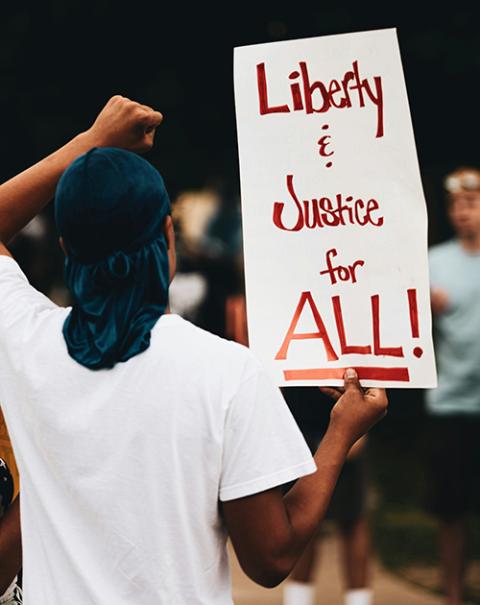
Minnesota, 2020 (Unsplash/Freddie)
"James Baldwin said, 'Nothing can be changed until it is faced.' Societies are shaped by what they remember and, perhaps even more, by what they refuse to remember. I believe the current polarization and cynicism about the country's anniversary stems from an unwillingness to honestly face and reckon with — without varnish, excuse or rationalization — the tragic histories of injustice and exclusion that have made us who we are. Genuine contrition is essential for a future of 'liberty and justice for all.' My hope is that the country engages in a truth and reconciliation process that has helped heal so many other nations. What sustains my hope is believing that the future is not foreclosed. With God's help, metanoia is always a possibility."
—Fr. Bryan Massingale, James and Nancy Buckman Chair in Applied Christian Ethics at Fordham University
☆
"Catholic engagement in U.S. public life has at its best been animated by a moral vision rooted in the dignity of the human person and a commitment to the common good. My hope for our country's 250th anniversary is that we recommit to this 'better kind of politics,' guided by Pope Leo's vision of human dignity as the measure of our political and technological choices. Such a witness would help foster the solidarity necessary for our pluralist democracy to flourish."
—Kim Daniels, director of the Georgetown Initiative on Catholic Social Thought and Public Life
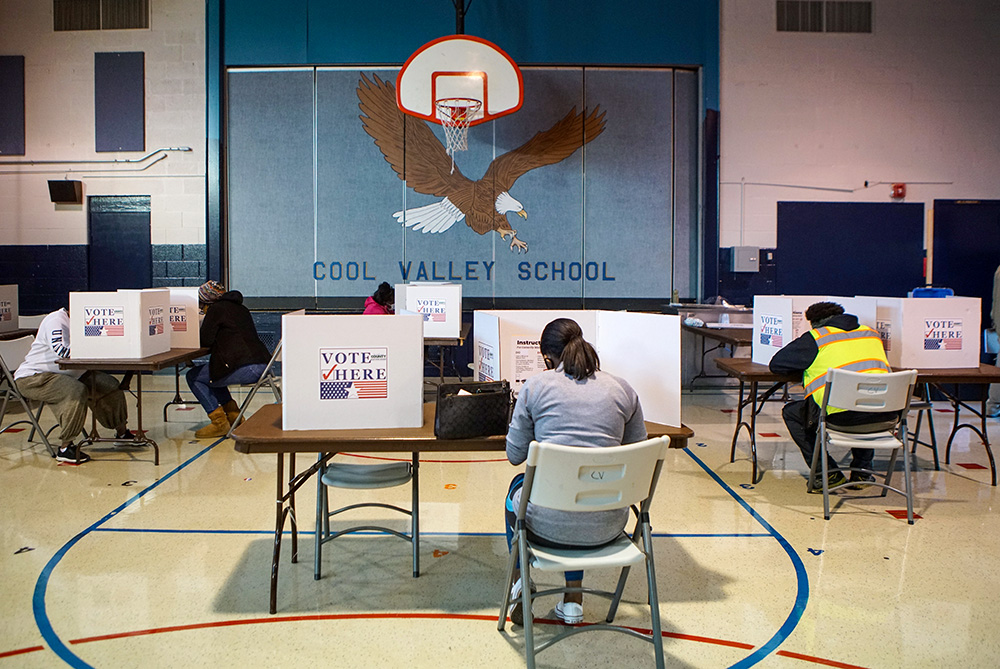
Voters mark their ballots at a Ferguson, Mo., polling station during Election Day Nov. 3, 2020. (OSV News/Reuters/Lawrence Bryant)
☆
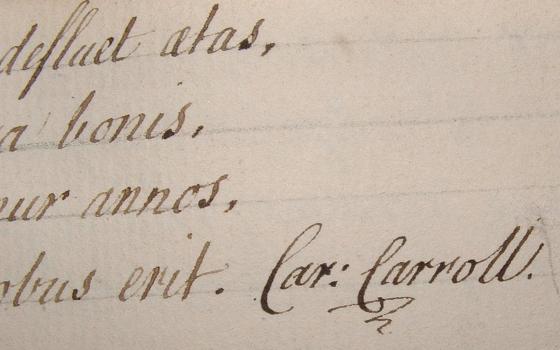
"American Catholics started out as a small, embattled minority in Maryland and Pennsylvania and prospered far beyond anything our early leaders, like Baltimore Archbishop John Carroll, could have imagined. In 1776, they constituted 1% of the total population; they are now the largest Christian community in the land. The astonishing thing about their success is that they were willing to both learn from the American experiment — separation of church and state, an appreciation for religious and social pluralism, etc. — as well as to contribute signal values to it: consistent concern for the common good, care for immigrants and the marginalized, a willingness to welcome all people into their hospitals and schools. It is what scholars mean when they refer to providential history."
—Jesuit Fr. Mark Massa, former director of the Boisi Center for Religion and American Public Life at Boston College
☆
"250 years ago our nation staked its claim on the revolutionary conviction that human rights of life, liberty and the pursuit of human flourishing derive from our inviolable human dignity imbued by our Creator. That logic claims that every human life matters. It further claims that the power of government lies in its service to the commonweal. The last sentence of this revolutionary document promises who we intended ourselves to be as a nation: 'And for the support of this Declaration, with a firm reliance on the protection of divine Providence, we mutually pledge to each other our Lives, our Fortunes and our sacred Honor.' "
—Michelle Loris, director, Center for Catholic Studies at Sacred Heart University
Catholic advocacy
"My hope for our nation on its 250th birthday is that we become the inclusive community we have always been called to be, united in pursuit of the common good. Our strength lies not only in individual freedom but also in our responsibility to one another. We must choose collaboration over division and build a shared future where no one is left outside the circle of our care. I pray that we move beyond polarization through honest dialogue, standing shoulder to shoulder to create a nation where everyone is welcome, everyone contributes, and together we truly become 'We the People.' "
—Social Service Sr. Simone Campbell, former director of Network and 2022 recipient of the Presidential Medal of Freedom
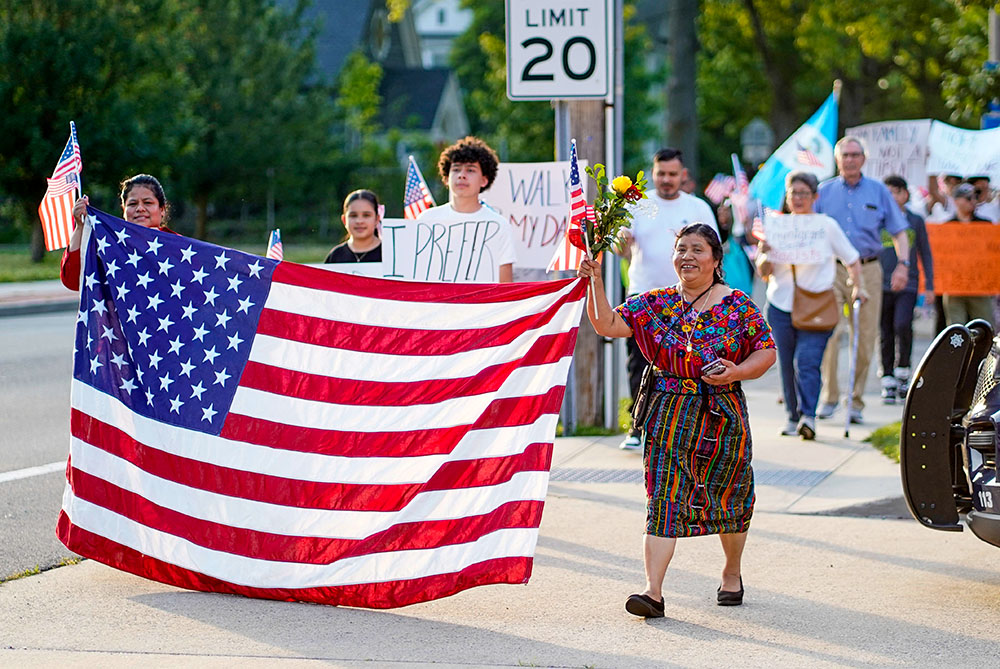
Women hold a U.S. flag as they lead a pro-immigrant march following a Spanish-language Mass at St. John the Evangelist Church in Riverhead, N.Y., June 22, 2025, the feast of the Body and Blood of Christ. (OSV News/Gregory A. Shemitz)
☆
"I hope the 250th anniversary of the United States marks not only a celebration of our history but also a moment of honest reckoning with where we stand today — confronting divisive racism, xenophobia, income inequality and our failure to care for the poor, the vulnerable and the marginalized. Let us build the next 250 years not on fear or domination, but on the Gospel's call to justice, mercy and the dignity of every person, especially those most targeted today: LGBTQ Catholics, immigrants, women and the poor. May we follow the Christ of the Gospels and rebuke the false idol of white Christian nationalism."
—Yunuen Trujillo, LGBTQ Catholic activist and immigration attorney
☆
"My hope for America at 250 is that each of us recognize our responsibility in ensuring that our nation's policies and systems reflect a commitment to human dignity. With the light of our faith, may our actions break down walls, promote peace and pursue a justice free from vengeance — especially through abolishing the death penalty. I hope for the healing of individuals, wounded communities and broken systems. I pray that we remember our call to engage one another with respect, with mutual accountability and a commitment to racial equity. And may we never lose sight of opportunities to cultivate reconciliation, hope and the common good for all."
—Krisanne Vaillancourt Murphy, executive director of the Catholic Mobilizing Network
☆
"My hope is that the United States moves beyond internal division and isolationism to embrace a renewed commitment to life, liberty and the pursuit of happiness for all people. Inspired by the Gospel and the witness of Maryknoll missioners worldwide, I pray that the United States becomes a more compassionate society that fiercely protects the marginalized, welcomes the migrant, promotes peace through active nonviolence and honors the integrity of God's creation through action on climate change. By shifting our national priorities toward the global common good, the United States can lead the next chapter of its history not through economic or military dominance, but as a humble champion of human dignity and restorative justice for our shared world."
—Susan Gunn, director of the Maryknoll Office for Global Concerns
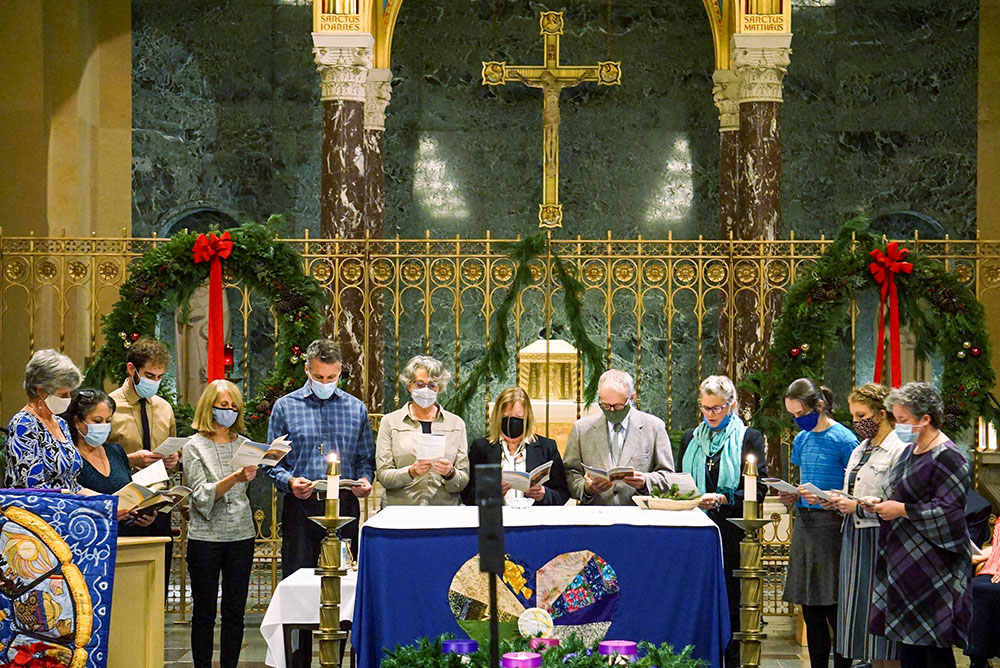
New Maryknoll lay missioners recite their "Commitment Prayer" at the Queen of Apostles Chapel in Ossining, N.Y., Dec. 11, 2021. The formation program prepared the missioners for cross-cultural ministries in six countries: Bolivia, Brazil, El Salvador, Kenya, Tanzania and the U.S.-Mexico border. (CNS/Courtesy of Maryknoll Lay Missioners/Pat Norberto)
☆
"My hope is that we remember that we, the people, belong to one another. So much of our turmoil in this country boils down to an us-vs.-them mentality that leads to some determining that the 'other' doesn't belong. Yet, we know that we can only be a great nation when we move beyond our fear of the other to love our neighbor as ourselves, create safe and welcoming neighborhoods, give food to the hungry, shelter to the unhoused and enduring hope for a future that includes all of us."
—Humility of Mary Sr. Eilis McCulloh, grassroots education and organizing specialist at Network
☆
"My hope for America 250 is that the foundational tenets upon which this country is grounded, that of life, liberty and the pursuit of happiness can be actualized for those who call this country home and are seeking and pursuing a better way of life for themselves and their families. As Catholics who believe in the Gospel and are informed by our Catholic social justice teachings, we are mandated to love tenderly, act justly and to humbly walk with our good God. Let our actions serve as a witness to guarantee that in the next America 250, no one is left behind and the pursuit of life, liberty and happiness is not a dream deferred."
—Notre Dame de Namur Sr. Patricia Chappell, former executive director of Pax Christi USA
☆
"As a Catholic reformer, I believe you can tell a lot about any institution — even a country — by who has a seat at the table. My hope is that America's next 250 years are measured not by power, but by who we welcome: the immigrant seeking refuge, the woman told to wait her turn, the LGBTQ+ sibling too long scapegoated, the person of color owed centuries of unpaid debt, the family forced to choose between basic necessities. I pray we become a country that looks around to see who's missing — and slides over to make more room at the table."
—Russ Petrus, executive director, FutureChurch