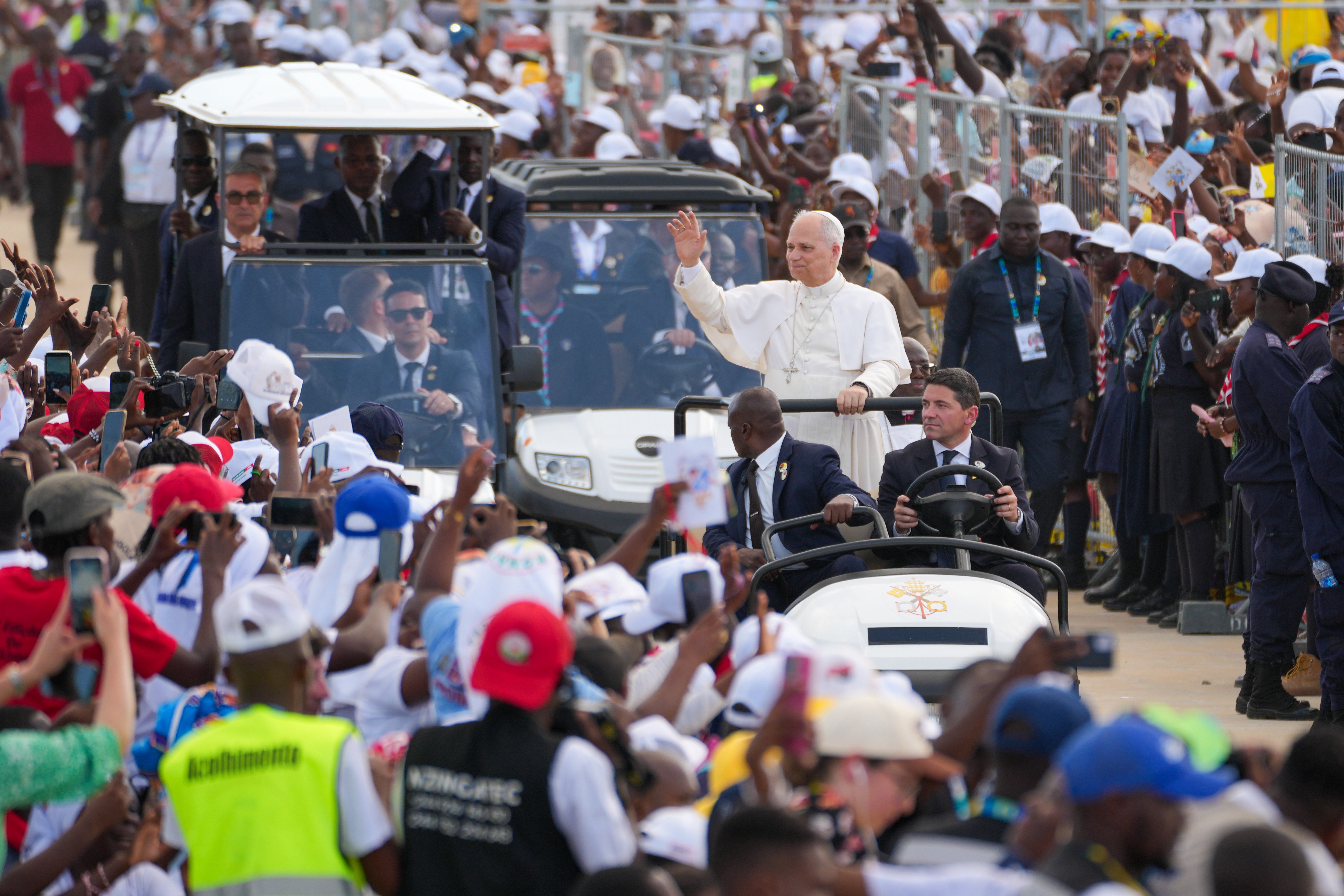
Pope Leo XIV greets the crowd as he rides in a golf cart to the Sanctuary of Our Lady of Muxima in Muxima, Angola, April 19, 2026. (CNS/Lola Gomez)

Join the Conversation
Send your thoughts to Letters to the Editor. Learn more
Since his election last May, Pope Leo XIV has hammered home the theme of unity.
But nowhere has that message taken on sharper contours than in Angola, where the long shadow of civil war and stark inequality continues to fracture the nation.
"It is possible to build together a country where old divisions are overcome once and for all, where hatred and violence disappear, and where the scourge of corruption is healed by a new culture of justice and sharing," the pope told the 100,000 people gathered for Mass in Kilamba, Angola, on the seventh day of his 11-day tour through Africa. "Only in this way will a promising future be possible, especially for the many young people who have lost hope."
In his two days in the former Portuguese colony, Leo again touched on several themes that he has spoken about throughout the last week of his travels in Africa: wealth inequality, corruption, the perils of foreign exploitation and encouraging young people.
Leo told reporters en route to Angola that part of the impetus for his entire trip was to confront "the difficulty we find throughout Africa of, many times, an unequal distribution of wealth."
Angola presents a paradox of a nation rich in oil and rare mineral reserves but where about a third of people live in poverty, positioning it as a country with one of the highest wealth inequalities in the world.
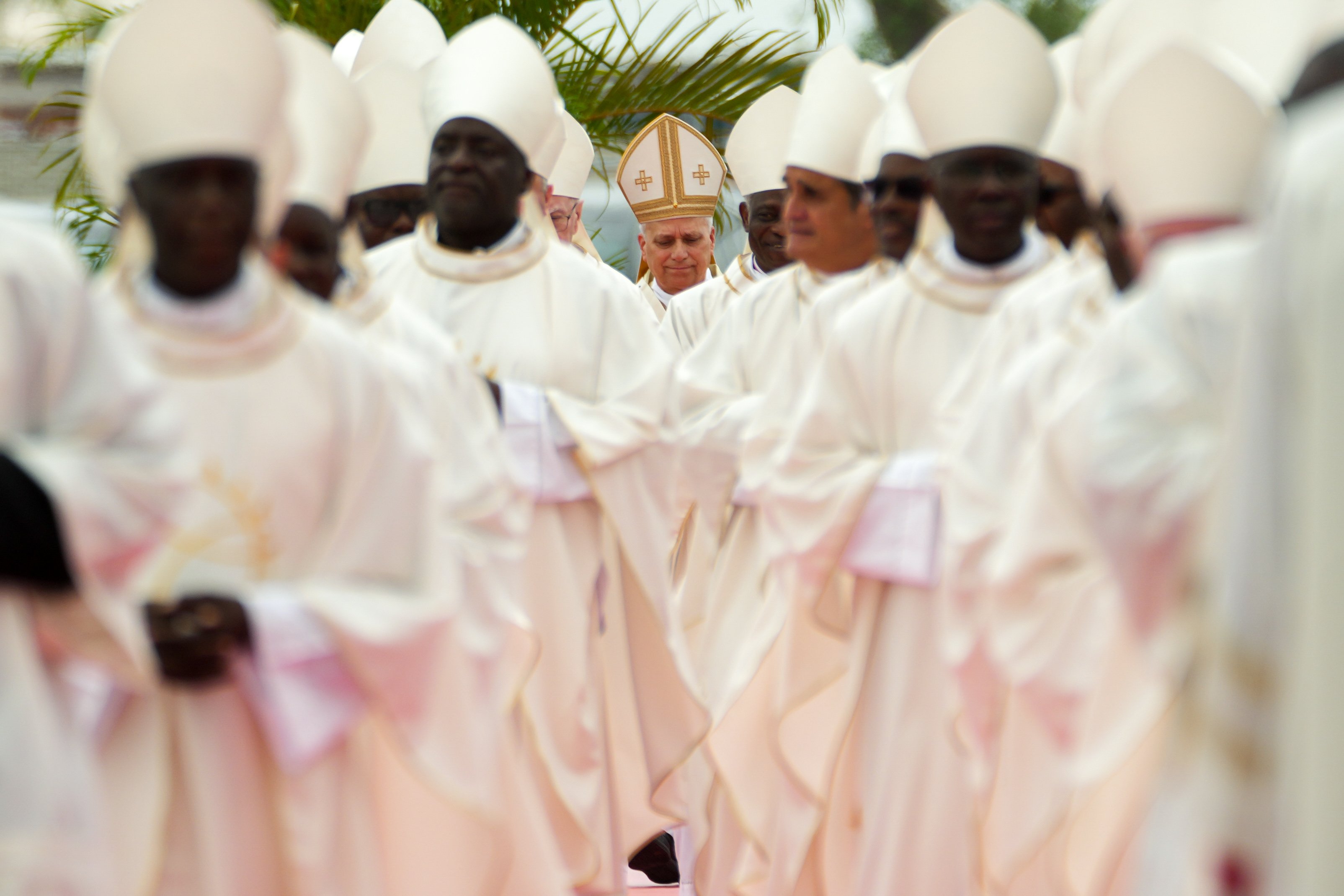
Pope Leo XIV walks in a procession to celebrate Mass at the Kilamba esplanade in Luanda, Angola, April 19, 2026. (CNS/Lola Gomez)
Those tensions were especially visible in Kilamba, the satellite city about 15 miles outside Luanda where Leo celebrated his first Mass. Built through an oil-for-infrastructure deal with China, the area is lined with Chinese-language billboards, luxury developments and rows of uniform apartment blocks that look like they have barely been broken in.
After arriving in Luanda on Saturday, the pope highlighted before Angolan President João Lourenço and the country's political leaders the "material riches upon which powerful interests lay their claim, even within your own country."
"How much suffering, how many deaths, how many social and environmental disasters are brought about by this logic of extractivism!" he said. "At every level, we see how it sustains a model of development that discriminates and excludes, while still presuming to impose itself as the only viable option."
For the crowds of people waiting to attend Mass with the pope, his message rang true.
Avellino Fwangali Kandondi, a 30-year-old student of occupational safety who attended Mass with the pope in Kilamba, said that "on the part of some companies that operate here, whether national or international, in terms of the exploitation of natural resources, there has been poor equitable distribution."
"The pope can bring this geopolitical vision, that our governments should not only think about exploiting resources that have an impact abroad, but also to think about sustainable ecology, in order to preserve the health of the people who live where these resources are exploited and for those who work there, and for the Angolan ecosystem," he said.
Addressing political leaders, the pope warned of fractures driven "by the arrogance of a few," saying Angolans continue to bear scars "not only of material exploitation, but also of the presumption of imposing an idea upon others."
Yet beyond economic inequality, Leo also addressed the country's lingering political divisions that have remained since its brutal 27-year civil war.
The country's independence in 1975, following 400 years of Portuguese rule, quickly resulted in a power vacuum that descended into a brutal 27-year civil war which killed an estimated 500,000 people and displaced millions. The victors, Soviet- and Cuban-backed People's Movement for the Liberation of Angola, have been in power since the war's end in 2002, establishing a competitive-authoritarian regime which strongly tilts power in favor of the ruling party.
Addressing political leaders, the pope warned of fractures driven "by the arrogance of a few," saying Angolans continue to bear scars "not only of material exploitation, but also of the presumption of imposing an idea upon others."
"There is disparity between political parties, between regions," said Patricio Musanga, a Congolese immigrant who has lived in Angola for a decade and is now a naturalized citizen. Waiting for Mass to begin he said that the pope, "as guarantor of the unity of Christians, we expect from him those messages of peace, those messages of unification of the people."
At Mass, Leo said the day's Gospel reading, in which two disciples lament the death of Jesus on the road to Emmaus, "brings to mind the pain that has marked your country: a long civil war with its aftermath of enmities and divisions, of squandered resources and poverty."
"When one is long immersed in a history so characterized by pain, one can risk losing hope and remaining paralyzed by discouragement, just like the two disciples," he said.
Advertisement
The message carried a particular weight in a country with one of the world's youngest populations, where more than half of citizens are under 18.
In Luanda, Leo urged political leaders: "Do not suppress the ideas of the young."
Just last year, mass anti-government protests in Luanda sparked by rising fuel prices were largely driven by young people, who voiced frustration with high youth unemployment rates – over 50% – and a lack of access to political systems to effect change.
Fr. Victorino Kalique, a member of the Congregation of the Poor Servants of Divine Providence, said that "many young people are without work, and therefore the wave of violence increases when a young person has neither an opportunity for employment, nor even an opportunity to study."
At the same time, he said, Angola's youth is full of promise for the Catholic-majority country and the church.
All of Africa, Kalique said, "has a privileged place in the heart of the pope and of the universal church, because it is the continent that grows the most in terms of the Catholic faith," he said. "So we feel honored and privileged, but also with a great responsibility to be able to respond to what the pope wants to ask of us."
The National Catholic Reporter's Rome Bureau is made possible in part by the generosity of Joan and Bob McGrath.