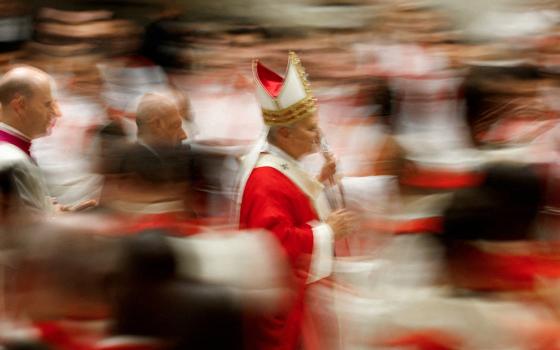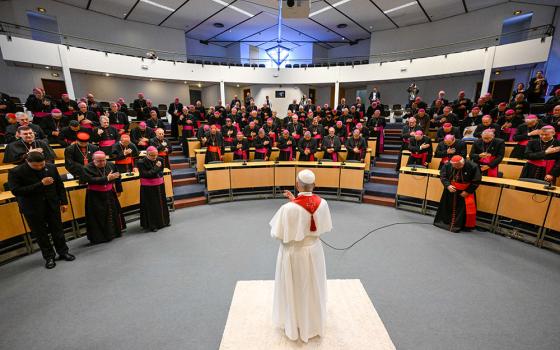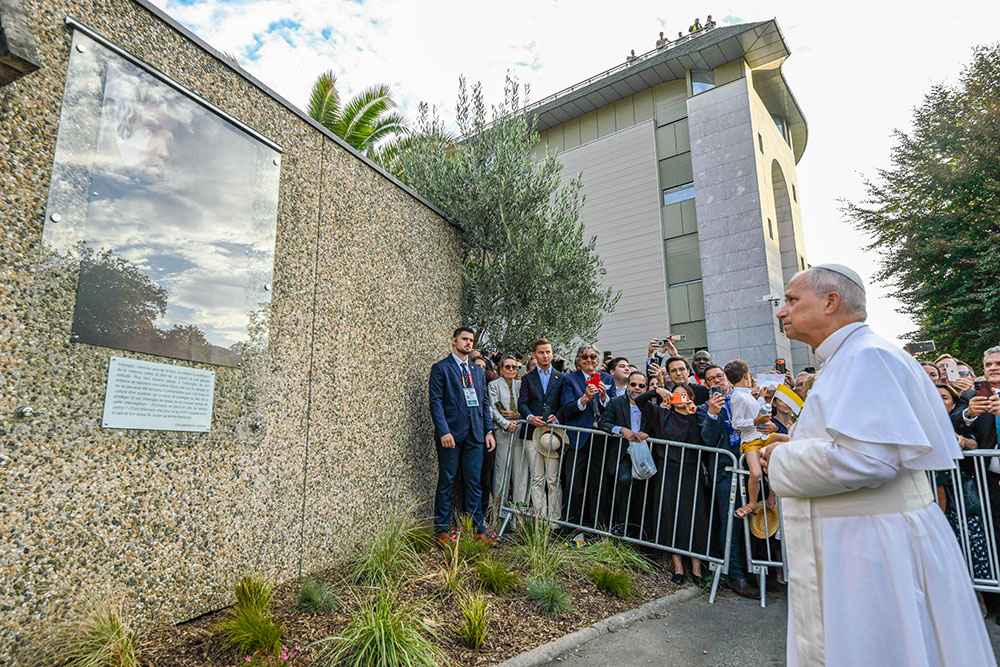
Before meeting with bishops representing the French bishops' conference, Pope Leo XIV stops for a moment at a plaque featuring a quotation from a survivor of abuse in Lourdes, France, Sept. 27, 2026. (CNS/Vatican Media)

Join the Conversation
Send your thoughts to Letters to the Editor. Learn more
On Sept. 27, Pope Leo XIV met with seven victims of sexual abuse suffered at the hands of Catholic priests and lay members of the church in France, which has had one of the most public reckonings of the clergy sex abuse in the world.
In the city of Lourdes, home to the Marian shrine that draws millions of pilgrims in pursuit of healing each year, the pope met individually with each of the seven victims — four men and three women selected by the Bishops' Conference of France — before addressing them together as a group.
Though Leo had met with victims of clerical sex abuse at the Vatican and during his June trip to Spain, his 90-minute meeting with victims in France was especially high stakes due to the local church's robust response to the sex abuse crisis. The response is sometimes touted as a model for the global church.
In 2021, an independent report commissioned by the French bishops' conference and the conference of French consecrated religious found that some 216,000 children had been sexually abused by priests and other clerics from 1950 to 2020, a figure that rose to 330,000 when considering abuse committed by lay members of the church, such as teachers or camp counselors.
After its publication, Pope Francis expressed his "shame that for so long the church has been incapable of putting this at the center of her concerns."
France's bishops responded the following month by adopting 26 measures to offer reparations and prevent future abuse, including establishing an independent body to compensate abuse victims; since then, some 2,000 people have approached the body to seek reparations.
Of the seven victims who met with the pope on Sunday evening, one was a victim of Abbé Pierre, the French priest who founded the Emmaus movement and became a national icon for his advocacy for the homeless. For years before his death in 2007, he was routinely voted France's most popular person, but his legacy was shattered when revelations emerged in 2024 that he had sexually assaulted more than two dozen women, some of them minors at the time.
Jérôme Guillement, a clergy abuse victim who had testified before the commission that produced the 2021 abuse report, told journalists after his meeting with Leo that "there was something sincere" about the pope during their conversation. "With him, every word was carefully chosen; every word had meaning."
Advertisement
The pope had a moment of prayer with some of the victims at the close of their conversations, and addressed them as the group at the end of the encounter, "expressing gratitude for the painful testimony and reaffirming their commitment to ensuring that the suffering they experienced is not repeated for others," the Vatican said in a statement after the meeting.
Olivier Mardi, the co-founder of a victim's advocacy organization in central France, said that Leo is "no fool" and is aware that the risk for abuse remains and the church must "remain vigilant."
"He responded positively to our very concrete proposals; he knows he has to work with us," Mardi said of the pope.
Meeting with France's bishops earlier that morning, Leo praised how the French church had "faced with determination the painful scourge of abuse committed against minors by members of the clergy."
"You have taken courageous measures to respond through listening, the search for truth, justice, forgiveness and making amends, and through a firm commitment to a culture of prevention and protection against these crimes," Leo said.
Introducing the pope for that meeting, Cardinal Jean-Marc Aveline of Marseille, who drew some votes during the conclave that elected Leo, described how a recent "shift in perspective" among the bishops to viewing abuse from the victims' point of view "set in motion within our church a long and demanding process of conversion and prevention, which we must continue in the years to come with the cooperation of the victims and the entire people of God."
In one of the church's most visible cases of reckoning with abuse, Bishop Jean-Marc Micas of Tarbes-Lourdes decided to cover massive mosaics adorning the facade of the basilica where the pope visited on Sunday. The mosaics were created by a disgraced priest accused of widespread abuse.
The bishop later said that Leo had praised the decision. Meanwhile, days before the pope's visit to Lourdes new mosaics created by Fr. Marko Rupnik were inaugurated at a Marian shrine in Brazil.
In an open letter addressed to the pope before his visit to Lourdes, five abuse victims praised the bishop's decision as a "powerful and courageous gesture," but denounced the lack of transparency in the ongoing Vatican trial against their alleged abuser.
"We, Your Holiness, have lost all trace of justice," the letter stated. "A trial held in obscurity offers no security to anyone, neither to the defendant nor to the victims."
The National Catholic Reporter's Rome Bureau is made possible in part by the generosity of Joan and Bob McGrath.