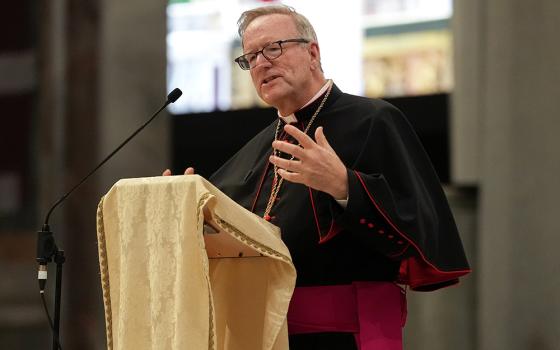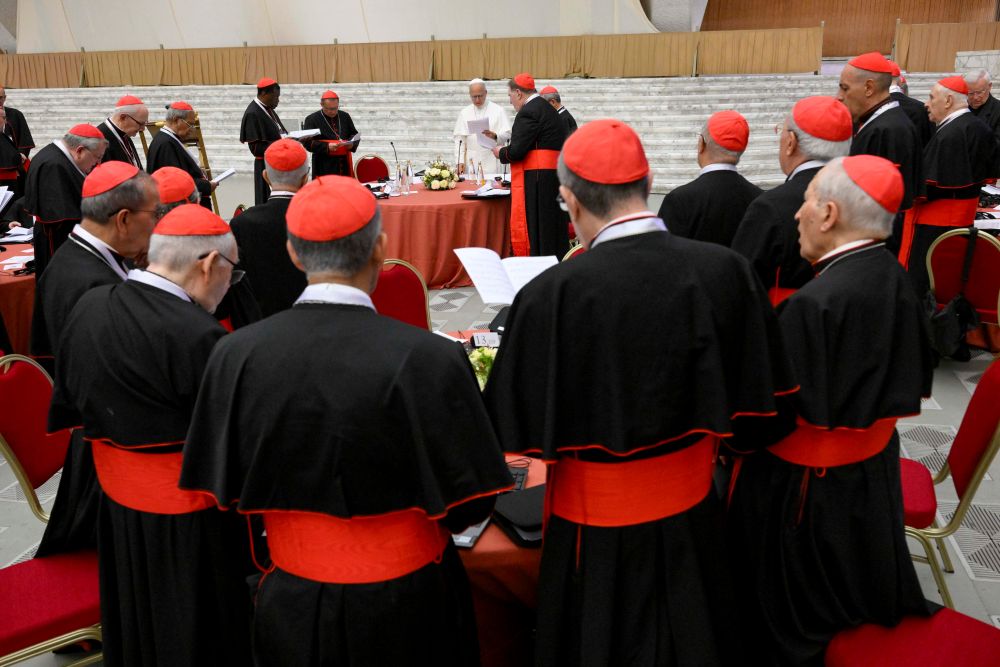
Pope Leo speaks June 26, 2026, at the opening of an extraordinary consistory of cardinals in the Paul VI Hall at the Vatican June 26-27. (OSV News/Vatican Media/Simone Risoluti)

Join the Conversation
Send your thoughts to Letters to the Editor. Learn more
The Catholic Church's teaching on "just war" has moved from an academic corner of moral theology to an unlikely flashpoint between Pope Leo XIV and leading U.S. officials, including Catholic Vice President JD Vance. Now, it has also become a central talking point among the world's cardinals.
During a two-day summit at the Vatican, 178 of the world's cardinals gathered in Rome and weighed whether the church should move away from language of "just war" and instead frame its moral teaching on conflict around the concept of "proportional defense."
The issue was placed at the heart of the June 26-27 meeting, known as a consistory of cardinals, after Leo intensified his criticism of modern warfare in recent months and codified it in the weightiest teaching document of his pontificate thus far: his encyclical Magnifica Humanitas, in which he wrote that the church's teaching on just war theory is "outdated."
One of the consistory's four working sessions, dedicated to "the culture of power and the civilization of love," invited cardinals to reflect on that section of the pope's encyclical.
At the end of the first day of meetings, where cardinals sat at 20 roundtables for small-group discussions that were then shared with the larger assembly, "many groups shared the need to overcome the logic of just war, since the Gospel cannot be imposed by force, and to instead speak about the right to a proportional defense," the Vatican said in a synthesis of the June 26 afternoon working session published after its close.
Sharing their discussions with the pope, the cardinals expressed "a unanimous commitment to support him and join him in his call for peace and his condemnation of war," the Vatican said.
Leo had set the tone for the meeting's reflection on war in his homily at the consistory's opening Mass, stating that "war is never worthy of humanity, and it is never blessed by God."
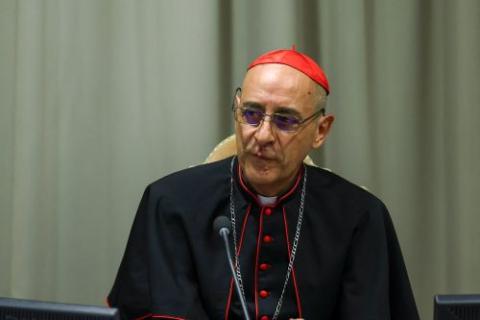
Cardinal Víctor Manuel Fernández, prefect of the Dicastery for the Doctrine of the Faith, is pictured at the Vatican's Synod Hall May 25, 2026, for the presentation of "Magnifica Humanitas." (OSV News/Reuters/Yara Nardi)
And the fact that the June 27 working session was introduced by Cardinal Víctor Manuel Fernández, head of the Vatican's doctrine office, underscored the magisterial weight of the discussion.
Opening the session, Fernández said the church's just war doctrine, which outlines the moral criteria for nations to engage in warfare, has led to church teaching being "manipulated to provide a theoretical foundation for the most unjust wars."
"Instead of stopping wars, it helps to justify them," the cardinal said, stating explicitly that the principle of legitimate defense cannot be invoked "in the broad and overly open sense of so-called preemptive wars."
In March, amid the expanding U.S.-led war effort in Iran, Cardinal Pietro Parolin, Vatican secretary of state, said that if the right for nations to launch preventative wars were recognized, "the whole world would risk being set ablaze." His comments came shortly after Secretary of State Marco Rubio, a Catholic, said the United States attacked Iran "proactively in a defensive way."
Advertisement
Before the cardinals, Fernández said that "whether in the case of Russia or the United States, the justification for foreign powers getting involved in the wars in the Middle East is seemingly always some form of supposed 'self-defense.' "
He also criticized "the enormous disproportion of the military interventions in Gaza and southern Lebanon."
The cardinal said that Magnifica Humanitas' language shows how "the very notion of legitimate self-defense must be more clearly defined so that it can be understood in its strictest sense," and said that the state of the world invites the church's social doctrine to weigh in as a moral voice.
"Indeed, our social teaching possesses an integrity, harmony, and coherence that is not found in politics, ideological proposals, or other sectors of society," he said.
The National Catholic Reporter's Rome Bureau is made possible in part by the generosity of Joan and Bob McGrath.