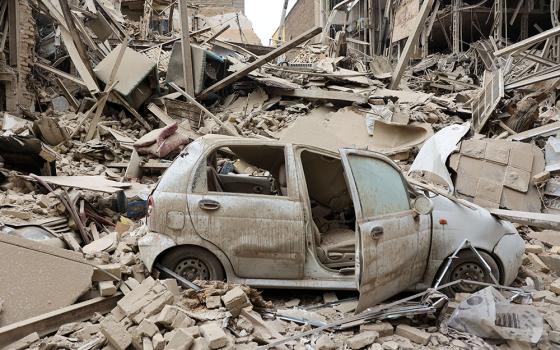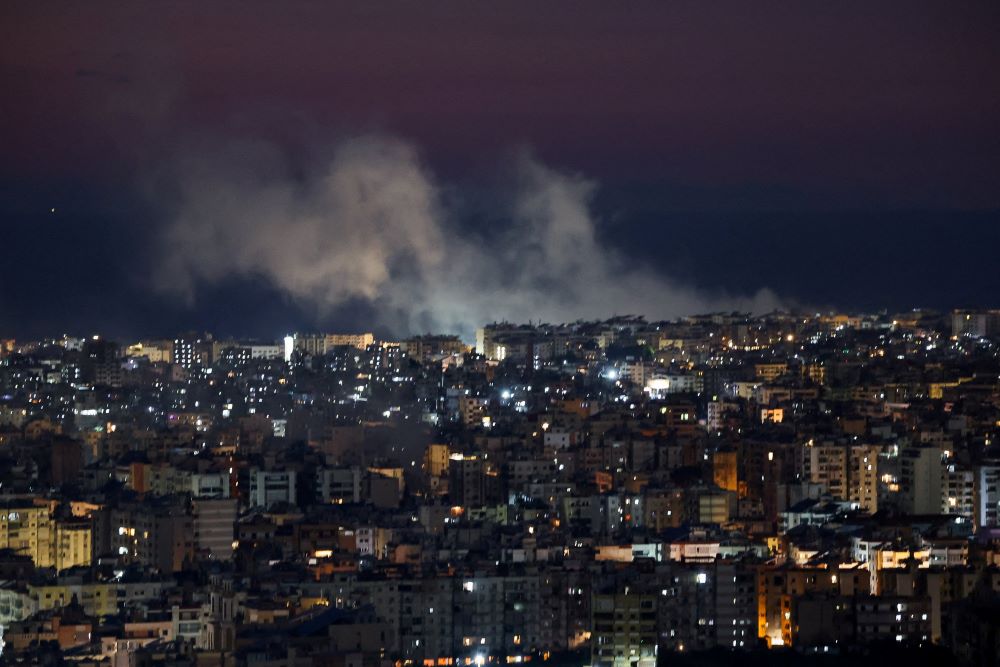
Smoke billows March 3 after an Israeli strike on Beirut's southern suburbs following an escalation between Hezbollah and Israel amid the U.S.-Israeli conflict with Iran. (OSV News/Reuters//Mohamed Azakir)

Join the Conversation
Send your thoughts to Letters to the Editor. Learn more
Nations acting on their own accord and without recourse to international consensus risk setting the world "ablaze" through conflict, the Vatican's top diplomat said in reference to the war in the Middle East.
"The force of law has been replaced by the law of force, with the conviction that peace can arise only after the enemy has been annihilated," said Cardinal Pietro Parolin, Vatican secretary of state in an interview to Vatican News on the ongoing Middle East conflict. "This erosion of international law is truly worrying: Justice has given way to force."
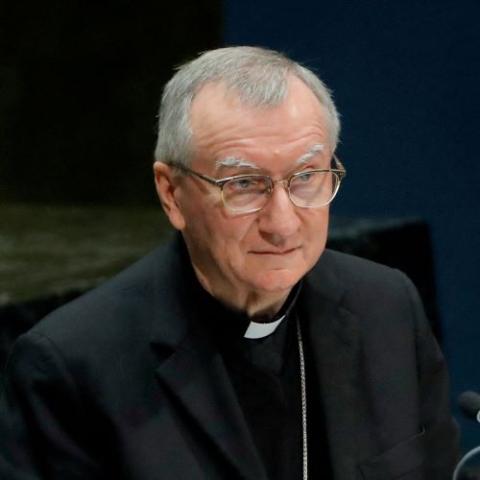
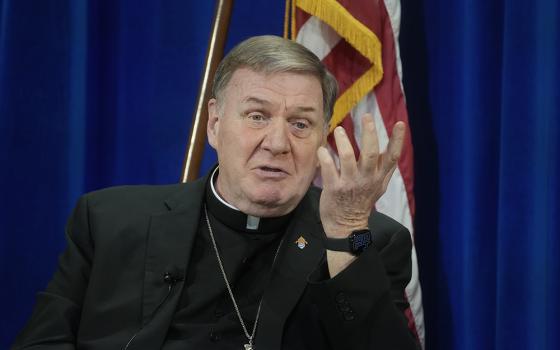
Cardinal Pietro Parolin, Vatican secretary of state (OSV News/Reuters/Brendan McDermid)
The March 4 interview was published after Pope Leo XIV made no mention of the Middle East or Iran in his morning general audience, a venue in which popes — including Leo — have typically made appeals in light of current events. The pope previously warned of "a tragedy of immense proportions" unfolding in the Middle East if diplomacy were not pursued to stop the war.
Parolin, without explicitly mentioning the United States, Israel or Iran, condemned "a multipolarism marked by the primacy of power and self-referentiality," which he said is "dangerously taking hold."
"If states were to be recognized as having a right to 'preventive war,' according to their own criteria and without a supranational legal framework, the whole world would risk being set ablaze," he said.
The cardinal's comments stand in stark contrast with those of U.S. Secretary of State Marco Rubio, a Catholic, who said the United States attacked Iran "proactively in a defensive way."
As of March 4, more than 1,000 people had been killed in Iran after five days of war, with 50 dead in Lebanon and 11 in Israel. Six U.S. service members were killed in an Iranian drone strike targeting a command center in Kuwait.
Advertisement
Parolin called Lebanese President Joseph Aoun March 4 to express the Holy See's support for Lebanon and "expressed its willingness to help alleviate the suffering of the Lebanese people" in the midst of Israel's ground offensive in the country.
While the cardinal said that Iran's bloody crackdown on protesters calling for regime change since December is of "deep concern," he said that "we may ask ourselves whether anyone truly believes that the solution can come through the launching of missiles and bombs."
"There are no first-class and second-class dead, nor people who have more right to live than others simply because they were born on one continent rather than another, or in a particular country," he said.
Parolin also lamented how the "whole body of international law built up in areas such as disarmament, development cooperation, respect for fundamental rights, intellectual property, and trade and transit is being questioned and gradually set aside."
After praying the Angelus in St. Peter's Square March 1, Leo called on diplomacy to "regain its proper role" and said peace is built only through "reasonable, sincere, and responsible dialogue."
And visiting a Rome parish later in the day, the pope told a group of young people to "pray hard for peace and seek ways to live in unity and always reject the temptation to harm others."
"Violence is never the right choice," he said. "We must always choose the good."
The National Catholic Reporter's Rome Bureau is made possible in part by the generosity of Joan and Bob McGrath.