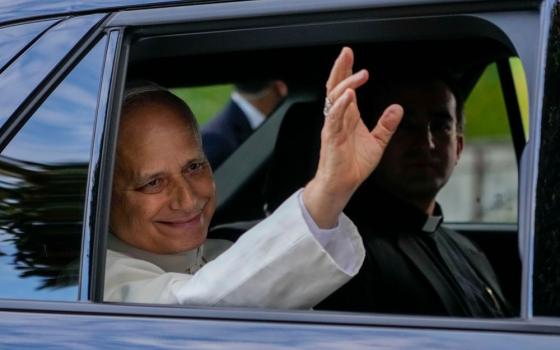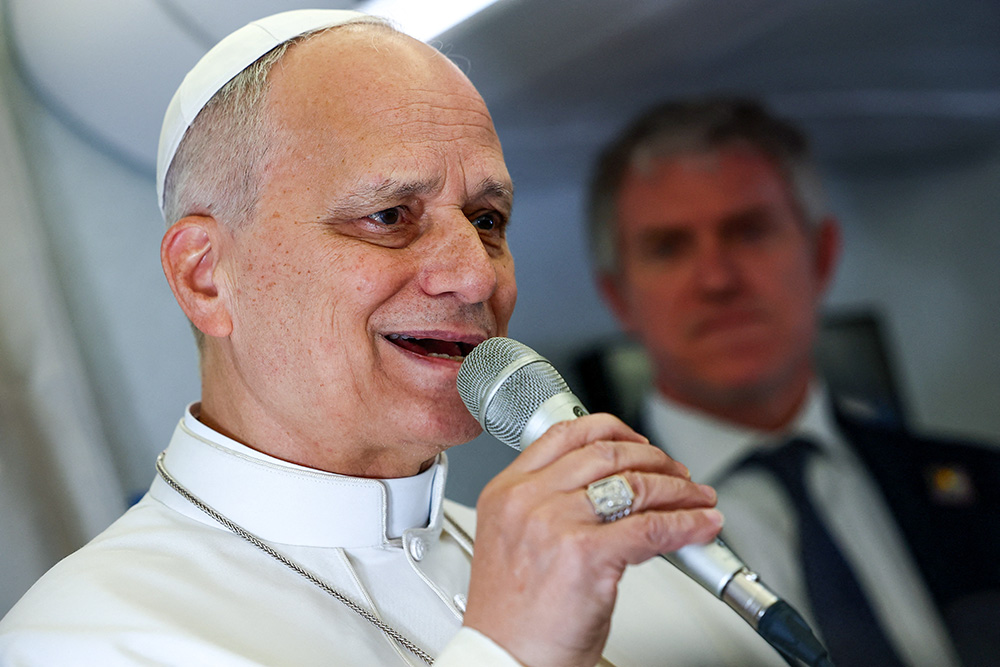
Pope Leo XIV speaks to members of the media aboard the papal plane April 15, 2026, en route to Yaoundé, Cameroon, amid his apostolic journey. (OSV News/Guglielmo Mangiapane, pool)

by Carol Zimmermann
Join the Conversation
Send your thoughts to Letters to the Editor. Learn more
By about Tuesday afternoon I think many of us were saying,"Well, that was a week."
This week's wild news cycle was a church and politics mash-up that started with the president of the United States taking on — more than once and with no plan to apologize — the U.S.-born leader of the Catholic Church for his repeated calls for peace amid the current war in Iran.
Pope Leo XIV, on his way to visit Africa, told reporters he was not afraid of President Donald Trump and would continue to speak the message of the Gospel. During his trip, he dropped a few more zingers, saying in Cameroon — to interpret as you wish — "The world is being ravaged by a handful of tyrants." *During the trip and on its return, Leo stressed to reporters that his tryrant remark was not aimed at Trump despite how it was characterized in the media.
In between remarks from these closely watched and very different leaders, more news broke that would not likely be on anyone's bingo card. Catholic Vice President JD Vance essentially urged the pope to stay in his lane and be careful when talking about theology. Trump posted on social media an image of himself that looked a lot like Jesus and later of him getting a side hug from Jesus. Midweek, Pete Hegseth, U.S. secretary of war, led a prayer at the Pentagon said to be from the Bible that was actually an excerpt from the movie "Pulp Fiction."
As my former boss Tony Spence used to say quite often: "You can't make this stuff up."
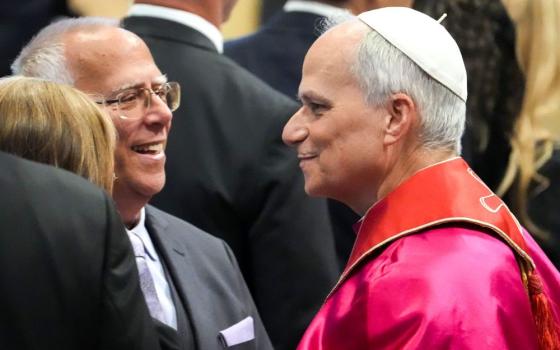
The headlines — and immediate reaction — about the back and forth between the pope and the president kicked off Sunday night after a "60 Minutes" episode featuring Cardinals Robert McElroy, Blase Cupich and Joseph Tobin. The U.S. church leaders, from Washington D.C., Chicago and Newark, New Jersey, spoke with Norah O'Donnell about their take on the war in Iran and mass deportations — views very much in line with the current pope.
Advertisement
At the National Catholic Reporter that evening, we had a column reacting to the segment ready to be published, with a news story scheduled the next morning.
But then news broke of Trump's rail against Leo on Truth Social, the president's social media platform. We switched gears to cover both the "60 Minutes" segment and Trump's attack, which turned out to be just the beginning of an odd news cycle.
The spat between Trump and Leo, the Jesus art and the vice president's unsolicited advice for the leader of the world's 1.2 billion Catholics on what he should and should not talk about certainly got a lot of reaction. Even late-night comedians weighed in and a few of our reporters and our executive editor were interviewed on various news outlets about what to make of it all.
By week's end there were no clear winners: Trump supporters still seemed on his side and those who questioned the pope still had questions and vice versa.
One dark horse was the Catholic Church's just war theory.
This church doctrine about when and how war can be morally justified originated from St. Augustine in the fifth century.
And, coincidentally, the pope paid a visit this week to the place where Augustine served as bishop, in modern-day Algeria.
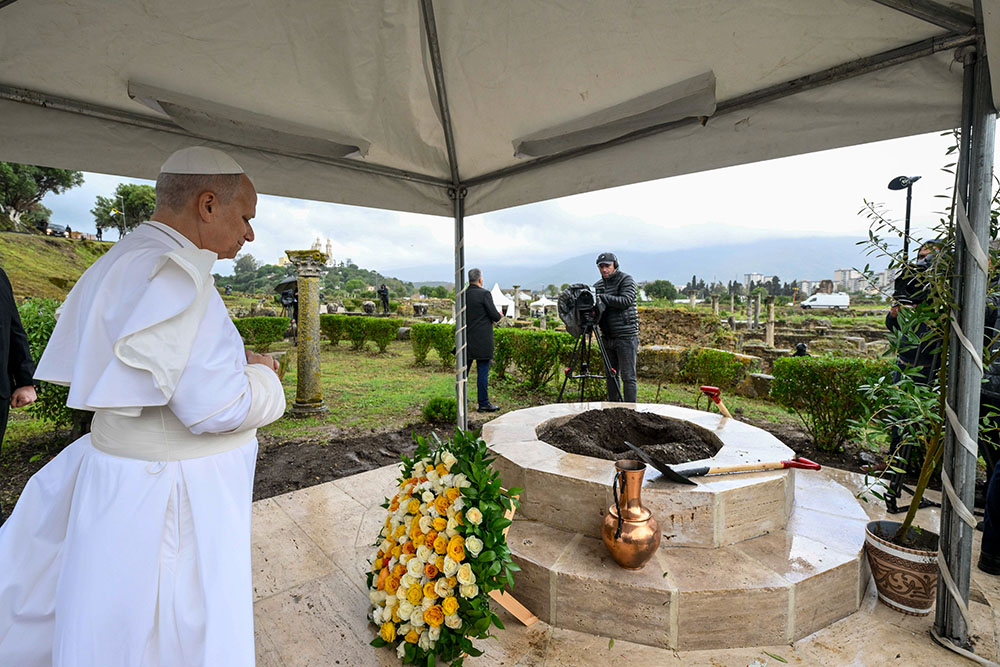
Pope Leo XIV prays as he visits the archaeological site of Hippo Regius, the city where St. Augustine was bishop in 395-430, in Annaba, Algeria, April 14, 2026. (OSV News/Vatican Media/Simone Risoluti)
Those who were unfamiliar with just war theory soon learned it was not about just war as in merely war, but just as in: Is it right?
When asked about this church doctrine Wednesday on PBS Newshour, Jesuit Fr. James Martin, editor at large of America magazine, said that it is "an ancient concept in the Catholic Church and in the Christian church more broadly that talks about the types of requirements that are needed for war to be considered just."
He also urged viewers to "go online and find" these requirements, pointing out that one of them is "there has to be a proportionate response that's usually in defense."
That same day on a panel on "CNN NewsNight" with Abby Phillip, Caroline Downey, a columnist for the National Review, said the pope risked confusing lay Catholics with his anti-war message and should be more precise.
"There is actual clarity from the Catholic Church on this" said Phillip, who quoted Bishop James Massa, chairman of the U.S. Conference of Catholic Bishops' Committee on Doctrine. Massa, auxiliary bishop of Brooklyn, New York, had issued a statement that day on just war theory.
So, if nothing else, this week proved that the church does have something to say in the public square and not just when taunted by a politician. Also, its modern-day message that started with Augustine has legs, from more than 1,500 years ago.
*Updates with Leo's remarks about how his quote about tryants during his Africa trip had ben misinterpreted.