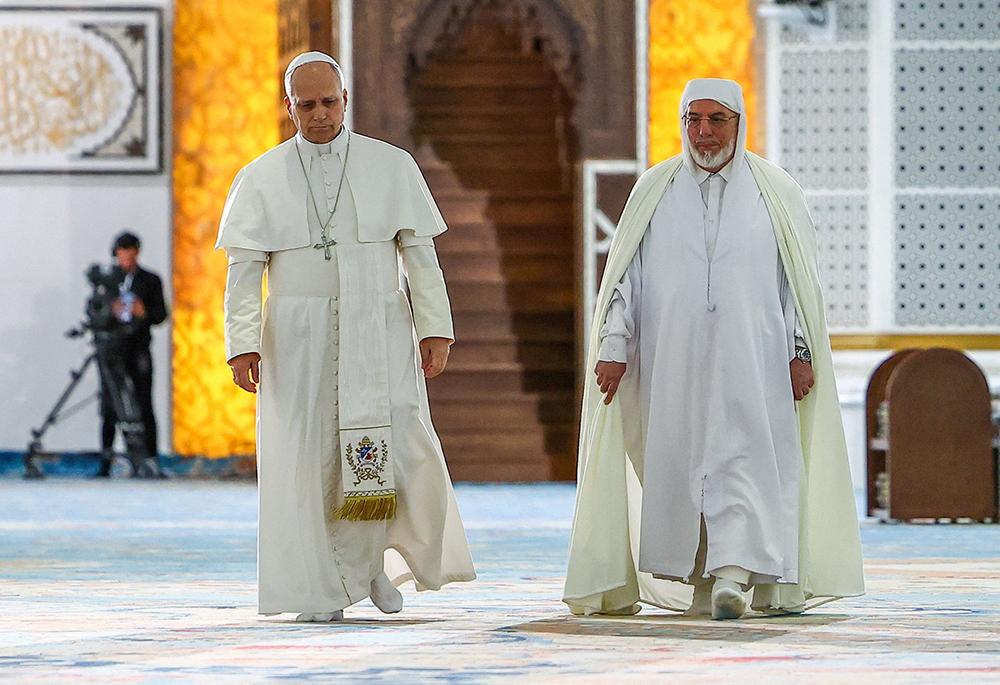
Pope Leo XIV and Rector of the Great Mosque of Algiers Mohamed Mamoun Al Qasimi during a visit to the Great Mosque of Algiers (Djamaa El Djazair), in Mohamadia, Algiers, Algeria, April 13, 2026. (OSV News/Reuters/Guglielmo Mangiapane)

Join the Conversation
Send your thoughts to Letters to the Editor. Learn more
Even before touching down in Algeria, Pope Leo XIV had already made headlines with his candid, airborne comments to reporters in response to an attack lodged against him by President Donald Trump on social media.
And immediately upon arrival, Leo stepped into uncharted territory for a pope, becoming the first leader of the Catholic Church to visit Algeria and bringing with him a message of reconciliation, justice and unity in the overwhelmingly Muslim-majority nation still reckoning with the wounds of its colonial past and the division of its decade-long civil war which ended in 2002.
The pope's arrival in Algiers on April 13 marked the first stop on his ambitious 11-day, four-nation tour of the African continent where he will pay homage to his spiritual father, St. Augustine, and turn his gaze toward the demographic future of the church in sub-Saharan Africa.
On the flight to Algiers, the pope told journalists that his trip to Algeria was the first international voyage he wanted to embark on as pope, proposing the prospect shortly after his election in May 2025. His two other previous trips, to Turkey and Lebanon and a one-day visit to Monaco, came in response to invitations issued to his predecessors, Popes Francis and Benedict XVI, respectively.
As head of the Augustinian religious order, Leo had already visited Algeria twice; the order maintains a small presence in Annaba, the site of ancient Hippo where Augustine was a bishop.
Though Leo's trip began in a country with a 99% Muslim population, his next stops will take him to Cameroon, Angola and Equatorial Guinea — Christian-majority nations with significant Catholic populations that increasingly make up a larger proportion of the global church.
In his first day, however, Leo advanced a stated objective of his trip to Algeria, to build "bridges between the Christian world and the Muslim world." He met with government officials, the capital's tiny Catholic community and visited the Great Mosque of Algiers – the world's largest after the mosques in Mecca and Medina with a capacity of 120,000 people.
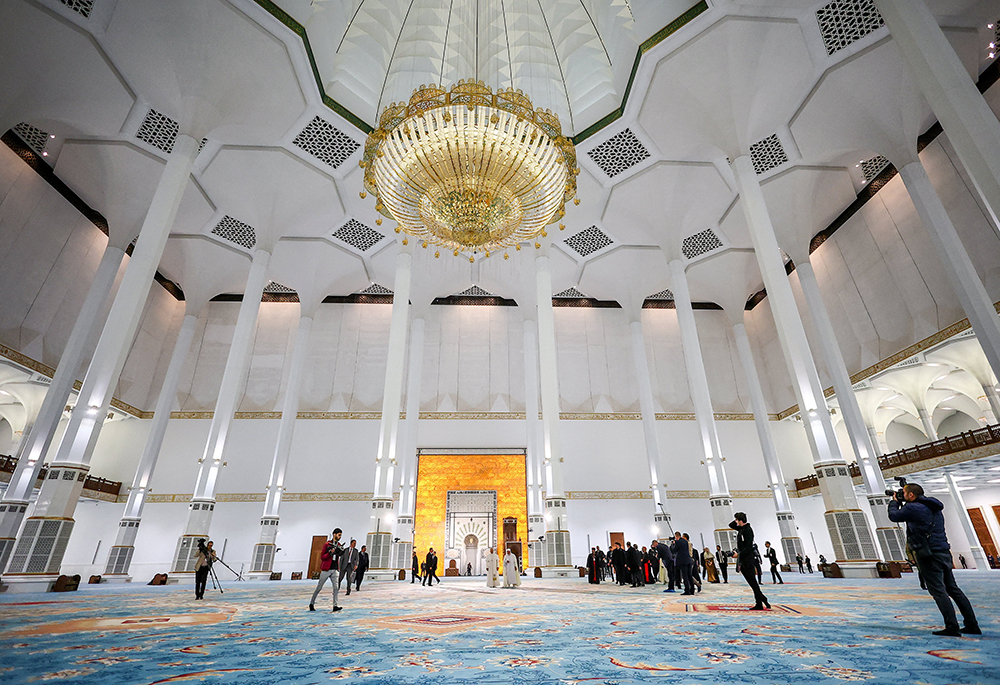
Pope Leo XIV walks with Mohamed Mamoun Al Qasimi, rector of the Great Mosque of Algiers in Algiers, Algeria, April 13, 2026. The pontiff visited the mosque, one of the largest in the world, in a gesture aimed at reinforcing Christian-Muslim dialogue. (OSV News/Reuters/Guglielmo Mangiapane)
This is not Leo's first visit to a mosque as pope, but it appeared to have been the first time he took a few moments to pray inside one.
Leo made headlines in December when during his visit to Istanbul's Blue Mosque his first visit to a mosque, because it was not visibly clear that he prayed inside, unlike his two immediate predecessors, Francis and Benedict XVI, each of whom had both publicly prayed there during their visits to Turkey.
On Monday (April 13), however, Leo stood in silence for more than 30 seconds before the mosque's qibla, the wall facing Mecca, alongside the mosque's rector Mohamed Mamoun Al Qasimi.
Advertisement
The sober moment came after the two walked around the mosque's sprawling interior in socks, as it is customary to remove one's shoes upon entering a mosque.
Leo and Al Qasimi then stood side by side in front of the nearby journalists, in what was a much more choreographed visit than the pope's mosque visit in Istanbul some four months ago.
Before that visit, the pope preached a message of justice and shared commitment for the common good in his meetings with government officials.
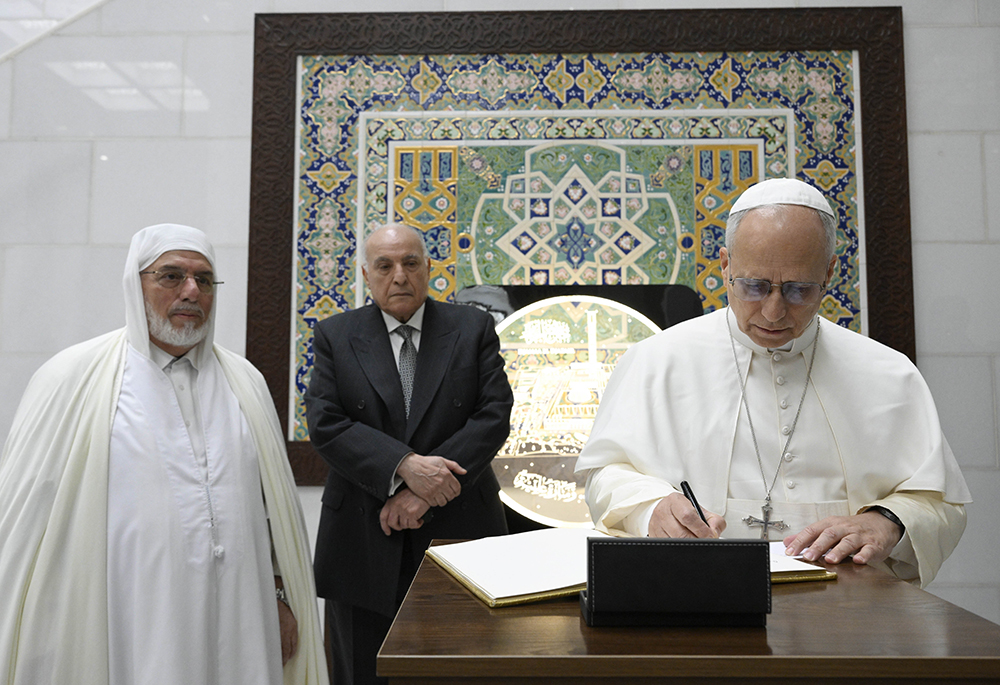
Pope Leo XIV signs a book, alongside Mohamed Mamoun Al Qasimi, rector of the Great Mosque of Algiers, as he visits the mosque in Algiers, Algeria, April 13, 2026. The pontiff visited the mosque, one of the largest in the world, in a gesture aimed at reinforcing Christian-Muslim dialogue. (OSV News/Vatican Media/Simone Risoluti)
Although Algeria's government is widely regarded as an authoritarian regime, Leo told government officials that "the true strength of a nation lies in the cooperation of everyone in pursuing the common good."
"Authorities are called not to dominate, but to serve the people and foster their development," he said at Algeria's presidential palace. "Political action thus finds its guiding criterion in justice, without which there can be no authentic peace, and is expressed in the promotion of fair and dignified conditions for all."
He urged leaders to pursue dialogue and allow themselves to be "moved by the pain of others," which he said is "more urgent than ever in the face of continuous violations of international law and neocolonial tendencies."
The pope told government officials that "the Catholic Church, too, through her communities and initiatives, wishes to contribute to the common good of Algeria."
The Algerian government and the church have had their fair share of tensions in recent years: The government shut down the church's local Caritas charitable organization in 2022 because it was considered a "foreign nongovernmental organization." French-born and Algerian-nationalized Cardinal Jean-Paul Vesco, who accompanied the pope throughout his day in Algiers, has been a key figure in smoothing over the church's relationship with the government.
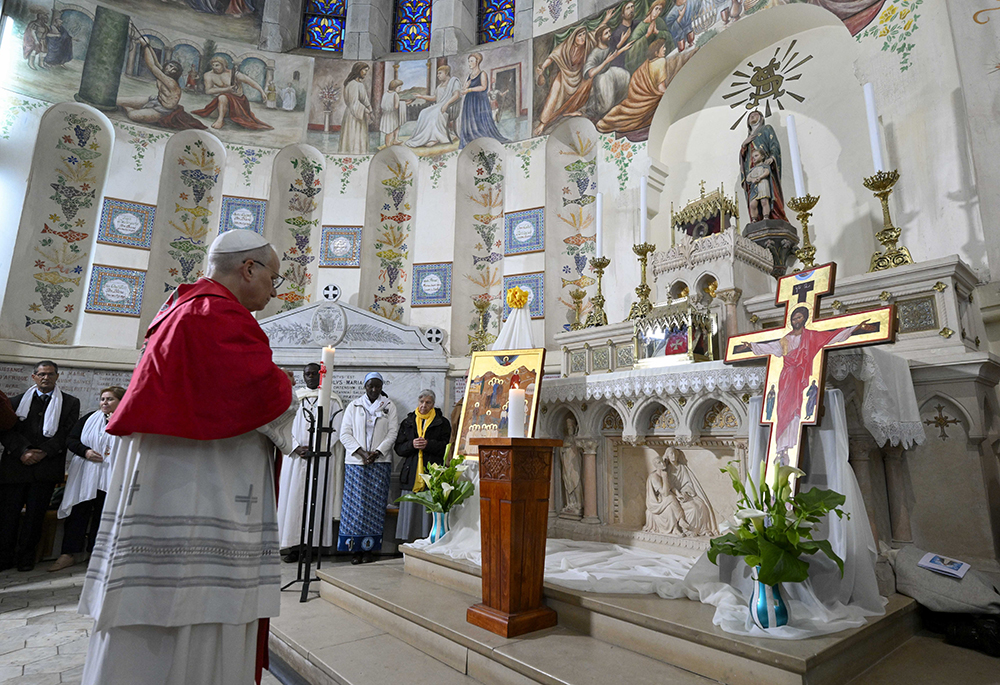
Pope Leo XIV prays during a meeting with the Algerian community at the Basilica of Our Lady of Africa in Algiers, Algeria, April 13, 2026. (OSV News/ Vatican Media/Simone Risolutie)
Although Algeria only has about 9,000 Catholics in a country of 46.7 million the pope received the red carpet treatment when he visited the Basilica of Our Lady of Africa, where an inscription in the church's apse asks Mary to "pray for us and for the Muslims."
In addressing the jubilant crowd, Leo recalled the 19 Catholic martyrs who were killed in Algeria's civil war while serving Christian and Muslim communities.
"In the face of hatred and violence, they remained faithful to charity even to the point of sacrificing themselves alongside many other men and women, Christians and Muslims," the pope said.
"Peace and harmony have been fundamental characteristics of the Christian community from its very beginnings," he continued. "Faith does not isolate, but opens us up; it unites us, but does not create confusion; it brings us closer, without homogenizing, and fosters true fraternity."
The National Catholic Reporter's Rome Bureau is made possible in part by the generosity of Joan and Bob McGrath.