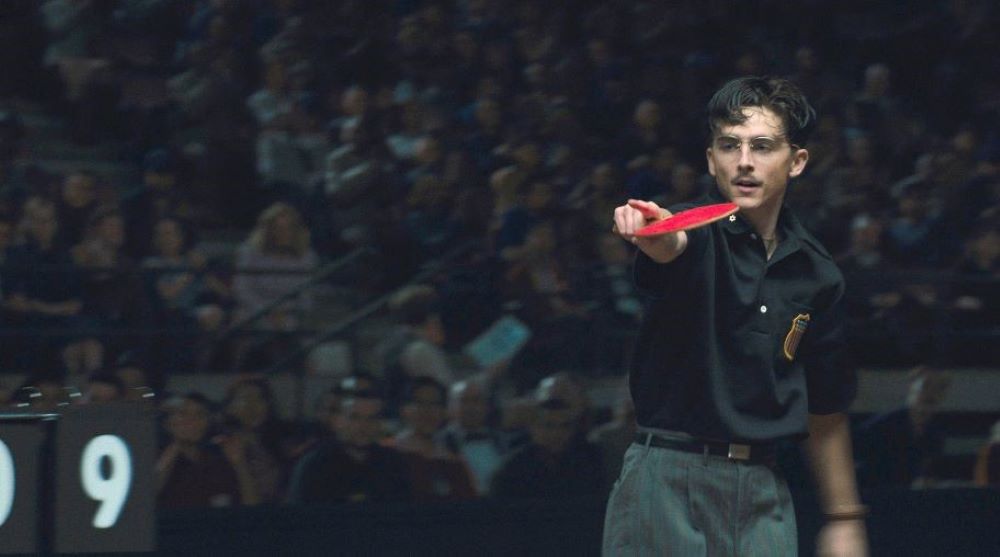
Timothée Chalamet stars in a scene from the movie "Marty Supreme." The movie has been nominated for nine Oscars, including three for Chalamet. (OSV News/A24)

by Jean P. Kelly
Join the Conversation
Send your thoughts to Letters to the Editor. Learn more
In a key scene of the frenetic, nine-time Oscar nominated "Marty Supreme," the titular character — played with combustible intensity by Best Actor nominee Timothée Chalamet — abandons his pregnant girlfriend with this rationalization: "I have an obligation to see a very specific thing through. And with that obligation comes sacrifice, OK? My life is the product of all the choices I've had to make."
That last kernel of truth — and Chalamet's electric embodiment of a hopelessly flawed antihero chasing international table tennis glory — hints at a moral depth far beyond typical sports-comedy clichés. The film's central tension, ping-ponging viewers through 150 minutes of Marty's self-sabotaging schemes, venial close calls, narrow escapes, humiliating defeats and almost-victories, rests on two questions: Will Marty Mauser, a working-class Jewish shoe salesman on Manhattan's Lower East Side in the 1950s, stop at nothing to win fame, security and respect? And will it consume the preternaturally promising paddler and everyone he loves?
Amid Marty's lies, hustles, infidelities and callow performativity is the core of Catholic teaching: Redemption is not reserved for the pious nor perfect. Chalamet's ability to surface charm, vulnerability and humanity in such an "unredeemable" character is, in my view, Oscar-worthy.
(The 98th Academy Awards show will be broadcast live on ABC and Hulu March 15.)
The movie's mixed reviews are understandable. Marty is not easy to love. He lies and gaslights as naturally as he wields a paddle. But he backs his braggadocio with brilliance — talent, discipline and daring. Thanks to a production design that immerses him in a seamy, teeming postwar milieu governed by "every man for himself," we understand how his moral compass went awry. His mother (Fran Drescher) fakes illness for sympathy; his married girlfriend fabricates domestic abuse; his uncle-boss promotes him, then withholds his pay, then bribes cops to arrest him in the low-rent rooming house where they all live. No wonder this silver-tongued operator — loosely based on real table-tennis hustler Marty Reisman — spends the film either shaking down friends or shaking off family who begrudge his success. To finance tournament fees and flights to London and Tokyo, Marty needs more than a killer backhand. He needs chutzpah.
This protagonist is cut from the same cloth as the unstoppable strivers in directors Josh and Benny Safdie's "Uncut Gems" and "Good Time." But in Josh Safdie's solo debut, the lead character is almost likable, careening from one high-energy, nail-biting sequence to the next, always teetering on the brink of serious immorality but never tumbling to the depths of depravity. More than once Marty, who always wears a Star of David necklace, resists theft when encountering wads of cash, insisting only on what he is owed (including a $2-and-change refund after falling through a cheap hotel floor). He holds a gun and dodges bullets but never fires. He refuses to throw an exhibition match sponsored by a fellow hustler (Kevin O'Leary), always cops to his lies, and remains, as one character puts it, "a f***ing mensch" — the kind of guy who chisels a chunk of the Great Pyramid to bring home to his mother.
While sin may grease Marty's progress, none of his offenses go unpunished. Every bad decision yields a bad consequence, culminating in a humiliating, bare-skinned paddling by O'Leary’s smarmy character.
Yet as the little guy with little to lose, Marty speaks truth to power. He demands better hotel accommodation for players from elitist tournament officials, shames an overconfident bully in a ping-pong hustle, and calls out his slimy sponsor. "Nah," he says when dismissed from a lunch meeting. "I think you owe me a meal first."
Advertisement
That I found myself rooting for this dissolute megalomaniac — praying that consequences might correct rather than crush him — is a testament to Chalamet's performance. The actor himself has been criticized for unapologetic ambition, including last year's SAG Awards acceptance speech (for playing Bob Dylan in "The Complete Unknown") in which he declared, "I want to be one of the greats." It's a bold thing to say in a room full of decorated actors and raised more than a few eyebrows, but at just 30, the French American star can back it up: With "Marty Supreme" he became the youngest male actor to earn three Oscar nominations.
Like Marty, Chalamet's dedication to his craft is unmistakable. Rattling off a breathtaking number of lines, he dominates nearly every scene opposite a quirky ensemble, including veteran stars Drescher and Gwyneth Paltrow. His androgynous beauty disappears beneath acne scars, a scratched chin, and a crooked upper lip that twitches — his tell — when not curled in a charming smirk.
For this role, Chalamet spent six years training in period-specific table tennis techniques, even spraining an ankle in the process. That commitment makes the tournament sequences unexpectedly riveting. A dancer's athleticism allows him to perform all the sports choreography himself: swaying, jittering and bouncing before serve; leaping to make overhead smashes; lunging far behind the table to return backspin; and crumpling down the centerline after grueling points. It's no wonder the game once relegated to basement rec rooms is enjoying a resurgence.
Whether audiences buy Marty's late-stage conversion is immaterial. The film's hope-filled conclusion reflects an essential spiritual truth: Even the worst sinner — the dishonest, the proud, the selfish — can be redeemed. Toxic self-confidence may consume, but it need not condemn. Not Marty Supreme, and not Timothée Chalamet.