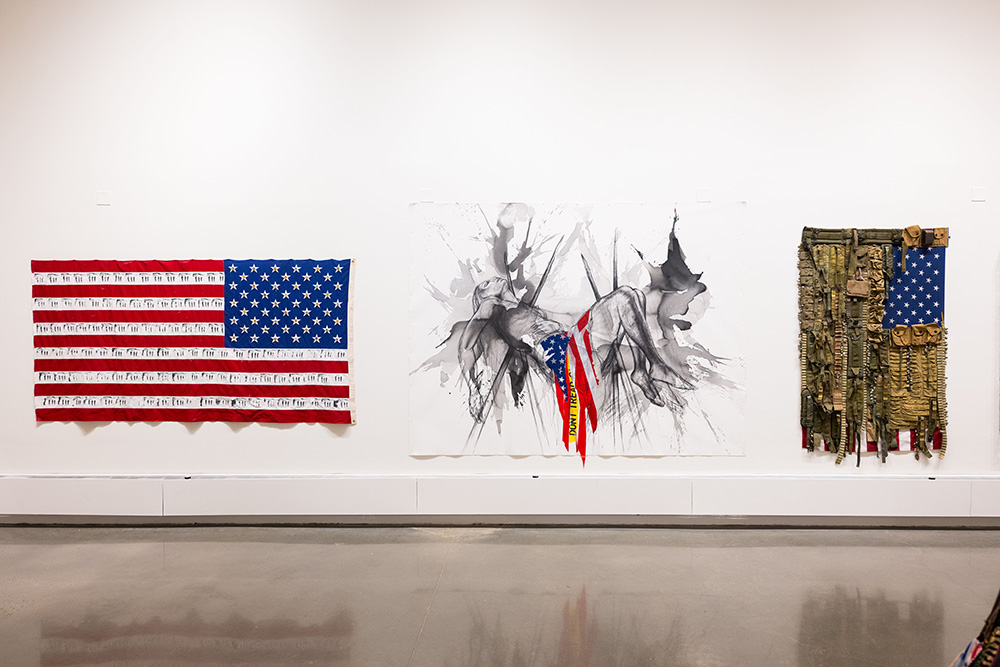
The Fairfield University Art Museum exhibition "For Which It Stands" includes these works at the university's Walsh Gallery. (Left): Danielle Scott, False Flag, 2020, photo transfer and found objects (shotgun shells) on US flag. Courtesy of the artist. © Danielle Scott. (Center): Imo Nse Imeh, and i'll be there with you, 2021, charcoal, India ink and conte crayon on unstretched canvas. Courtesy of the artist. © Imo Nse Imeh. (Right): Sara Rahbar, I don't trust you anymore, Flag #59, 2019, mixed media, collected vintage objects, on vintage US flag. Courtesy of the artist. © Sara Rahbar. Photo: Joe Adams for Fairfield University.

Join the Conversation
Send your thoughts to Letters to the Editor. Learn more
It is revered and iconic — a symbol of hope, pride and glory for many, but a symbol of deferred and unfulfilled dreams for others.
The American flag — Old Glory, the Stars and Stripes, the banner spangled by the classic colors of red, white and blue — means different things to different people, serving as a kind of Rorschach test for what it means to be an American.
That might be especially true as the United States commemorates its semiquincentennial, or 250th anniversary, this weekend. And it serves as a guiding principle of the exhibition "For Which It Stands … " which opened in January and continues through July 25 at two exhibit spaces at Fairfield University in Fairfield, Conn.
The wide diversity of artistic reactions to the American flag — through painting, photography, print, video and mixed media, among others — affirms the Jesuit institution's commitment to the value of intellectual inquiry, said Fairfield University Art Museum director and exhibition curator Carey Mack Weber. And, when necessary, "to question and to highlight injustice, making the exhibition a space for difficult conversations."
"For Which It Stands ...," Weber hopes, "is an opportunity for all of us to examine the narratives that have shaped our country, particularly those that have been overlooked or challenged."
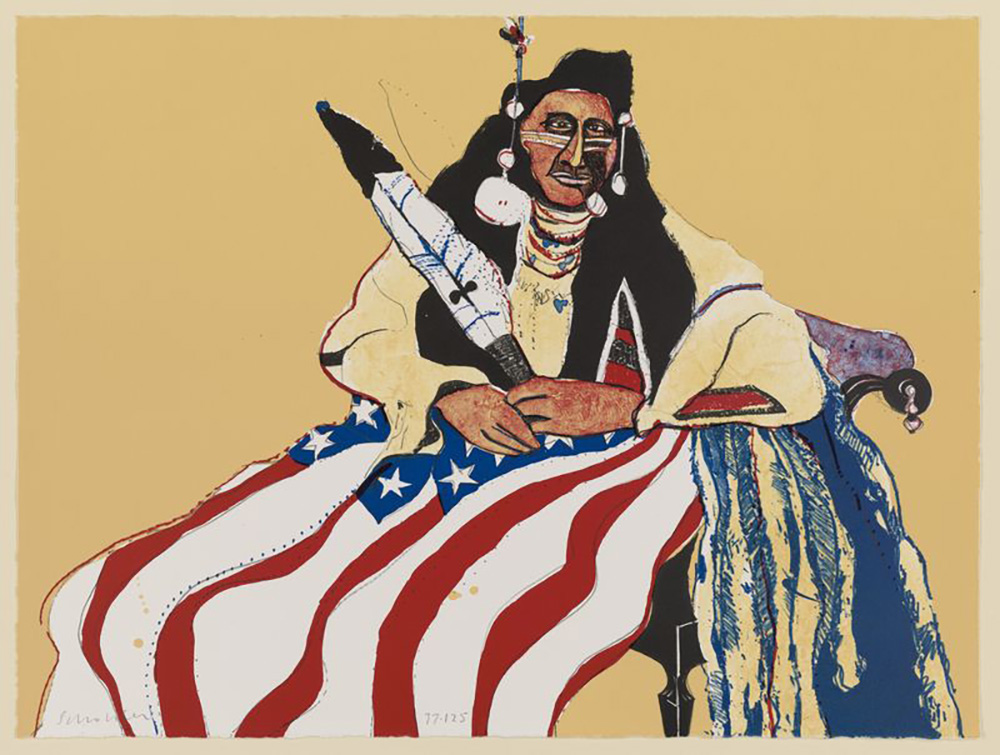
Fritz Scholder, Bicentennial Indian, from the Kent Bicentennial Portfolio: Spirit of Independence, 1974, color lithograph. © Fritz Scholder. Courtesy the estate of the artist and Garth Greenan Gallery, New York, New York. Yale University Art Gallery. Gift of the Lorillard Company
Affirming the Jesuit tradition of intellectual exploration, Fairfield's president, Mark Nemec, said in a preface in the exhibition catalog, "Far beyond a singular painting, each work in this exhibition stands on its own, but just as importantly they stand as a collective, reflecting a spirit of inquiry and rigor and asking us to engage thoughtfully with the American experiment."
With art that explores both patriotism and protest, "For Which It Stands … " highlights the diverse ways Americans embrace the flag.
"I know that the flag means different things to different people," Weber said. "We are not asking people to agree on what the flag means, as that is very personal. But through this exhibition, to question whether America has always lived up to what the flag represents, 'E Pluribus Unum.' Out of many, one."
While guiding a visitor through the 74-piece exhibit, the first part of which is at the university's Bellarmine Hall Galleries, Weber noted that massive street protests now greeting the administration of President Donald Trump indicate "there's been a real effort to reclaim the flag."
Advertisement
"It's everyone's flag," she said, something affirmed in photographs from an earlier era that show street demonstrations during the Vietnam War, with both anti-war protesters and war supporters employing the flag.
Talking about democracy
"I wanted to show people things they hadn't seen before," Weber said, hoping that the diversity of art will not only commemorate the signing of the Declaration of Independence but prompt people to talk about "our democracy, and to start thinking about the next 250 years."
The exhibition is not short on well-known images, like Joe Rosenthal's classic 1945 photograph "Raising the Flag on Iwo Jima" or Keith Mayerson's 2012 oil painting "First Men on the Moon," depicting American astronauts planting the Stars and Stripes on the moon's surface. Another retains its power to disturb: Stanley Joseph Forman's 1976 photograph "The Soiling of Old Glory," which shows a white protester attacking a Black man during the violent mid-'70s protests against school integration in Boston.
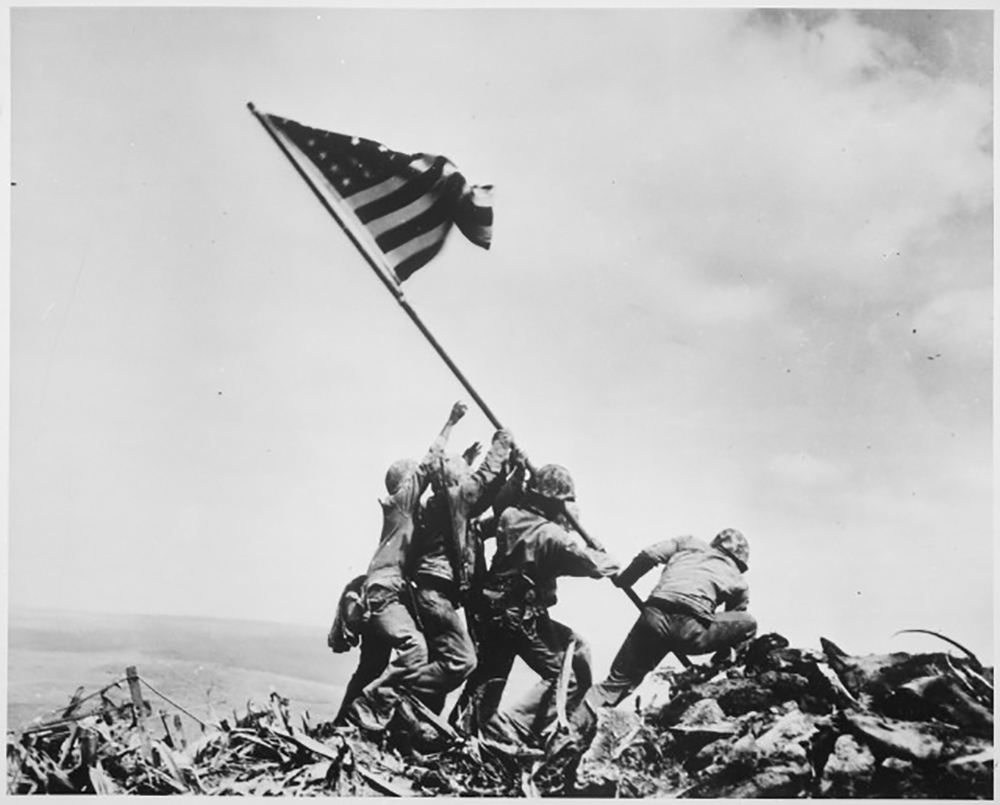
Joe Rosenthal, Raising the Flag on Iwo Jima, 1945, gelatin silver print. Lent by the Estate of Hanns & Patricia Kohl. © Joe Rosenthal
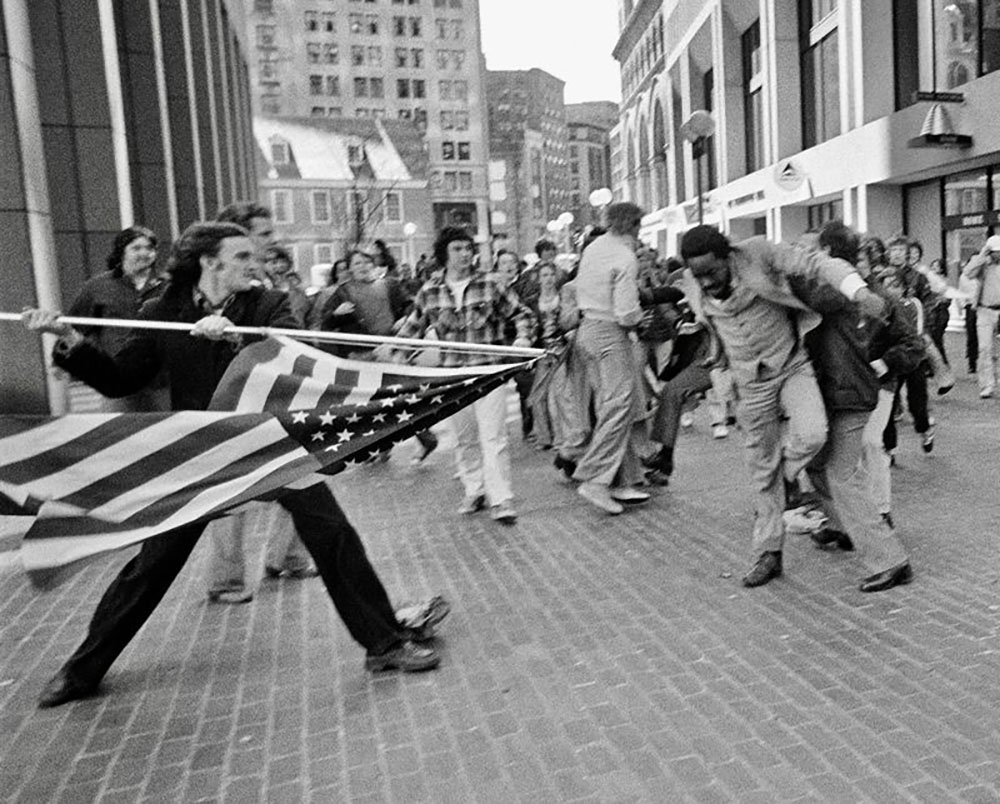
Stanley Joseph Forman, The Soiling of Old Glory, photographed 1976, printed in 1982, gelatin silver print. Fairfield University Art Museum, Museum purchase, 2024. © Stanley Forman
The exhibition is also not short of work by well-known figures like Jasper Johns (an early pioneer in using flag imagery), Gordon Parks, Faith Ringgold and Robert Rauschenberg.
Still, much of what is on display will be new to viewers.
Two such pieces that demonstrate quite different takes on the flag are Robert Lynn Lambdin's "Heroes of World War II," which dates from 1958, and an untitled 1993 painting by Jane Hammond.
Lambdin's work, from a collection of the Bridgeport (Connecticut) Public Library, seems on first viewing a standard patriotic evocation of military heroes. But as Weber notes, the painting contains potentially disturbing elements, including suggestions of shell shock and a background that hints at an unsettled, ongoing war.
As for Hammond's arresting large canvas dominated by florid red, Weber suggests the busy images and a flag resembling a musical staff rather than the traditional Stars and Stripes may be a commentary on the ubiquity of American popular culture.
![Robert Lynn Lambdin, [Heroes of World War II], 1958, oil on canvas. Bridgeport Public Library Collections](/files/2026-07/heroesWW2%20RESIZE.jpg)
Robert Lynn Lambdin, [Heroes of World War II], 1958, oil on canvas. Bridgeport Public Library Collections
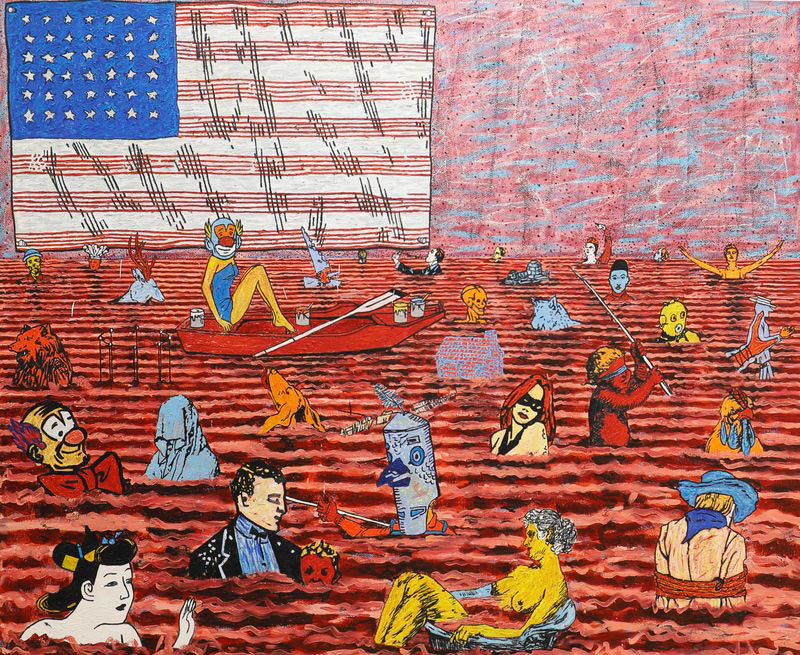
Jane Hammond, Untitled (28, 157, 272, 179, 64, 95, 45, 244, 247, 109, 146, 185, 9, 234, 207), 1993, Oil on canvas with metal leaf. Collection of the Orlando Museum of Art. Purchased with funds provided by the Acquisition Trust. © Jane Hammond, Courtesy Galerie Lelong
More critical images sadden some
Based on the curator's tours she has given since January, Weber said viewers have largely embraced the exhibition's diversity, though some museum visitors do not uniformly like some of the images. (There is at least one image of a flag burning.)
One viewer, she said, said the exhibition saddened her. "It made her look at America's shortcomings, and I guess she didn't like that."
While a clear theme of the exhibit is the way the flag has been used to undergird American "civil religion," there are occasional nods to the intersection of religious faith and patriotism.
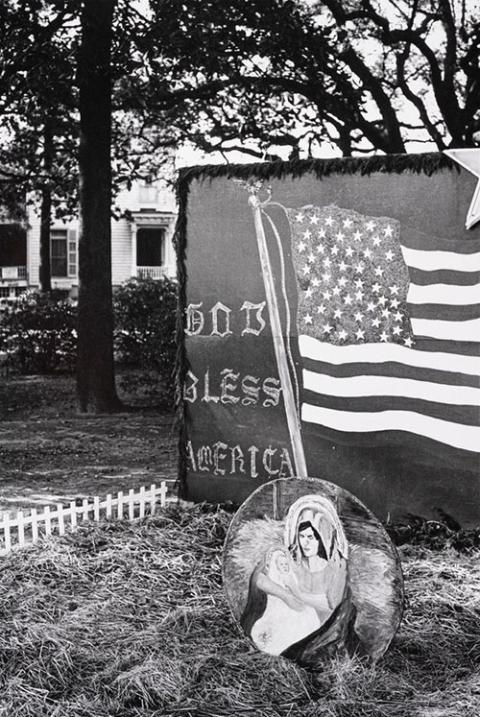
Leonard Freed, God Bless America — sign in private garden in South Carolina, 1964, gelatin silver print. Fairfield University Art Museum, Gift of anonymous benefactors, 2025 (2025.35.95) © Leonard Freed / Magnum Photos.
For example, a 1964 photograph by Leonard Freed titled "God Bless America — sign in private garden in South Carolina," shows a flag in a South Carolina garden adjoining an image of the Virgin Mary cradling the baby Jesus.
Lydia Willsky-Ciollo, who teaches religious studies at the university, wrote an accompanying caption for the image. She notes that the photograph was taken at the height of the Cold War and came a decade after the words "under God" were added to the Pledge of Allegiance.
Freed's work, she said, "reveals the burgeoning ideology known as Christian republicanism, or the belief that the founding documents of the United States were Christian in origin and that the Founding Fathers had never intended a 'wall of separation' between church and state."
Willsky-Ciollo adds: "The flag appears to grow directly out of the image of Jesus Christ being cradled in the arms of the Virgin Mary. And so, in this particular understanding of the United States, not only does God bless America, but God created America and baptized it Christian."
If that image and reflection have particular resonance today amid debates about the role of religion in public life, so too do a number of works concerned with immigration and the question of American identity.
Among these are Puerto Rican artist Frank Diaz Escalet's print "Mojados" depicting the toil of undocumented immigrants trying to enter the United States from Mexico, and Indigenous artist Fritz Scholder's "Bicentennial Indian," a 1974 lithograph portraying the dual nature of American and Native American identities.
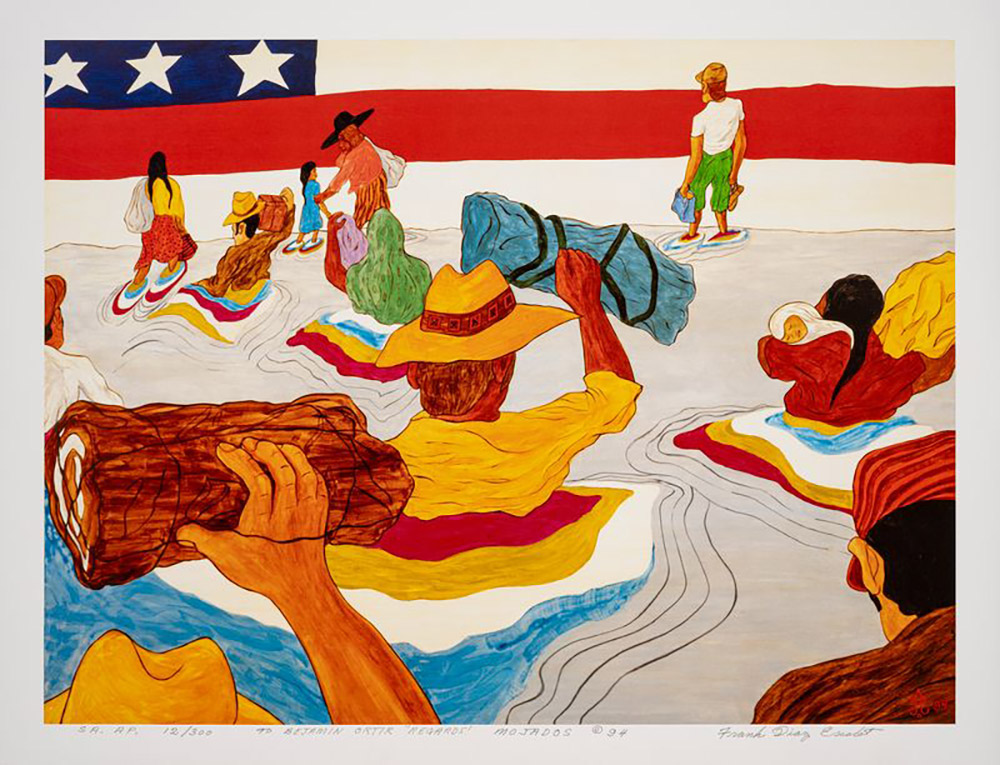
Frank Diaz Escalet, Mojados, 1994, color offset print. Fairfield University Art Museum, Gift of Ben Ortiz and Victor Torchia, Jr., 2024, 2024.34.03. © Frank Diaz Escalet
Much of the recent art dealing with immigration and other topical themes is in the exhibition's second space, the Walsh Gallery, where viewers are asked to provide their reactions to the exhibition on Post it-notes.
Among them:
"Proud. Sad. Hopeful."
"Proud to be MAGA." (With a nearby reaction: "Ashamed!")
"How lucky to be born American."
"Proud of the diversity."
"I am grateful"
Weber is encouraged by the honesty of the reactions, something she sought.
In the initial announcement of the exhibit, Weber said that visitors were being asked "to engage deeply with the pressing issues of justice, representation, and unity — issues that are as relevant today as they were when our nation was founded."
Fairfield University Art Museum's "For Which It Stands ..." runs through July 25 at two exhibit spaces on the university campus. An online tour of the exhibition can be viewed here.