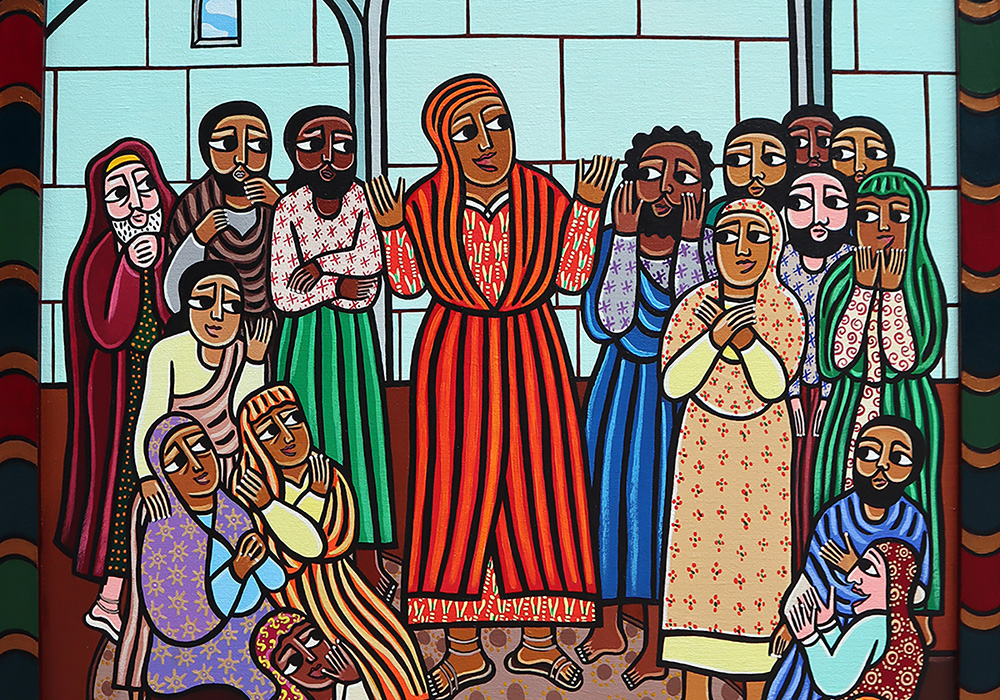
Close-up of "Mary Magdalene Proclaims Resurrection," by Laura James; a full view is below. (Laura James)

by Jim McDermott
Join the Conversation
Send your thoughts to Letters to the Editor. Learn more
New York City is known for its great museums and exceptional art shows. But right now a powerful exhibit depicting the Resurrection from the point of view of Mary Magdalene is on display not at any of the city's great galleries, but in a Catholic girls school.
The show, "Stations of the Resurrection," is the brainchild of FutureChurch board member Rita Houlihan, a former management consultant whose life was changed on a pilgrimage to Rome that followed in the footsteps of early Christian women.
"I had my jaw on the ground the whole trip, seeing women in the catacombs teaching, women at funerary banquets presiding, the sarcophagi of women from the fourth and fifth century who wanted to preserve their image as teachers," Houlihan told the National Catholic Reporter. "It was just unbelievable."
Houlihan decided to bring her management skills to bear on the issue of women in the church.
"As an organizational consultant, I knew that to have an effect when you're confronting an institutional wall, you need to look for the thing that's going to be pivotal," she said, "something where you're also going to have the possibility of ripple effects immediately as well as long term."
Advertisement
Mary Magdalene fit the remit: Though she was the first disciple Jesus revealed himself to after the Resurrection, the church later rewrote her into what Houlihan described as a "hypersexualized" penitent prostitute, erasing her actual significance.
With the help of Scripture scholar Carolyn Osiek of the Society of the Sacred Heart, Houlihan set out to become an expert in Mary Magdalene. "I took it like an assignment, like I'm getting a master's in Mary Magdalene," she said.
But over time she noticed that talking about Mary Magdalene to Catholics only moved the needle so far. "I could see people's eyes glazing over," she said. She realized that she needed a different medium: "If I could get this translated into art that is appealing and accessible, that would make a difference."
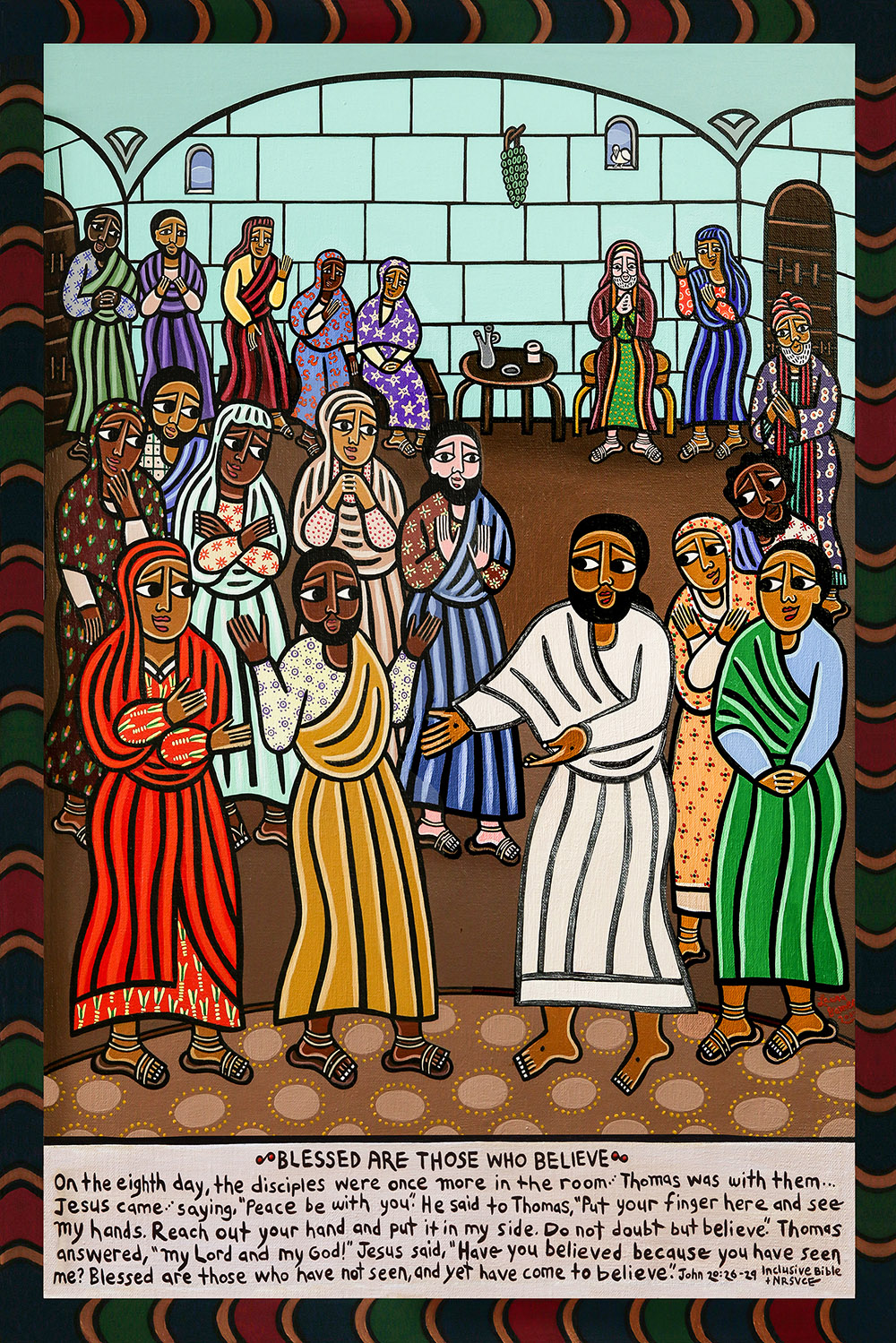
"Blessed Are Those Who Believe," by Laura James (Laura James)
Houlihan began commissioning artists to do work about Mary Magdalene. Among them was Brooklyn native Laura James, who grew up in the Brethren, an evangelical Christian community. The Brethren actually "frowned on having pictures of biblical things," James recalled. "On the walls we had Bible verses framed."
But they did give the youth children's Bibles filled with pictures from Scripture, and those images had key things in common: "Jesus was always white with blond hair and very, very blue eyes. He didn't even look like his mother," James said, noting that Mary was usually given a more Middle Eastern cast. "He kind of looked like a superhero, which, I don't know, maybe was the point."
Meanwhile, said James, "The Black people were servants, they were very weirdly colored — they were gray."
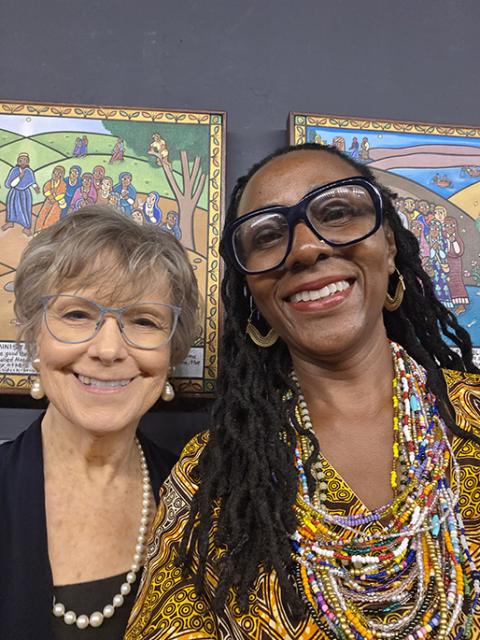
Rita Houlihan, left, and Laura James pose for a photo. (Courtesy of Laura James)
As a teenager, James came upon a book on the Ethiopian magic scrolls, Christian iconographic art of Ethiopia in which angels and other figures were represented as Black Ethiopians. For James, whose family came from Antigua, the difference was attractive. She set out to paint in that style herself.
"The Bible was full of endless stories to paint," she said. And after years spent in church hearing and reading them multiple days a week, "I knew these stories."
Eventually, Liturgy Training Publications found James' work online and commissioned her to do 24 illustrations for a new Book of the Gospels. Houlihan saw James' work and thought it would be perfect for her own parish community.
"I'm in a very mixed parish, lots of Dominicans, Puerto Ricans, Ecuadorians, Mexicans," explained Houlihan. "They all have sodalities and spiritual groups, and I knew their literature was not covering Mary Magdalene. I wanted to have an ethnically rich portrayal."
Houlihan hired James to do a set of four images representing John 20:11-18, in which Mary Magdalene meets the resurrected Jesus and is sent to the disciples to let them know he had risen. Each year on Easter Sunday we hear the beginning of John 20, in which Mary discovers the empty tomb and brings Peter and the beloved disciple to see it. But the following Sunday skips the story of Mary Magdalene's subsequent meeting with Jesus and commission to go to the other disciples. Since 2015 Houlihan had been petitioning the Vatican to include the excluded passage on Easter Sunday, as well as to elevate her to a solemnity.
The four images that James created are: Mary Magdalene meeting Jesus outside the tomb, Mary Magdalene proclaiming the news of Jesus' resurrection to the disciples, Jesus appearing in their midst and sending them forth on Pentecost, and Jesus showing his wounds to Thomas. The art is extraordinary both for the vibrancy with which James depicts the scenes and for the way it changes our understanding of those events.
Rather than simply a follower of Jesus who was first to discover the empty tomb, as we normally hear at Easter, Mary Magdalene truly becomes, as the Vatican named her in 2016, "the apostle to the apostles."
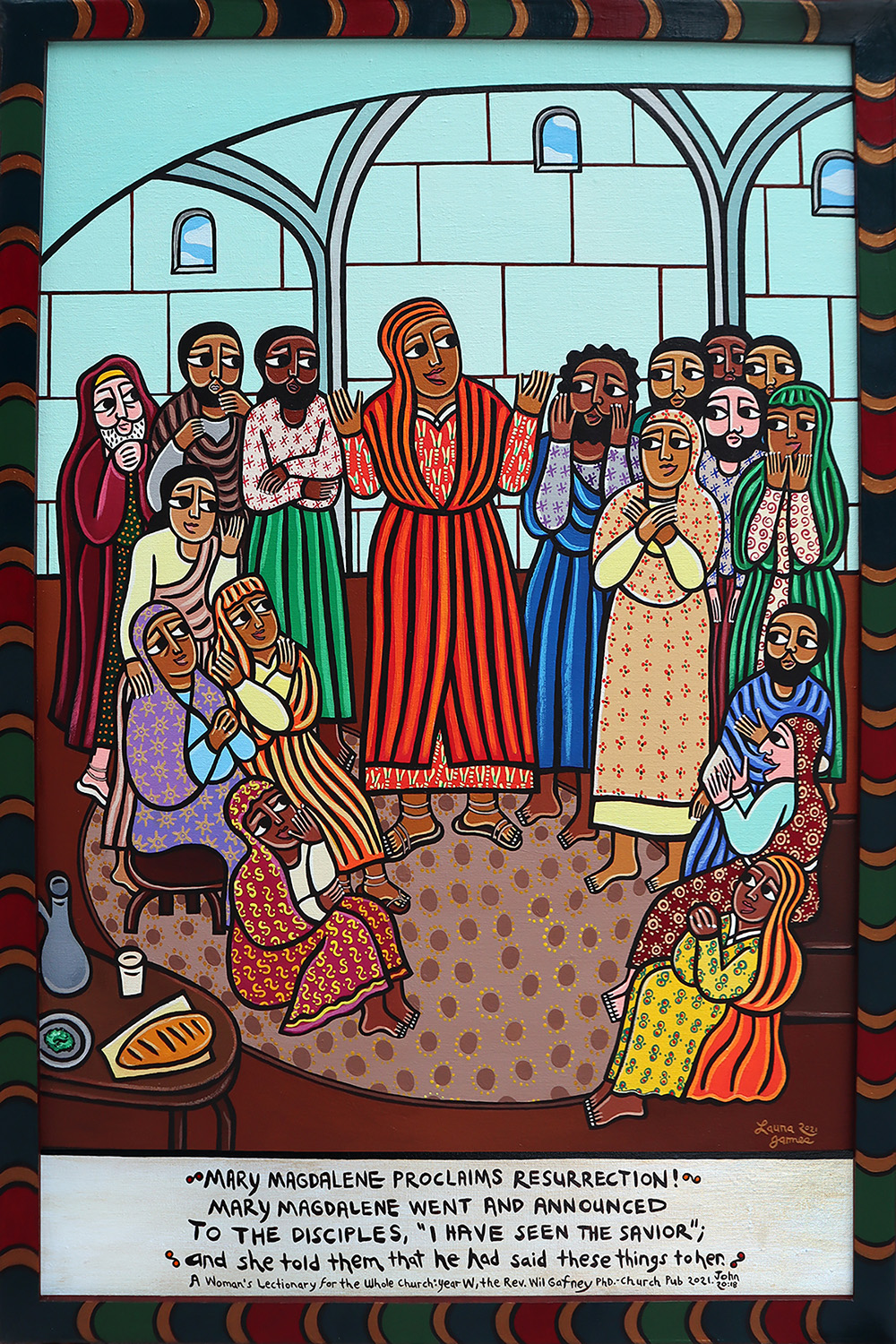
"Mary Magdalene Proclaims Resurrection" by Laura James (Laura James)
Houlihan had James' work turned into prints and postcards so that Catholics throughout the world could see them and put them in their churches, schools and homes. And after a successful show at New York's Sheen Center in 2021, she commissioned six more paintings from James to tell the full story of Mary Magdalene's journey in John 20. The full set has been on display this spring at the Cornelia Connelly Center, a full scholarship Catholic grade school for girls on the Lower East Side.
Executive director Shalonda Neeley Gutierrez has marveled at the effect the paintings have had on her students.
"Christ, his disciples and our faith in general are rarely represented in a way that represents our community," she explained. To see Jesus, Mary Magdalene and the disciples represented as people of color and discover so many women amongst the disciples "has been a transformative experience," she said. "It has helped our students to see themselves."
To see Jesus, Mary Magdalene and the disciples represented as people of color and discover so many women amongst the disciples "has been a transformative experience," [executive director Shalonda Neeley Gutierrez] said. "It has helped our students to see themselves."
"It reminds them of who they are and what we aspire to, what Jesus represents, love in action and faith in action. It's just been really beautiful," she said.
James has found Houlihan's commission personally meaningful as well. "I want people to see themselves in these stories," she said. "We are all part of the beloved community. We are all there. We can all participate, and we have to. We have to all get together for anything good to happen."
Houlihan continues to press the church to embrace the true story of Mary Magdalene and with it the place of women in the community.
"Mary Magdalene was the focus of a lot of the pagan philosophers who criticized early Christians," she explained. " 'You believe your leader was raised from the dead at the testimony of a hysterical woman? What kind of men are you?' " they asked. "And by the sixth century men are no longer taking direction from women. It's really egregious."
In the final portrait of the series painted by James, the community of disciples watch as Jesus shows Thomas his wounds. While Thomas seems to recoil, Jesus' arms are extended not simply in a gesture of display but as an offer of embrace. It's a fitting image for this point in time: the church feeling fearful to give itself over to the truth of its history, and yet Jesus' offer of love persisting.
And rather than abandoning Thomas, Mary Magdalene stands at his side with love in her eyes, encouraging him to receive the Lord.