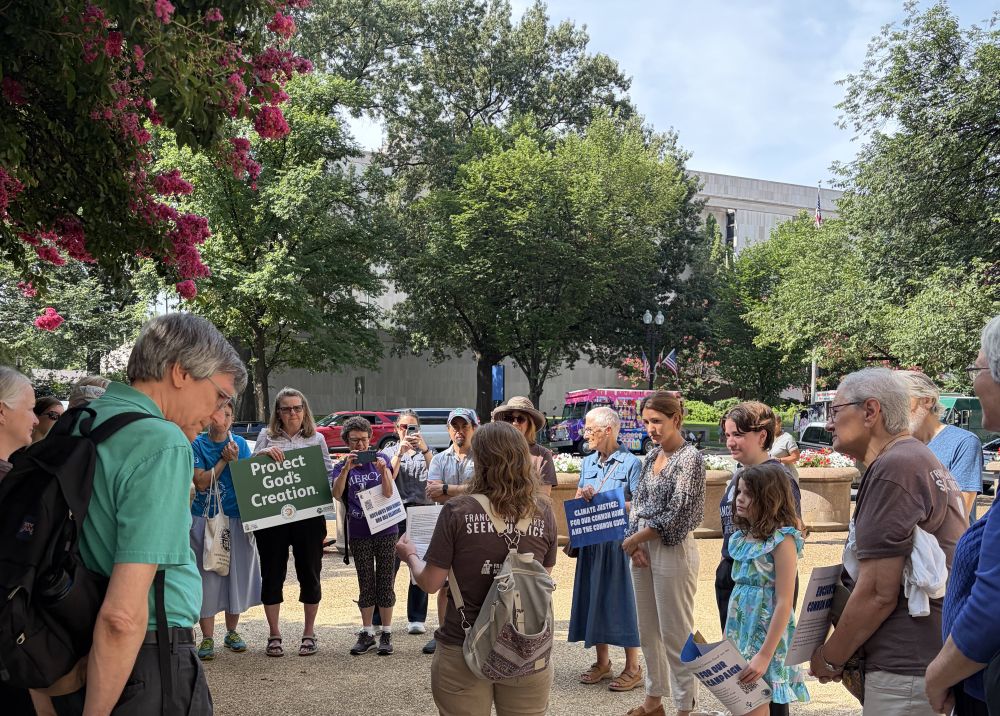
Approximately two dozen Catholics held a prayer service July 24 outside headquarters for the U.S. Environmental Protection Agency in Washington, D.C. The gathering was intended to protest actions taken by the agency under the Trump administration that Catholics say devalue human life and the environment. (Catholic Climate Covenant)

Join the Conversation
Send your thoughts to Letters to the Editor. Learn more
Along Constitution Avenue in Washington, roughly two dozen Catholics gathered a week ago for a prayer service outside the headquarters of the U.S. Environmental Protection Agency.
Over the course of an hour, the small group sought God's intervention to reroute the federal agency that under the second Trump administration they say has devalued human life and God's creation and abandoned its guiding charter to safeguard public health and the environment.
"Today we urge the Environmental Protection Agency to remember its mission, to do its job of protecting the environment and vulnerable people," Franciscan Sr. Marie Lucey, associate director of Franciscan Action Network, said during the service.
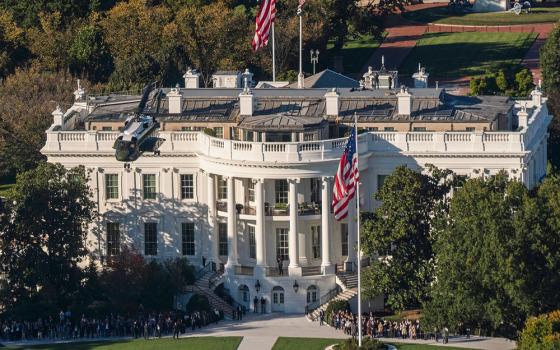
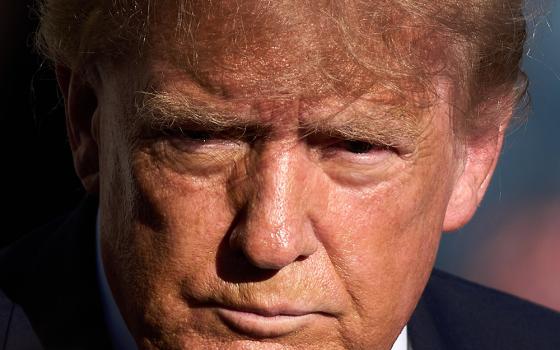
The public prayer outside the EPA, held July 24 and organized by Catholic Climate Covenant, comes nearly 18 months after Donald Trump returned to the White House. During that time, his administration has undertaken a dramatic, sweeping deregulatory campaign of the nation's pollution controls, environmental protections and climate regulations. Leading those efforts has been EPA Administrator Lee Zeldin, a former New York congressional representative.
"We are driving a dagger straight into the heart of the climate change religion," Zeldin said in March 2025, drawing wide rebukes from faith leaders, as EPA announced 31 public health and environmental regulations it targeted to eliminate or significantly scale back.
In addition to the prayer service, Catholics delivered a letter with more than 2,440 signatures, including from one bishop and 506 women religious, outlining EPA actions they viewed as "deeply concerning" and urging Zeldin to change course.
Among them was EPA's move in February to repeal the agency's 2009 "endangerment finding" that concluded greenhouse gas emissions — the main driver of climate change released primarily from burning coal, oil and gas — are a danger to public health and welfare. That determination, grounded in extensive scientific study, has formed the backbone of federal climate regulations for nearly two decades.
The Catholic groups also highlighted a decision by EPA in January to no longer calculate an economic value for lives saved from limits on fine particulate matter (PM 2.5 or soot) and ozone pollution, essentially placing it at zero dollars.
"Our dismay is doubled when only the costs to companies of complying with pollution regulations and not the considerable health benefits of regulations are part of how we calculate the impact of regulating air pollution," the letter stated.
"As people of faith, we find the devaluing of human life and creation — created by God and entrusted to the care of humankind — egregious."
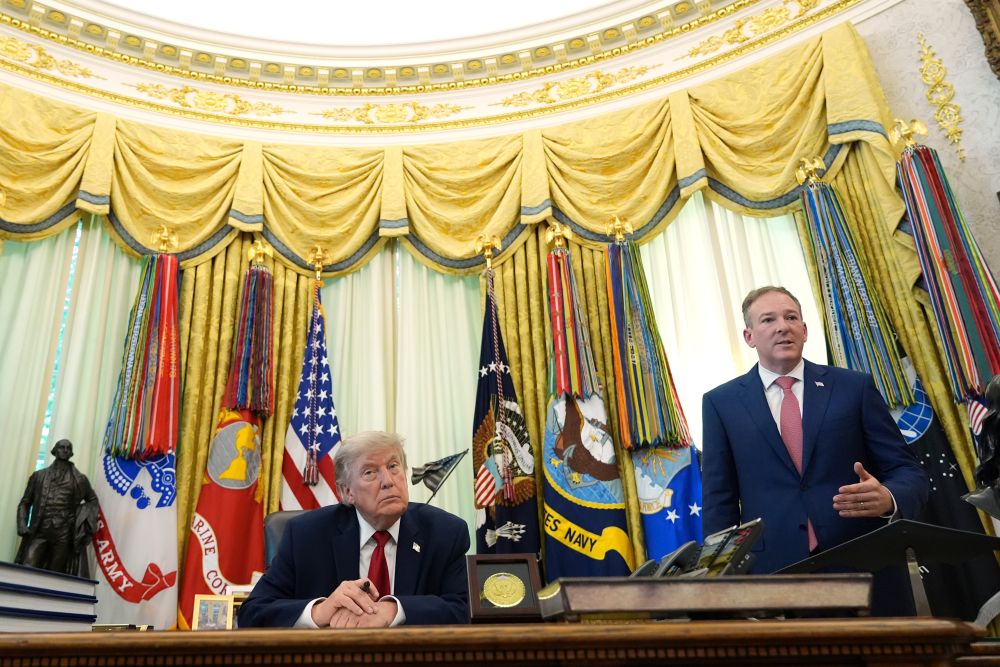
Environmental Protection Agency administrator Lee Zeldin speaks as President Donald Trump listens before Trump signs a presidential memo regarding pollution control in vehicles, in the Oval Office of the White House June 29, 2026, in Washington. (AP/Jacquelyn Martin)
In a statement to EarthBeat, an EPA spokesperson said the agency under the Trump administration "has been committed to keeping its core mission of protecting human health and the environment at the forefront of every action it takes," pointing to a list of hundreds of environmental actions. Environmental groups have questioned the list, saying many items are routine EPA functions.
"Administrator Zeldin has met with and listened to career scientists, lawyers, and staff at the agency to make the best decisions, alongside EPA leadership, that fulfill the agency's statutory obligations, follow gold standard science, and are rooted in the best reading of the law," the EPA spokesperson said.
Backing the letter were Catholic Climate Covenant, Franciscan Action Network, the North American chapter of the Laudato Si' Movement, Maryknoll Office for Global Concerns, the Sisters of Mercy of the Americas justice team, Ignatian Solidarity Network and the National Religious Partnership for the Environment.
Other EPA actions cited in the Catholic letter included:
- Its repeal in February of new emissions standards for cars and trucks, and a July proposed rule to weaken standards for heavy-duty vehicles;
- A lack of environmental standards for data centers, including a directive to provide only "minimum requirements for public participation" in the air permitting process;
- A May proposal that would permit "non-polluting" elements of projects to begin without environmental reviews or air pollution permits;
- The rollback of emissions regulations of a variety of toxic and hazardous materials and substances, including from coal- and gas-fired power plants.
Kayla Jacobs, director of advocacy and youth mobilization for Catholic Climate Covenant, said the flurry of actions at EPA over the past 18 months "has been pretty disastrous and almost impossible to keep up with."
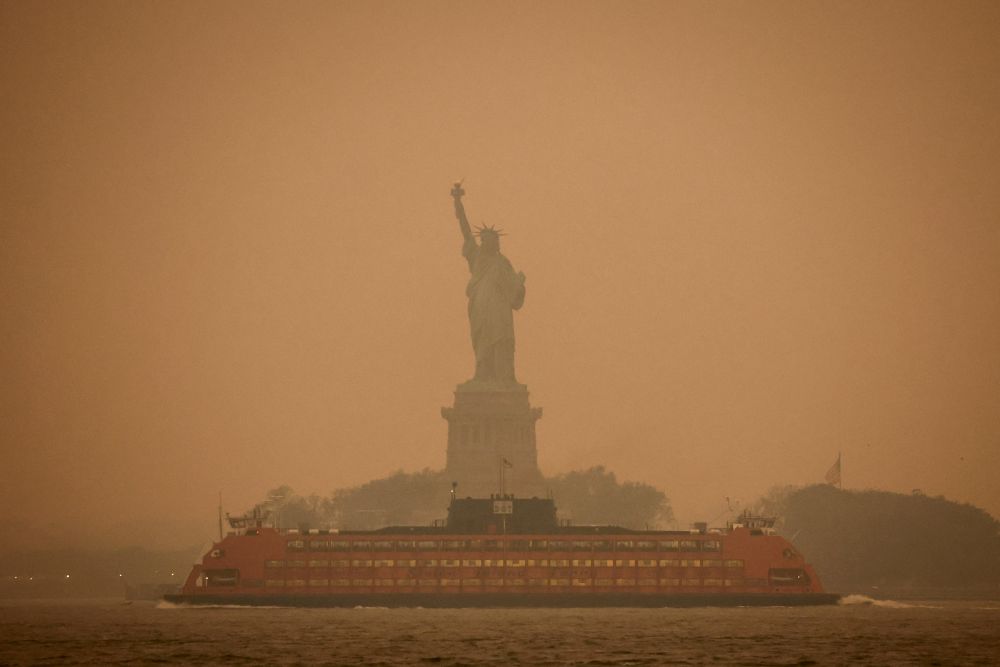
The Statue of Liberty is covered in haze and smoke caused by wildfires in Canada, in New York June 6, 2023. (OSV News/Reuters/Amr Alfiky)
During the second Trump administration, EPA so far has put forward more than 70 proposed rules, finalized rules and other guidance aimed at eliminating or significantly scaling back climate mitigation and adaptation measures, according to a database by the Sabin Center for Climate Change Law at Columbia University.
Many of the actions have sought to void rules and policies put in place under President Joe Biden. That has included rolling back stronger limits on methane emissions (a potent greenhouse gas), hydrofluorocarbons and mercury pollution, the latter long a priority of U.S. Catholic bishops due to mercury's acute health impacts on unborn children and pregnant women.
Concerning drinking water, the agency has backed away from testing for microplastics and proposed rollbacks on forever chemical limits. It also proposed to narrow the scope of environmental reviews under the National Environmental Protection Act and invited industries to apply for exemptions from rules on hazardous air pollution and delayed compliance deadlines for fossil fuel facilities, including cleaning up coal ash.
In addition, Zeldin has shut down EPA's main scientific research office and hundreds of scientists have left the agency. Elsewhere in the government, the Trump administration has moved to cancel renewable energy projects — especially large-scale solar and wind power — open up extensive tracts of public lands and water to mining and extraction, and limit protections of endangered species to allow more fossil fuel development. The U.S. has also withdrawn from the Paris Agreement on climate change and its underlying United Nations treaty.
Zeldin and others in the administration have said cutting environmental regulations are necessary to lift burdens on businesses, boost jobs and industries (especially artificial intelligence) and "unleash energy dominance." Addressing AI's impact on utility bills, Trump touted at the EPA July 23 a voluntary pledge for tech companies to procure and pay for all data center energy needs.
Taken together, the actions share a common thread in making more people sick from toxic chemicals and harmful pollution, said Jeremy Symons, a senior adviser with the Environmental Protection Network, an organization of former EPA workers. Symons worked in EPA's air office under the Clinton and George W. Bush administrations.
"This has been such a radical departure from EPA's mission of protecting human health and the environment, that it will have widespread consequences for people that are expecting EPA to still be on the job and holding polluters accountable for what they put in our air, water and food," he said.
Analyzing 12 of the 31 rollbacks that Zeldin identified, an EPN report found they would result in nearly 200,000 premature deaths through 2050 and wipe out $254 billion in annual benefits for public health through avoided medical bills, avoided sick days and longer lives.
In addition to the long-term impact of deregulating environmental protections, particularly clean air standards, Symons said a danger in the near-term comes from EPA pulling back from enforcing compliance with the Clean Air Act, Clean Water Act and other environmental laws.
A June YouGov poll found 53% of U.S. adult citizens believe that the country's environment has gotten worse in recent years. Fifty-six percent said the government is not doing enough, with more than half of respondents supporting greater regulations around water pollution, air pollution, oil drilling, wildlife habitats and pesticides.
In 2024, an estimated 53% of Catholics voted for Trump, who campaigned openly how he would ramp up fossil fuel production and eliminate environmental and climate protections. Under Zeldin, that agenda has pushed forward at a rapid pace.
"A lot that's been happening is very not in line with our church's teachings. Very not Laudato Si' friendly, that's for sure," Jacobs said, referencing Pope Francis' 2015 encyclical on ecology "Laudato Si', on Care for Our Common Home."
She told EarthBeat the prayer service and letter were in response to concerns Catholic Climate Covenant heard from its network about what was happening, especially related to data centers.
Advertisement
The D.C.-based organization has provided updates about public commenting periods on proposed EPA rules while also focusing more attention at state and local levels where there's more optimism to secure environmental protections and clean energy.
"We're not stopping at the federal level stuff because obviously, no matter what, it's important," Jacobs said. "We need to do something about it, and we need to be on public record, that when history looks back at this time that the Catholics were saying it was wrong."
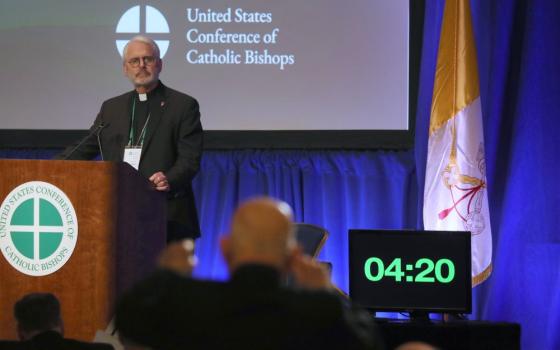
In June, the U.S. Conference of Catholic Bishops wrote to Zeldin urging EPA to strengthen its requirements for coal ash disposal. That followed a February letter calling for the Trump administration to reconsider its rollback of vehicle fuel-economy standards.
Ultimately, the fate of many of the EPA rollbacks may lie in the courts. In recent months, federal judges have overruled EPA's attempt to eliminate the 2024 soot pollution rules and declared illegal its cancellation of environmental justice grants. Legal watchers expect its repeal of the endangerment finding to end up at the U.S. Supreme Court.
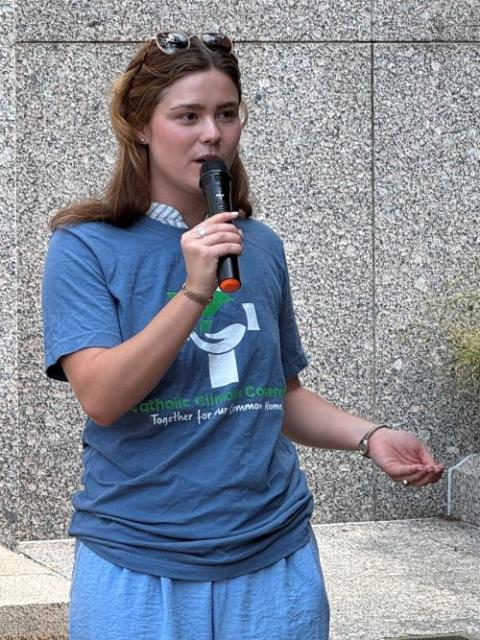
Sarah Hook, an intern with the Catholic Climate Covenant, speaks during a prayer service July 24 outside EPA headquarters in Washington, D.C. (Catholic Climate Covenant)
Sarah Hook, a summer intern with Catholic Climate Covenant, sees the real-life consequences of EPA's pullback from enforcing environmental regulations and repealing others in her home state of Louisiana. For years, residents have pushed for greater public health protections from fossil fuel and petrochemical facilities, often situated close to neighborhoods and polluting its air and water.
"We are also just such a vulnerable community in regards to our resources and everything. And if regulations aren't put in place, then we're not able to really protect ourselves," she said.
Hook, who will be a senior at Louisiana State University in the fall, helped organize and lead the prayer service outside EPA headquarters. At its close, she offered a message for any onlooking EPA officials.
"I hope that if the EPA is watching, that they can see that we do care a lot and that we're going to continue to care. And that we're going to continue to show up. And if our voices aren't heard, we'll make sure that they're heard."