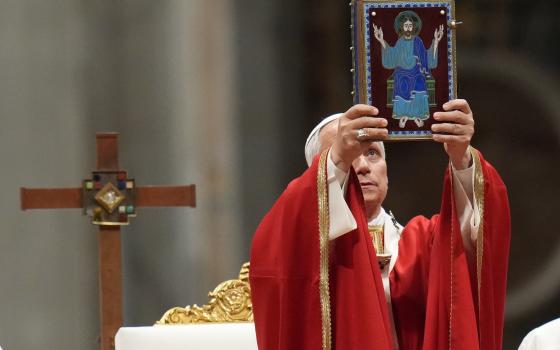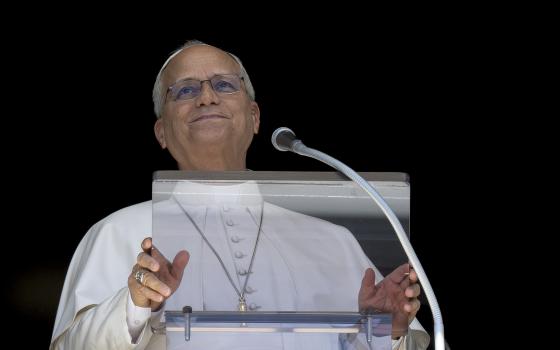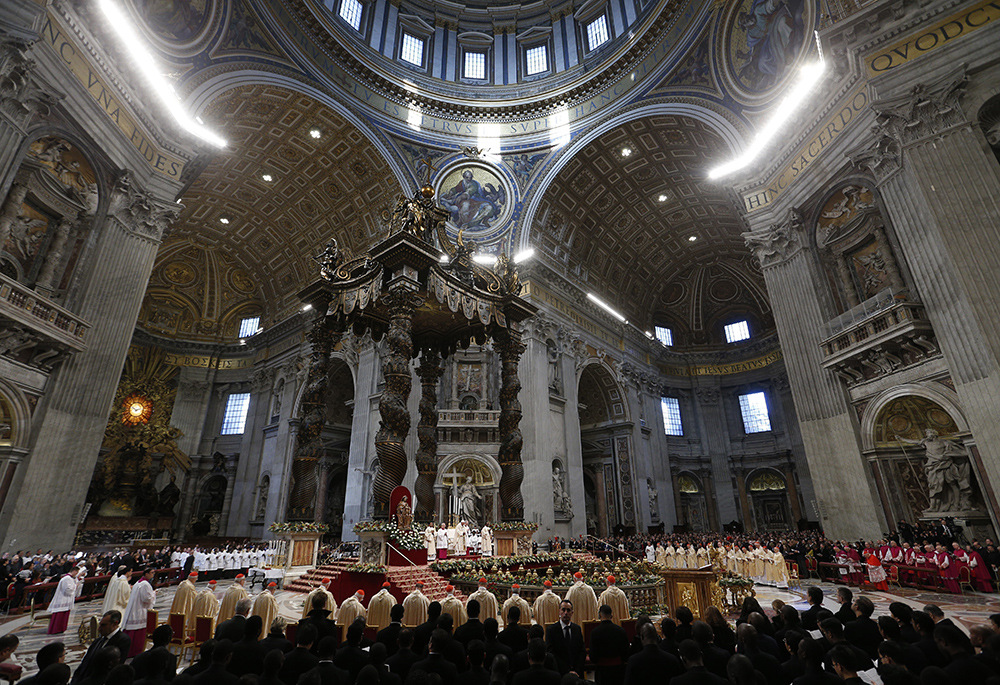
Pope Francis celebrates Mass marking the feast of the Epiphany in St. Peter's Basilica at the Vatican Jan. 6, 2018. Author Bruce Feiler tells the story of his visit to the basilica in the first chapter of his new book A Time To Gather. (CNS/Paul Haring)

by Jeromiah Taylor
Join the Conversation
Send your thoughts to Letters to the Editor. Learn more
I've always thought that Flannery O'Connor's claim that good fiction depends on mystery and manners was applicable to religion as well. Good religion depends on ritual, which is an exercise in manners and a realization of mystery. Or as prolific nonfiction writer Bruce Feiler puts it in his new book A Time To Gather: How Ritual Created the World — and How It Can Save Us, ritual is proof that "doing is believing."
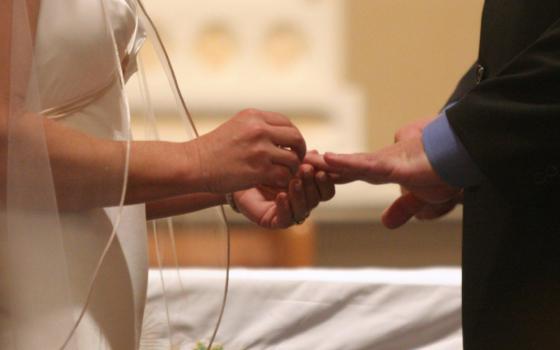
While in the West, adult conversions are rebounding to near pre-pandemic levels and globally the Catholic Church continues to log modest growth, the real meat and potatoes of the religion are increasingly left on the table. Vocations, marriages and baptisms are all down. For a religion whose unique selling proposition is low-key popping off, we're running out of opportunities to do so. Or more precisely: Catholics are opting out of Catholic ritual. The problem is not uniquely Catholic — it's part and parcel of the contemporary world. As Feiler notes, less than half of Americans are married and only a third are buried.
"It took us ten thousand years to establish cultural norms around how we mark our collective life transitions," he writes. "It took us fifty years to dismantle them."
As to why exactly the practice of once nonnegotiable rituals has declined precipitously, readers will likely assign blame to their favorite ideological boogeyman (I personally prefer capitalism). For his part, Feiler makes a serious attempt to survey the civilizational arc of ritual and its relationship to religion. The story goes like this: Ritual predates religion, but religion perfected it, and for a very long time controlled it — and those days are over. The results include the destabilizing polarity and alienation afflicting body politics the world over at just the precise moment when human coordination is most urgently required to address global existential threats.
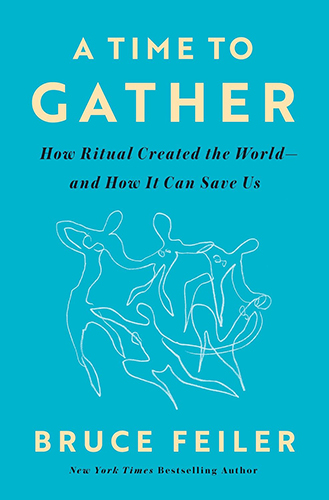
But this is a happy book with a blue and yellow jacket, so there's hope. Indeed, we are to believe that an underreported renaissance of ritual is happening beneath our noses — including but not limited to Taylor Swift divorce parties, "honor walks" for deceased organ donors and post-birth placenta rituals.
From the jacket: "Fed up with top-down scripts, everyday people, from boomers to Gen Z, are reimagining collective rituals at a remarkable pace, inventing fresh ways to gather around life, love, health, and family — and forging thriving communities in the process."
The above schmaltz notwithstanding, I am happy to report that the book itself consists of prose rather than copy. Though Feiler does posit the sort of neat matrices innate to self-help, which sharpen concepts but also weigh them down. For instance, rituals are acts, they are shared, they are unnecessary, and most of all they are italicized. Or take the blueprint for modern life rituals which contains five convenient elements: boundaries, stakes, compromise, empathy and hope. At some point this powerpoint prose overwhelms — one feels the need for a pen and paper so as to diagram the dizzying overlap of parameters.
Genre excess aside, Feiler peppers the book with elegant and studied allusions. To capture the contemporary disillusionment with traditional ritual, he quotes Laertes from Hamlet, who responds to the church's refusal to bury his sister Ophelia due to her ostensible suicide by saying, "What ceremony else?"
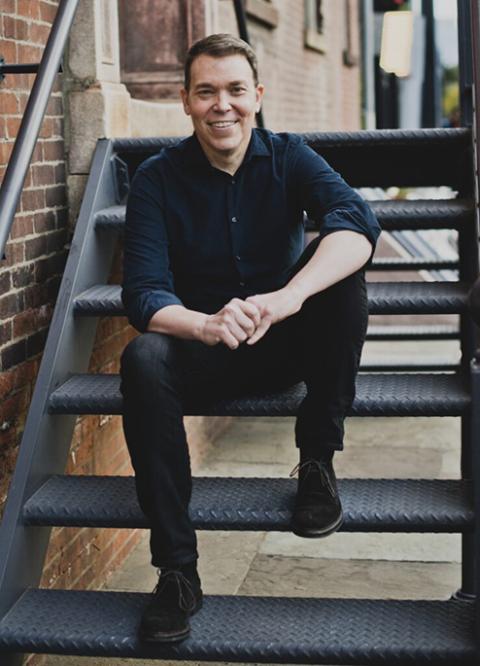
Bruce Feiler (brucefeiler.com/Jonica Moore)
For Feiler, that captures the modern mood, but the thrust of his argument is that while we may look elsewhere for ritual we can by no means afford to relinquish it. All the ills of the world are handily reduced to yet another maxim: "Our we-I axis is completely out of whack."
I'm strongly inclined to agree with Feiler that ritual is an existential necessity for the human species, as are the bevy of anthropologists cited by the author. Yet I am not convinced that "bottom-up," "grassroots" or "bespoke" rituals are an adequate replacement for what's been lost: a comprehensive social vision expressed and enforced by ritual participation. While custom rituals might be personally edifying, that is hardly the point. A well-integrated life transition may benefit me as an individual, but a society or culture it does not make.
A dilemma which brings those of us who are not reactionaries to the following question: How can humans maintain social cohesion while avoiding the harshest tendencies towards exclusion? A question with profound mutual pertinence to the Roman Catholic Church in the 21st century — something Feiler as a good journalist recognizes, and dedicates considerable time to.
The book opens in fact with what Feiler calls the "high-water mark of religion's control over ritual," or what most call St. Peter's Basilica. Feiler frames the post-Reformation era and the requisite dawn of modernity as a permanent and ongoing decline of the Roman church's ritual hegemony: "Ever after, life rituals would become voluntary."
With genuine respect and a sentiment bordering on wistfulness, Feiler tells the story of his visit to the basilica in the book's first chapter. Hosted by Franciscan Fr. Agnello Stoia, Feiler had been invited to witness a "novel approach to one of the more widely practiced life rituals in history" — a group baptism at the Vatican. Evidently, Feiler visited during the October 2024 general assembly of the synod on synodality, an event he reductively describes as a "contentious summit on women in the church."
Advertisement
However, his status as an outsider and researcher may have equipped him to capture the Catholic juxtaposition between faded glory and enduring relevance as poignantly as he did. Noting the antiquity of the trinitarian baptismal formula and the chapel's grandeur, Feiler goes on to write:
But underneath this unchanging veneer, change was everywhere. As the priest conducted the service, Agnello pinballed around the room chatting with parents, cooing at babies, polishing smudged candle sticks. It was as if he were saying, Ignore all this stuffiness, God's house isn't any more perfect than your house.
The parents, meanwhile, included interracial couples, intergenerational couples, international couples. The priests were Italians but the nuns were East Asian, Caribbean, African. The Vatican had just announced that transgender people could now be baptised as could the children of gay parents. The most unchanging life ritual was hardly immune from the winds of change.
Immersed as I am in the ecclesial hellscape of the 21st century, I couldn't help but cringe at the somewhat triumphalist accounting of those developments. How the church is supposed to continue as distinctly Catholic when all vestiges of Roman imperial might and Christendom's hegemony are decidedly lost was arguably the originating question of the Second Vatican Council. The council's wise, inspired and balanced discernments were conspicuously and audaciously challenged just this month by a "declaration of Catholic faith" issued by the soon-to-be excommunicated Priestly Fraternity of St. Pius X. It is a tragedy that as the church earnestly endeavors to respond to the questions raised herein she is beset by internal obstruction. But she must continue.
Ultimately, Feiler prescribes ritual as not our "last hope," but perhaps our "best" one. He sets before us a choice: "social decay or ritual cure." If he is correct about that forked road, and I suspect he is, then the Roman Catholic Church has perhaps more to offer in the way of ritual cure than any other repository. I can only hope and pray that as the world turns and burns and more is lost everyday that the church does end up playing some beautiful, heroic role in our redemption. But what I know is that Taylor Swift divorce parties won't cut it.