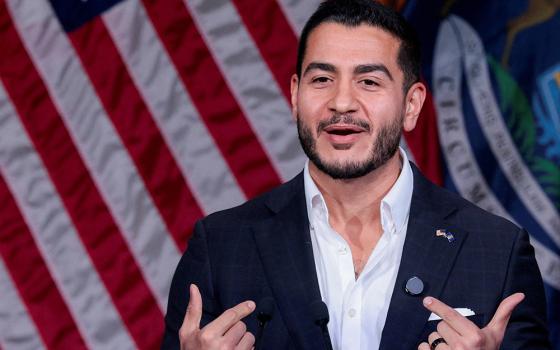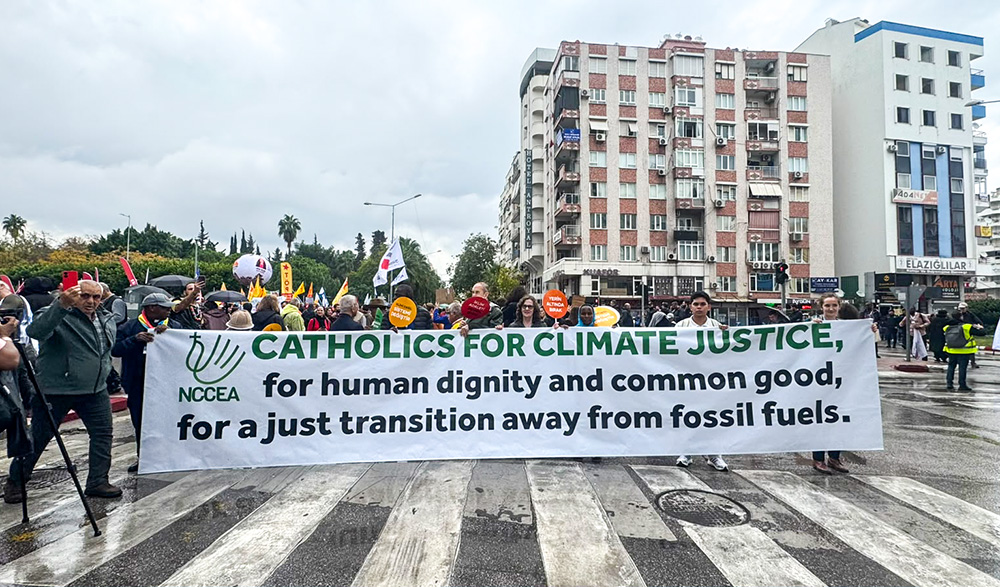
Officials with Catholic organizations take part in a climate march Nov. 14, 2026 in Antalya, Turkey, at the midway point in the COP31 United Nations climate change conference. (Rodne Galica)

Join the Conversation
Send your thoughts to Letters to the Editor. Learn more
Thirty-one Catholic institutions are severing financial ties with fossil fuels, the institutions announced in the final days of the United Nations climate change summit where activists are pressing for a global plan to phase out the use of coal, oil and gas.
The Catholic groups made up the majority of the 33 faith-based organizations to announce fossil fuel divestment Nov. 17. Among them were seven German institutions, including the Fulda Diocese — the country's first Catholic diocese to divest, the announcement said — as well as Misereor (the German bishops' development agency), Pax Christi Germany, and the Lumen Gentium Foundation, a lay organization in central Germany representing 19.2 million Catholics.
Fr. Martin Stanke, vicar general for the Fulda Diocese, said in a statement that fossil fuel divestment represented "a concrete step towards taking climate protection seriously."
"As the Church, we bear responsibility for the world in which we live and for the generations that will come after us. That is why it is only consistent for us to align our actions with the principles of caring for creation," he said.
To date, more than 700 faith-based organizations have publicly committed to divesting from fossil fuels as part of a global effort that has rallied upward of 1,700 institutions with combined assets eclipsing $40 trillion, the statement announcing the latest divestment commitments said. Religious groups make up the largest contingent of those pledging not to invest in fossil fuels. The latest divestment announcement pushes Catholic institutions making the declaration over 400.
Along with the Fulda Diocese, four other European dioceses committed to divestment, as did the international migrant and refugee nongovernmental organization Scalabrinian Foundation and 16 religious orders ministering on three continents, including the Carmelites, Province of the Most Pure Heart of Mary in the United States.
"As governments continue to fall short on climate action, faith institutions are showing the moral leadership this moment demands," said Lorna Gold, executive director of the Laudato Si' Movement, which worked with other Christian and multifaith groups in coordinating the joint divestment announcement. "Divesting from fossil fuels sends a powerful message: we cannot continue financing the destruction of our common home."
Since 2016, the Laudato Si' Movement has carried out a campaign to urge Catholic dioceses and other institutions to end or abstain from financial investments in the fossil fuel industry. The campaign has been buoyed at times by the Vatican, which has put out several guidances and initiatives that recommend avoiding investments in fossil fuels due to their primary role in raising global temperatures that are driving climate change.
In his 2015 encyclical, "Laudato Si', on Care for Our Common Home," Pope Francis wrote, "The use of highly polluting fossil fuels — especially coal, but also oil and, to a lesser degree, gas — needs to be progressively replaced without delay."
Advertisement
Eight years later, in his follow-up exhortation Laudate Deum "on the climate crisis," Francis lamented, "The necessary transition towards clean energy sources such as wind and solar energy, and the abandonment of fossil fuels, is not progressing at the necessary speed."
Pope Leo XIV has continued calls from the top of the Catholic Church to urgently address climate change, though he has not spoken directly on the role of fossil fuels.
In the U.S., the Diocese of San Diego has divested from fossil fuels, while the Diocese of Lexington, Kentucky, has pledged to do so. At least 38 U.S. dioceses have enrolled in the Vatican's Laudato Si' Action Platform, which includes among its recommendations fossil fuel divestment.
In March, the continental federations of bishops of Asia, Africa and Latin America, representing 820 million Catholics, issued a joint appeal endorsing the development of an international treaty to transition from the use of fossil fuels. In that appeal — coming before a gathering of nearly 60 countries in Colombia to discuss pathways to phase out fossil fuels — the bishops of the Global South also committed themselves to consider fossil fuel divestment.
"Guided by the preferential option for the poor and the care of creation described in the Catholic Social Teaching, we declare our unwavering support for a just transition and strongly call on the governments of the world to adopt a treaty to stop proliferation and abandon fossil fuels as a moral and political imperative," the bishops wrote.
At COP31, the U.N. climate summit in Antalya, Turkey, Catholic officials and environmental activists have pressed countries to build off momentum from the Colombia meeting for a fossil fuel phaseout. Ahead of the conference, a Brazilian diplomat put forward a global road map to phase out fossil fuels, alongside another to halt deforestation.
In 2026, global investments in coal, oil and gas are set to reach $1.2 trillion, according to the International Energy Agency. That's a decrease from prior years, though still nearly double the projected $665 billion in renewables. An International Energy Agency report in November forecast renewable energy capacity, already expanding at record pace, will see further growth driven predominantly by solar power.
For years, scientists have stated that meeting the Paris Agreement goal to limit average global temperature rise to 1.5 degrees Celsius (2.7 degrees Fahrenheit) will require no new fossil fuel development. Before the U.S.-Israeli war on Iran disrupted global oil markets, governments were set to produce double the level of fossil fuels aligned with that 1.5 C goal. Under an aggressive push by the Trump administration to ramp up fossil fuel production, U.S. emissions increased dramatically in 2025.
In August, scientists in a U.N. report concluded it is "inevitable" the world will surpass 1.5 C by the end of the 2020s and outlined pathways to bring global temperatures back down.
Catholic and faith leaders at COP31 and beyond have stressed the need for a just transition from fossil fuels, where wealthy, high-polluting countries lead in eliminating the use of fossil fuels and their heat-trapping greenhouse gas emissions, and investments are directed toward developing countries and vulnerable communities to assist in the shift to a low-carbon economy.
Madeleine Wörner, Misereor adviser on international climate and energy policy, said that real climate action must address financial flows to fossil fuels alongside eliminating their emissions.
"By supporting the divestment initiative," she said, "we are making it clear here at the 31st UN Climate Change Conference: Real change and the rapid expansion of renewable energy will only succeed if we simultaneously phase out climate-damaging financing."