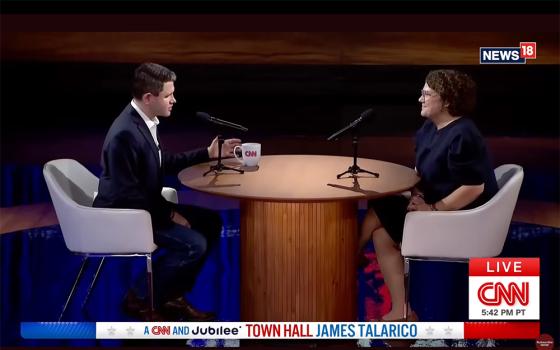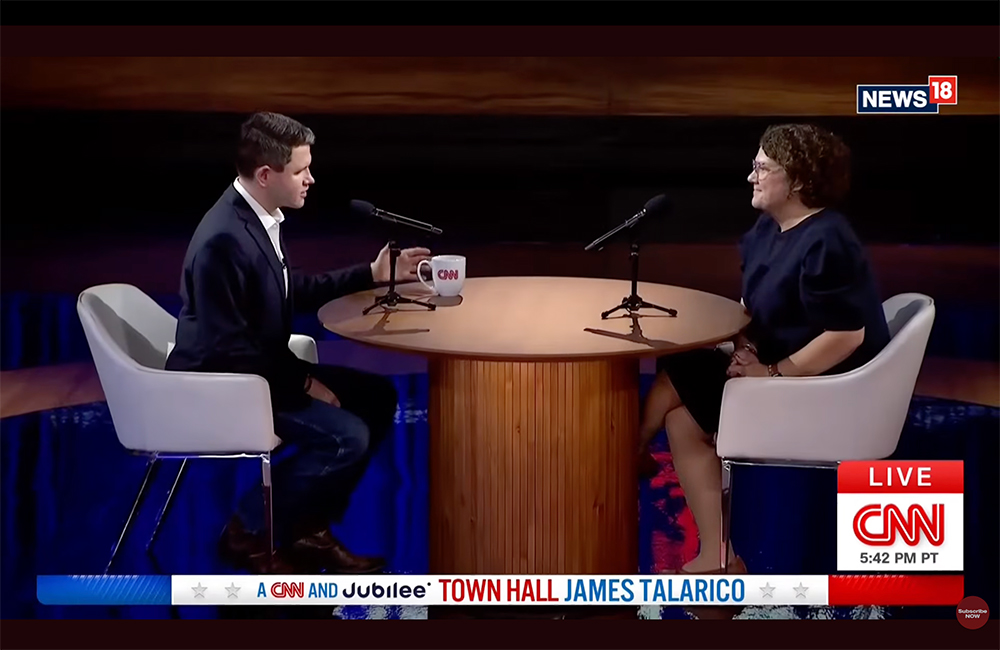
James Talarico and Jodi Hunt talk about abortion during a town hall hosted by CNN and Jubilee Media Oct. 14, 2026. (NCR screenshot/YouTube/CNN-News18)

Join the Conversation
Send your thoughts to Letters to the Editor. Learn more
A Texas Catholic professor of applied ministry challenged Texas Democratic Senate candidate James Talarico over his position on abortion during an Oct. 14 televised town hall arguing that protecting unborn children must take precedence in political decision-making.
Jodi Hunt, executive director of the Neuhoff Institute for Ministry and Evangelization at the University of Dallas, identified herself as an "orthodox Catholic" and described abortion as a decisive issue for Catholic voters in the event hosted by CNN and YouTube-based Jubilee Media.
Hunt told Talarico that Catholics believe human life begins at conception and that the unborn child deserves protection. "As people, we are to protect that life at all cost," she said.
Hunt then questioned how Catholics could trust Democratic candidates to defend human dignity if those candidates support abortion rights.
"If you cannot provide policies or support policies that protect the most innocent among us, who is the unborn child, how can we trust that you're going to provide policies to protect the rest of Texans?" she asked.
Talarico, a Christian seminarian and former educator, responded by invoking Pope Francis and Pope Leo XIV, whom he described as consistently pro-life because their concern for human dignity extends beyond abortion to poverty, climate change and war.
While acknowledging their different moral conclusions about abortion, Talarico argued that both could support policies aimed at reducing unintended pregnancies and abortions.
"If we treat this issue as a public health problem and not a culture war problem, then we can actually make progress together," he said.
He advocated scientifically grounded, age-appropriate sex education, access to contraception, and universal health care as practical approaches to reducing abortions.
Hunt pushed back, particularly against his assertion that the Bible is silent on abortion. She also raised objections to government involvement in sex education, stressing Catholic teaching that parents are the primary educators of their children.
But the most consequential theological question raised by Hunt's remarks may be her insistence that unborn life must be protected "at all cost."
Megan McCabe, a moral theologian at Gonzaga University in Spokane, Washington, told the National Catholic Reporter that while Catholic teaching considers the direct termination of pregnancy "intrinsically evil" and "morally impermissible," it also recognizes exceptions for certain medical interventions under the principle of double effect. That principle allows procedures aimed at saving a pregnant woman's life even when the unintended consequence is the death of an embryo or fetus.
"To say that we have to protect the life 'at all cost' would actually start to move, as I interpret that statement, in the direction of a lot of preventative or extreme measures," McCabe said, adding that such an interpretation "does seem to even rule out the principle of double effect."
Advertisement
As an example, she cited ectopic pregnancies, in which a fertilized egg implants outside the uterus, often in a fallopian tube. Under traditional Catholic moral reasoning, removing an affected fallopian tube to save the woman's life can be permissible even though the embryo dies as a consequence. "That still results in the death of the embryo," McCabe said.
McCabe also rejected the suggestion that Hunt's remarks reflect a broader trend among Catholic theologians toward more restrictive interpretations of church teaching since the Supreme Court overturned Roe v. Wade in 2022.
"There are some sharp divisions, almost ideologically, in the American Catholic Church, including among some theologians," she said. "But this feels like a distinctively American culture war dimension that is popping up in particular isolated contexts. And of course, some people would say those are the only true Catholic contexts."
Talarico pointed to the consequences of Texas' restrictive abortion law, arguing that it has endangered women experiencing pregnancy complications.
He said the ban prohibits abortion even when a mother's life is threatened. Texas law, however, contains an exception for certain life-threatening medical conditions, although its application has generated considerable controversy.
"If we are authentically pro-life, I think we should be disturbed by the outcomes of this extreme abortion ban," Talarico said.
Despite their disagreements, both participants acknowledged some common ground. Hunt welcomed Talarico's concern for protecting human life "from the womb to the tomb," while the candidate suggested they continue their theological discussion over coffee or on a podcast.
Abortion is emerging as a significant issue in the 2026 midterm elections, with voters in four states — Virginia, Nevada, Idaho and Missouri — set to decide ballot measures that could reshape abortion laws. Catholic bishops in all four states have mobilized against measures that would expand or protect abortion rights, although public opinion polls suggest their campaigns face significant challenges. In Nevada, for example, 64% of voters supported a constitutional amendment protecting abortion rights in 2024, which must receive voter approval again this November.
The stakes are particularly high in Missouri, where voters will decide whether to reverse a constitutional amendment protecting abortion rights that passed narrowly in 2024. A September SLU/YouGov poll found voters almost evenly divided, with 43% supporting the proposed repeal, 44% opposing it and 13% undecided.
Nationally, a Public Religion Research Institute survey found that 61% of Americans believe abortion should be legal in all or most cases, underscoring the political challenges facing abortion opponents four years after the Supreme Court overturned Roe v. Wade.