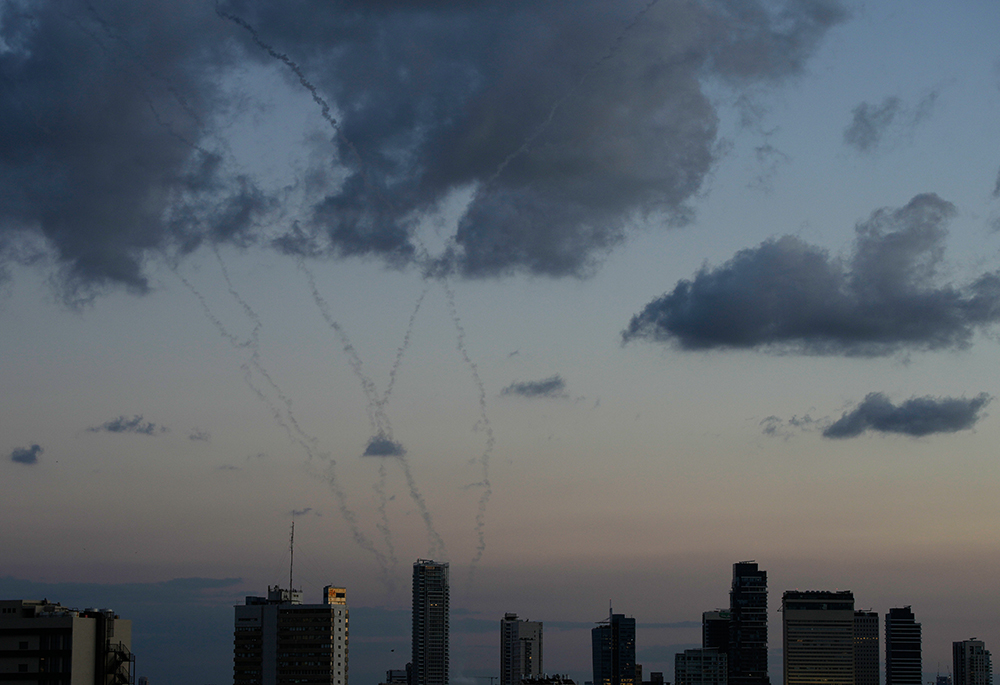
Traces of an air defense missile interception is seen over Tel Aviv, Israel, Saturday, Feb. 28, 2026. (AP photo/Ohad Zwigenberg)

Join the Conversation
Send your thoughts to Letters to the Editor. Learn more
Catholic pilgrims visiting the Holy Land have been stranded in Israel and the West Bank after the rapid escalation of hostilities between the U.S., Israel and Iran triggered widespread airspace closures across the Middle East, grounding commercial flights and sharply restricting movement across borders.
International carriers suspended operations to and from Tel Aviv as missile exchanges intensified. Although Israeli authorities have since allowed limited flight activity, schedules remain fragile and subject to immediate cancellation depending on security conditions.
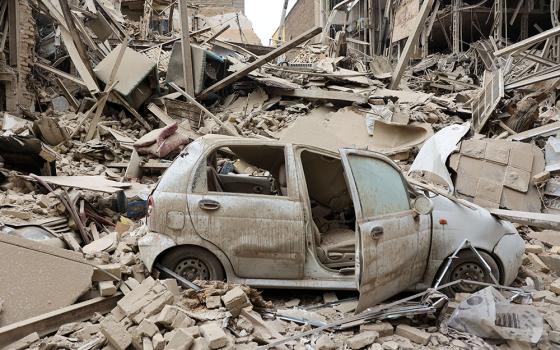
The conflict deepened after coordinated U.S. and Israeli strikes targeted Iranian military infrastructure, prompting retaliatory missile and drone launches across multiple other Middle Eastern countries. Air raid sirens have echoed repeatedly across Jerusalem and central Israel, sending residents and visitors into shelters. In the West Bank, security measures had been previously tightened, complicating road travel between Palestinian cities and Jerusalem.
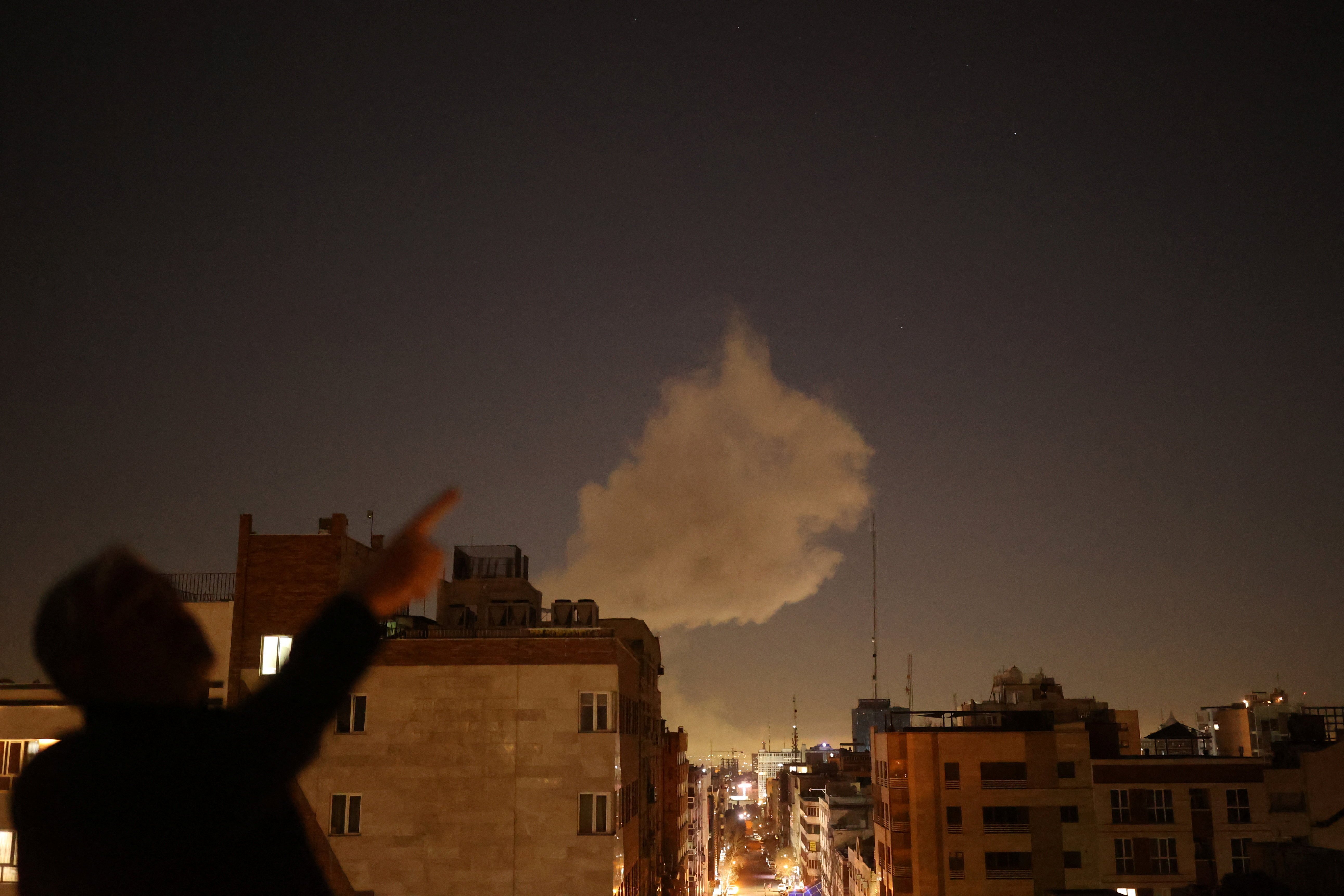
Smoke rises following an explosion in Tehran, Iran, March 1, 2026, after Israel and the U.S. launched strikes on Iran. (OSV News/West Asia News Agency via Reuters/Majid Asgaripour)
Among those caught in the disruption was a group of 17 Italian and Italian American pilgrims led by Fr. Luigi Portarulo, parochial vicar at Basilica of St. Patrick's Old Cathedral in New York City. They had already visited Nazareth and Bethlehem and were en route to Masada at the Dead Sea on early Saturday morning (Feb. 28) when emergency alerts began to sound across their mobile phones.
"It was an incredible fear," Portarulo said in a WhatsApp interview to the National Catholic Reporter, recalling the moment the bus driver turned around in the middle of the desert. The group could see and hear missiles overhead. Calls were placed to local diplomats as the driver sought instructions. The pilgrimage itinerary was abandoned.
The pilgrims returned toward Bethlehem to retrieve their belongings and then pushed on to Jerusalem after being told a hotel there had a reinforced bunker. For two days and two nights, their routine was defined by the cadence of sirens and the descent to shelter.
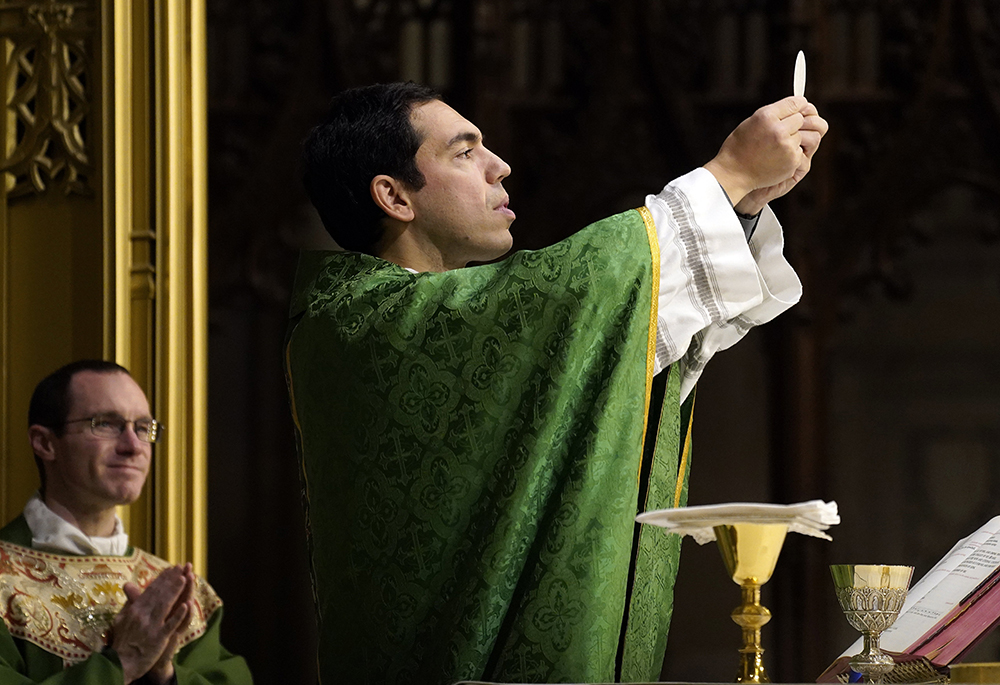
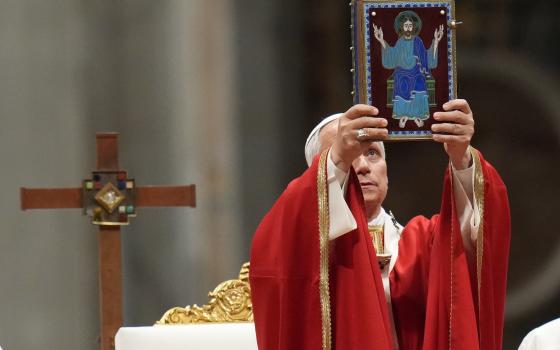
Fr. Luigi Portarulo elevates the host during a vigil Mass for participants in the New York City Marathon at the Basilica of St. Patrick's Old Cathedral in New York City Nov. 2, 2024. Portarulo, parochial vicar at St. Patrick's, was leading a pilgrimage of Italian and Italian Americans en route to Masada at the Dead Sea when emergency alerts began to sound across their mobile phones Feb. 28, 2026. Portarulo spoke to NCR via a WhatsApp interview. (OSV News/Gregory A. Shemitz)
Inside the bunker, the group attempted to impose order on uncertainty. Portarulo said they spoke, wrote messages home and celebrated Mass with little to no light. A ballistic missile landed in West Jerusalem close enough to strongly shake the building, Portarulo added. They later discovered that the same missile killed nine people* just miles from their hotel.
"We didn't sleep because there were constant alarms and we were going up and down from the hotel to the bunker," he said. "We realized the extent of the war."
As airspace closures rippled across the region, exit options narrowed. International airlines suspended or diverted flights across Israel, Iran and major parts of the Gulf. Pilgrims began searching for alternative routes, including overland travel to neighboring countries where airports were functioning intermittently.
For Portarulo's group, one possibility emerged through Jordan. Another option involved a 10-hour bus ride to Egypt and departure from Cairo. Even beyond Israel's borders, however, the atmosphere remained tense, marked by the constant presence of military aircraft overhead, he said.
Advertisement
In Jerusalem, the Franciscan Custody of the Holy Land has been assisting stranded groups while maintaining regular shelter procedures for local residents. Franciscan Br. Francesco Ielpo, the Franciscan custos of the Holy Land appointed by Pope Leo XIV in June 2025, experienced the disruption firsthand when a flight he was on from Milan to Tel Aviv on Saturday morning was forced to turn back midair. He later reached Jerusalem by traveling through Amman, Jordan.
Since then, he said to NCR he has encountered multiple pilgrimage groups unable to depart. He said other Italian and Chinese Catholics have been waiting for guidance from Israeli authorities, while other groups are being hosted in Franciscan facilities.
Civil defense protocols in Israel rely on a nationwide mobile alert system that directs the population to shelters when missiles are incoming. Convents and church compounds are integrated into this system. "There is a very efficient mobile phone alert system, so the entire population is warned in time to go to shelters," Ielpo said.
Franciscan houses in Jerusalem and Jaffa have opened protected spaces not only to pilgrims but also to nearby families. "Near the church, we have a bunker where we can also accommodate our neighbors," he said, describing a pattern of local solidarity that surfaces during periods of escalation.
The timing of the conflict coincides with the beginning of a significant Franciscan commemorative year marking the 800th death of St. Francis of Assisi, who also journeyed to the Middle East during the Fifth Crusade. The anniversary was intended to focus on the saint's encounter with the Sultan of Egypt, often cited as an emblematic gesture of dialogue and peace amid war.
Ielpo reflected on that history in the context of current hostilities. St. Francis, he noted, traveled to the region at a time of open conflict and met the sultan without altering the course of the Crusades. "From a political history perspective, nothing changed," he said. Yet the episode endures symbolically. "He began to change hearts," Ielpo said, arguing that such gestures, while not immediately altering political outcomes, sustain a longer horizon of hope.
"Hope is definitely not gone," he said.
For now, however, the immediate concerns are logistical and security-related. Foreign embassies have advised citizens to monitor developments closely and prepare for potential delays. A leading international Catholic pilgrimage operator who spoke to NCR on condition of anonymity said they have reported mounting cancellations and uncertainty about upcoming travel seasons. Despite the recurring challenges, pilgrimage traffic still forms a substantial part of the Holy Land's religious tourism sector, particularly in the weeks preceding Easter, the operator said.
*This story has been updated with the casualties of the missile strike.