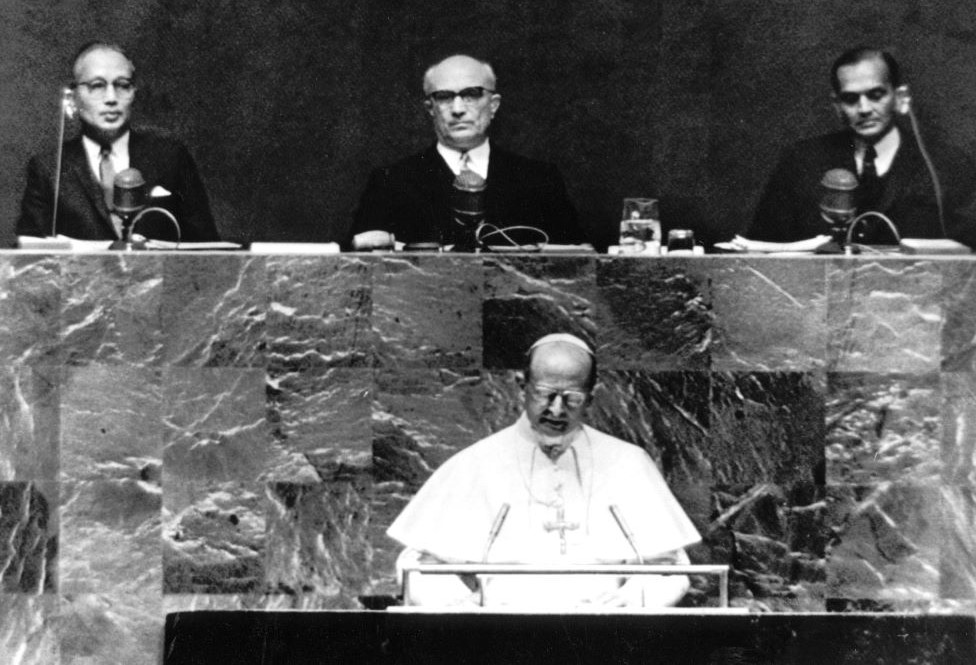
Pope Paul VI pleads for world peace before the United Nations General Assembly on Oct. 4, 1965. Behind him are (from left) U.N Secretary-General U Thant of Burma, Assembly President Amintore Fanfani of Italy and Under-Secretary for General Assembly C.V. Narasimhan. In his speech, Paul said, "Never again war, never again war!" (CNS file photo)

Join the Conversation
Send your thoughts to Letters to the Editor. Learn more
President Donald Trump's recent criticisms of Pope Leo XIV have drawn global attention in both political and religious circles. And although public disagreements between a U.S. president and a pope are unusual, scholars say the episode fits into a longer history of both cooperation and tension between Washington and the Vatican.
For José Casanova, a leading voice on the sociology of religion and senior fellow at Georgetown University's Berkley Center for Religion, Peace and World Affairs, the moment is not entirely unexpected.
"Trump had attacked Pope Francis before. So it was very clear that he views the world around his person and his personality, and whatever is good for him is good for the world," he said to the National Catholic Reporter.
"A person who thinks only about building walls, wherever they may be, and not building bridges is not Christian," Francis said in 2016, ahead of Trump's first term in office. "This is not in the Gospel."
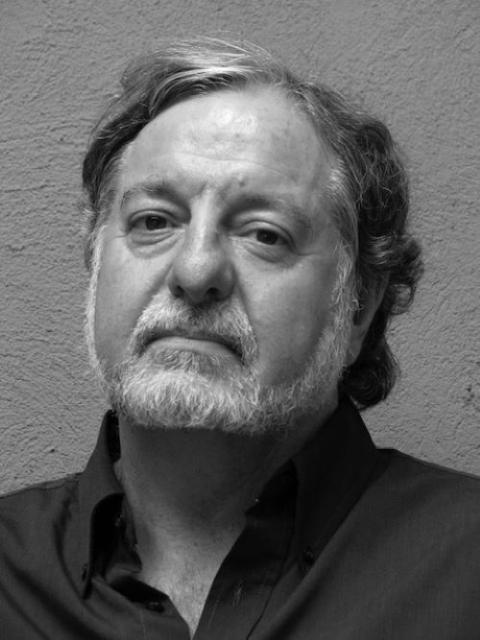
José Casanova, sociologist of religion and senior fellow at Georgetown University's Berkley Center for Religion, Peace and World Affairs (Courtesy of José Casanova)
In Casanova's view, Trump's criticism of Leo came at a politically sensitive moment for Trump. "It's not surprising that this came out just minutes after the news that Orbán had lost the elections in Hungary. So it was a way of changing the topic. He doesn't want to be recognized as somebody who is in trouble."
To understand the broader context, Casanova pointed to the relatively recent nature of formal ties between the U.S. and the Vatican. Diplomatic relations were established only in 1984, under Ronald Reagan and Pope John II. Before that, suspicion of Catholic influence was widespread in American political life.
"Let's not forget that for centuries, the words 'popies' and 'popery' had been part of the normal Protestant discourse," Casanova said. Anti-Catholicism, he said, shaped public attitudes and politics for generations. Even in the 20th century, concerns about loyalty persisted. When John F. Kennedy, a Catholic, ran for president in 1960, he had to reassure Protestant voters that the pope would not dictate his policies.
"I do not speak for my church on public matters, and the church does not speak for me," Kennedy said.
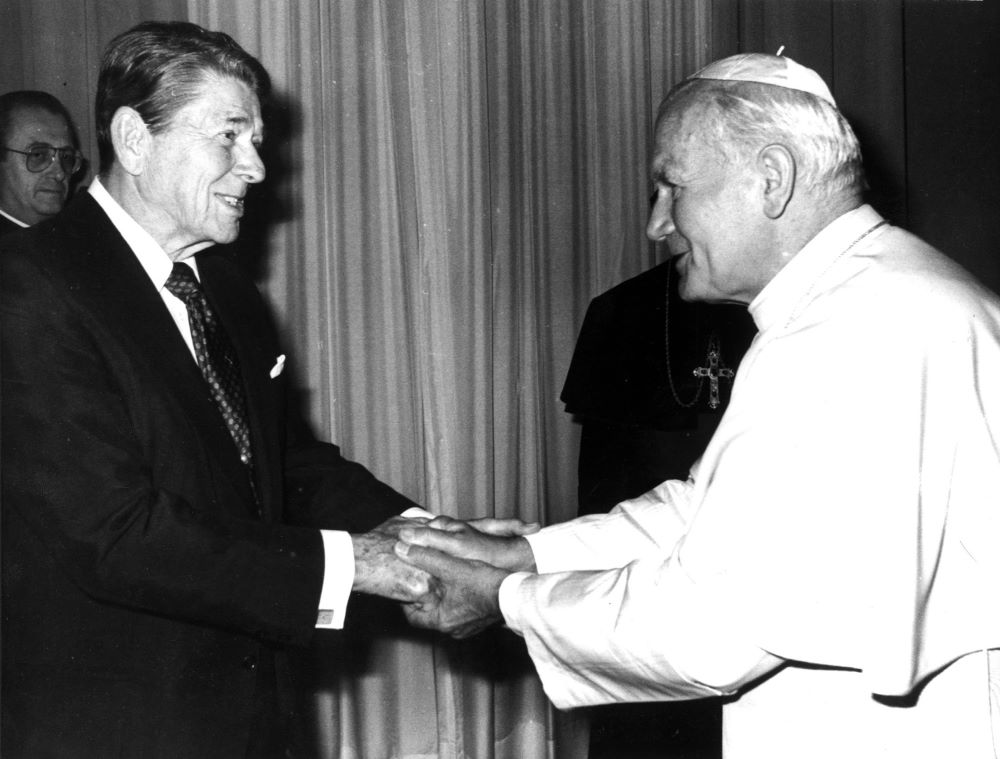
President Ronald Reagan shakes hands with Pope John Paul II during Reagan's June 6, 1982, visit to the Vatican. The two worked together during the Cold War to fight the influence of the Soviet Union. (CNS/Reuters)
The relationship changed during the Cold War. Reagan and Pope John Paul II worked together against the influence of the Soviet Union, supporting efforts such as the Solidarity movement in Poland. Even during this period, Casanova said, the Vatican maintained its independence and freedom to criticize other military interventions.
"There is a tradition of popes basically having been critical of all the last wars in the Middle East, all of them," he said. He pointed to opposition from John Paul II and Benedict XVI to the Iraq War, as well as criticism from Catholic leaders in the United States itself.
This critical stance, Casanova said, is part of a broader development in the role of the papacy after World War II. Beginning with Pope John XXIII, who led the church 1958-1963, the Vatican has increasingly presented itself as a global moral voice.
He highlighted John XXIII's role during the 1962 Cuban missile crisis, when both the United States and the Soviet Union turned to the pope as a mediator.
This role was further developed through major church documents addressed not only to Catholics but to the wider world. John XXIII's 1963 encyclical Pacem in Terris ("Peace on Earth" and later teachings emphasized peace, development and human dignity.
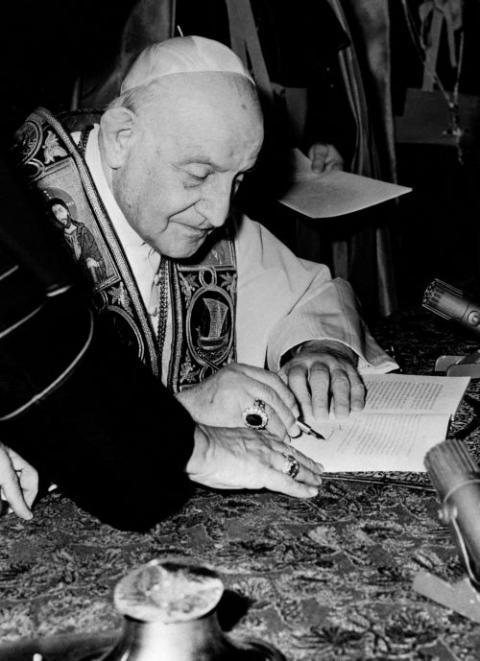
Pope John XXIII signs his encyclical "Peace on Earth" ("Pacem in Terris") at the Vatican in this 1963 file photo. (CNS)
"The papacy adopted the voice of being a voice for all of humanity to defend the interests of all of humanity," Casanova said.
The church's position has often led to tensions with U.S. policy. From Vietnam to Iraq and more recent conflicts in the Middle East, popes have repeatedly called for restraint and negotiation. Casanova said this reflects a consistent line since 1945 rather than a new development.
He also identified immigration as an area of growing disagreement. The U.S. church was historically built by successive waves of immigrants, which shaped both its social outlook and its political alignments. Today, political shifts have made immigration a more divisive issue, contributing to tension between Vatican priorities and parts of the U.S. political landscape, he said.
Despite these tensions, Casanova said, the Vatican's influence lies less in direct political power than in its ability to shape moral debate over time. He explained that this influence works indirectly, through public opinion rather than formal authority. "When the moral consciences of the citizens are moved, the politicians listen," he said.
Mathew Schmalz, professor of religious studies at the College of the Holy Cross, agreed that Trump's attacks on Leo stand out, particularly because of who is involved.
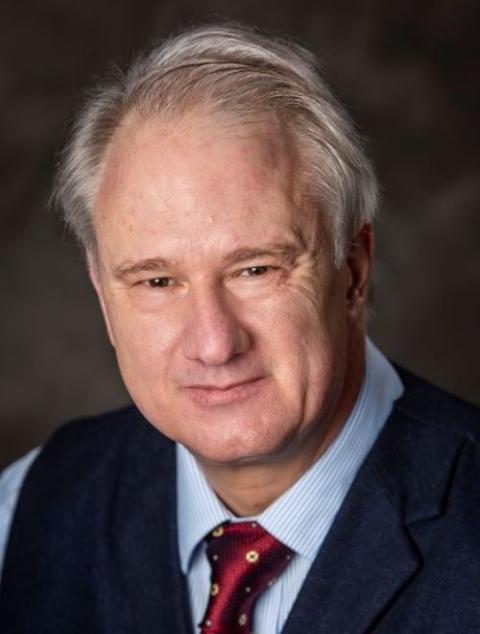
Mathew Schmalz, professor of Religious Studies at the College of the Holy Cross (Courtesy of College of the Holy Cross)
"The answer to the question whether this is unprecedented, is yes, it is unprecedented coming from a U.S. president," Schmalz said. But the escalation itself was predictable, he said.
"Donald Trump has shown his not just willingness but eagerness to personalize issues of political disagreement, and so even though he has many Catholic supporters, I think he reacted instinctively to what he understood to be criticism coming from the pope," he said. "And his way of doing things is not to de-escalate, but to escalate."
Tensions existed during the Reagan era over nuclear weapons, and are ongoing with Democratic administrations over abortion, Schmalz said. But "it's hard for me to identify something specific that the Vatican has identified as an issue of concern the way Pope Leo has," he said.
Like Casanova, Schmalz pointed to a long-term shift in the church's emphasis on peace. "From Pope John XXIII onward," he said, there has been "a progression and a deepening of Catholic commitment to peace." Even though Catholic teaching still allows for just war, recent popes have consistently stressed diplomacy over force.
Advertisement
"There is a consistency in the message that peaceful options should always be pursued and diplomacy emphasized," Schmalz said.
He cited Pope Paul VI's historic 19165 call at the United Nations for an end to war. "Never again war, never again war! It is peace, peace, that has to guide the destiny of the nations of all mankind!" Paul told the U.N. General Assembly.
"Even though it may not have direct practical implications, the way that the pope speaks about things does shape the context for nation states as they present their reasons for going to war," Schmalz said. "So it's a kind of soft power, which in the short term is not necessarily that effective, but in the longer term, it could be," he added.
"In that sense, the pope is the conscience of the world."