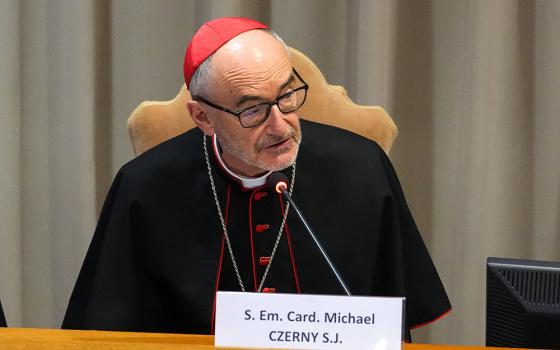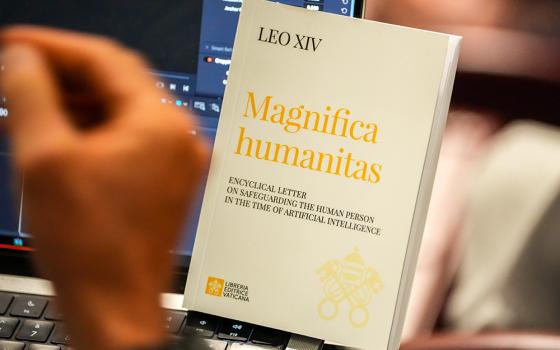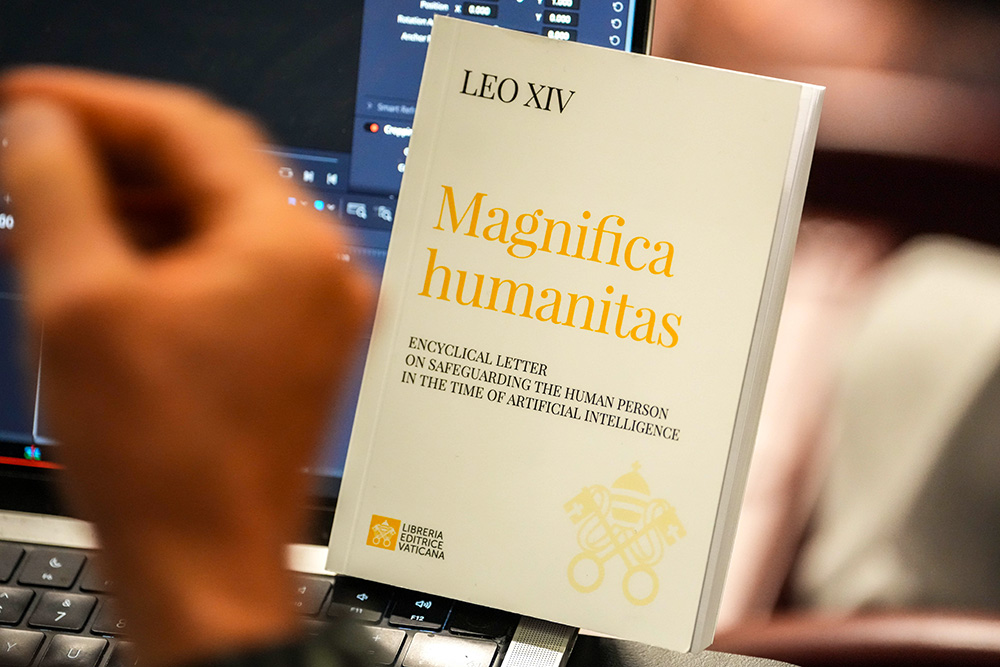
A copy of Pope Leo XIV's first encyclical, Magnifica Humanitas, is seen during a presentation on the document at the Vatican May 25, 2026. (CNS/Lola Gomez)

by Brian Fraga
Staff Reporter
Join the Conversation
Send your thoughts to Letters to the Editor. Learn more
With artificial intelligence developing rapidly and raising fears that the technology could upend if not threaten human existence, the world is hungering for guidance that the Catholic Church can provide, leading experts on AI told a Georgetown University panel.
"Even in San Francisco, folks who are not necessarily Catholic are looking for true moral leadership, something that is not guided by the pursuit of profit and productivity and efficiency alone, but a deeper set of values," said Jasmine Sun, a journalist who covers the culture and politics of AI for The Atlantic.
That search for moral leadership in the age of AI, Sun added, "is something that Magnifica Humanitas offers."
Pope Leo XIV's recent encyclical on humanity and artificial intelligence was a focal point of the Sept. 9 public dialogue at Georgetown University in Washington, D.C. The event was titled "AI, Catholic Social Teaching, and Pope Leo's Invitation to Dialogue with the World."
In welcoming the panelists and the audience who attended the dialogue, Eduardo Peñalver, president of Georgetown, said the timing of Magnifica Humanitas "could not have been better," both for the world and for the university, which is in the midst of crafting a campuswide initiative on artificial intelligence.
"Magnifica Humanitas invites us to reflect on the moral and human dimensions of AI from the perspective of Catholic social thought and the Catholic intellectual tradition," Peñalver said, adding that the encyclical invites people of goodwill to engage in collaborative discussions about AI.
Kim Daniels, director of Georgetown's Initiative on Catholic Social Thought and Public Life, which organized the discussion, said Leo had brought "the wisdom of the Catholic intellectual tradition" to this moment in history.
The encyclical, Daniels said, "begins a new chapter in the church's ongoing dialogue with the world, on what technological development means for work, for families, for public life and for human dignity. It asks us to consider who this technology is for and who is being left behind."
Archbishop Gabriele Caccia, the Vatican's ambassador to the United States who was appointed to that role in March by the pope, said the encyclical was born out of the pope listening to various stakeholders, which included scientists, engineers, political leaders, parents and teachers.
From that listening, Caccia said, the pope expressed his conviction in Magnifica Humanitas that "artificial intelligence needs to be disarmed," a strong claim that Caccia said is capable of "attracting attention, awakening conscience and lighting paths forward for humanity."
Anna Rowlands, the St. Hilda Chair in Catholic Social Thought and Practice at the University of Durham, said Magnifica Humanitas promotes a rational conversation about AI, which she said is vital given the prevalence of "magical thinking" about the technology's capabilities in secular tech spaces.
"One of the most profound aspects of this encyclical is the insistence that human beings are made for and within a world of limits, and limits are something not simply to be overcome," said Rowlands, who is a member of the Vatican's Dicastery for Promoting Integral Human Development.
Rowlands, who spoke at the Vatican's launch of Magnifica Humanitas in May, also said that the pope was looking to create a public space to discuss AI. She said one of the most misunderstood aspects of the encyclical that some critics voiced was that it did not offer specific policy solutions.
Advertisement
"The task of the church is not to offer solutions, which doesn't mean solutions can't be found," Rowlands said. "But that's what the process of our learning how to think through and reason through and reflecting upon these questions together is meant to produce."
Vilas Dhar, president of the Patrick J. McGovern Foundation, a philanthropic organization advancing AI for public purposes, told the Georgetown audience that the Catholic Church offers unique and important perspectives that include the conviction that any conversation about AI governance has to start with the inherent worth and dignity of the human person.
The church, Dhar said, also establishes "an institutional framework that is among the most significant in the world, through the followers of the faith and through the institutions that have supported civil society and our greatest aspirations for hundreds and thousands of years."
Dhar, who has served on the United Nations secretary-general's High-Level Advisory Body on Artificial Intelligence and is the U.S. government's nominated expert to the Global Partnership on AI, suggested that the church's posture toward artificial intelligence also comes from the moral humility of recognizing its own past failures in times of extreme change.
"I think one of the great things about the encyclical was its acknowledgement of how the church might have acted differently on questions of slavery," said Dhar, who described Magnifica Humanitas as "an incredible contribution to the discussion."
Molly Kinder, the CEO of the Breakwater Initiative, an organization building the policy response to AI's disruption of work, noted that the encyclical expounded on the essential nature of work for humans.
"I really appreciated that Pope Leo unequivocally stated that work is fundamental to the human experience," said Kinder, who suggested that there is a thirst for leadership that is not compromised by the financial and geopolitical factors that are driving AI's development.
"I think when Pope Leo unveiled this encyclical," Kinder said, "it went viral because I think the entire public, it doesn't matter if you're Catholic or not, has been looking for some clear moral human-focused guidance on where this should be going, not on where it could go, and I really do think that is the conversation that was started."
Sun, the journalist who has reported from Silicon Valley as well as in communities around the country being impacted by controversial AI data center projects, said there is a general lack of trust in tech leaders and their motivations and visions for the future.
"I think Pope Leo is one of many who are opening up the conversation for moral leadership on AI coming from folks who are not compromised by the industry," Sun said, adding that she was surprised by how many people she knew in Silicon Valley had paid attention to the encyclical when it was released.
"There was a lot more engagement than I expected," Sun said.