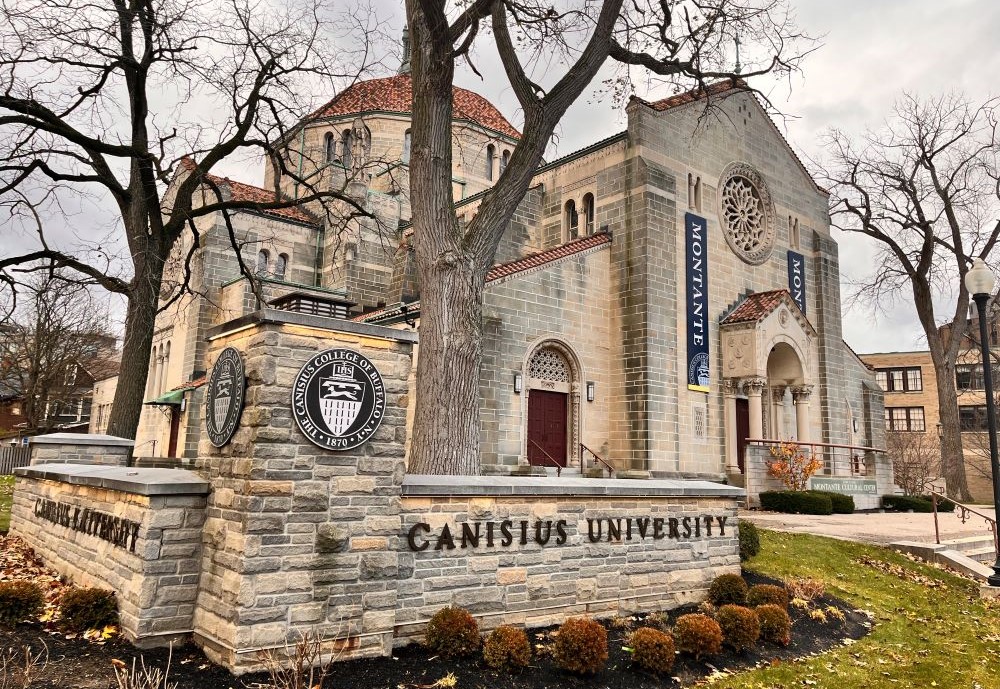
Montante Cultural Center at Canisius University is a former church now used for lectures and concerts. Canisius was among the first U.S. colleges to join the Vatican's Laudato Si' Action Platform in 2021. (George Cassidy Payne)

by George Cassidy Payne
Join the Conversation
Send your thoughts to Letters to the Editor. Learn more
Freshman Kylie Conway watches prospective students on a tour of Canisius University navigate the dining hall with trays in hand, pausing to figure out where leftovers belong. To her, the scene illustrates ecological care in everyday life.
"Canisius is a breath of fresh air in Buffalo," she says. "The city is industrial, but you can still find pockets of nature. Canisius highlights that — especially in the inner quad. The grounds are well cared for and garbage is always cleaned up."
Her attention extends to food waste. The university partners with Natural Upcycling, a New York company that diverts surplus food from schools and hospitals. Some becomes energy; the rest is transformed into compost for farms across the state.
"Even small actions on campus ripple into the wider community," Conway says.
These ripples reflect a deeper commitment. Canisius was among the first U.S. colleges to join the Vatican's Laudato Si' Action Platform in 2021. The multiyear initiative calls Catholic communities to develop plans mapping courses of action to respond to the cry of the Earth and the poor, foster ecological spirituality and strengthen local communities, among other efforts.
The Vatican program derives from "Laudato Si', on Care for Our Common Home," Pope Francis' 2015 social encyclical that framed climate change as a moral imperative and called the world to urgent actions in care of a common planetary home. At Canisius, that call has been embodied in compost bins, nature journaling, native plantings and community partnerships.
In its first year with the Laudato Si' Action Platform, Canisius, a Jesuit-run university, assessed its existing sustainability efforts and mapped a path forward.
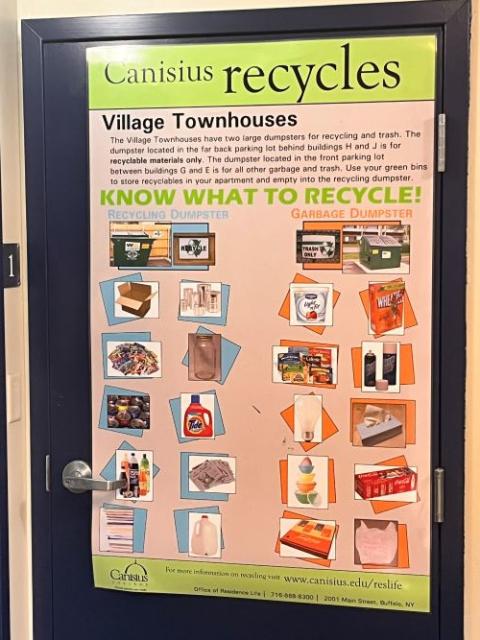
A poster on Canisius University's campus reminds people what items to place in recycling dumpsters. (George Cassidy Payne)
Dining venues have replaced disposable plastics with greenware products. LED lighting and low-flow fixtures now illuminate campus buildings. A partnership with a solar farm reduces the campus' carbon output.The university donated land for two community gardens in nearby food deserts and created academic minors in conservation and environmental sustainability.
"The healing and stewardship of our planet is fundamental to our Jesuit mission of building a just and humane world," says Jennifer Lodi-Smith, a psychology professor who researches how environments shape identity across the lifespan. "The earlier we engage young people and help them see that their actions matter, the more likely they are to carry healthy behaviors into adulthood, for themselves and for the world."
That formation extends beyond classrooms. Each year, Lodi-Smith leads students, and not only environmental science majors, on an immersion trip in the Everglades. Guided by ecologists, they wade into cypress domes, observe alligators, birds and mushrooms, and reflect through nature journaling.
"We call it self-expansion," she says. "Students learn ecological connections between waterways, wildlife and their own well-being."
Many camp for the first time, forming bonds with classmates and the natural world while learning safety, stewardship and outdoor skills.
Back in Buffalo, the lessons continue. Students spot migratory birds, trace ecological patterns and notice the rhythms of nature in daily life. Lodi-Smith sees this as part of a broader cultural shift.
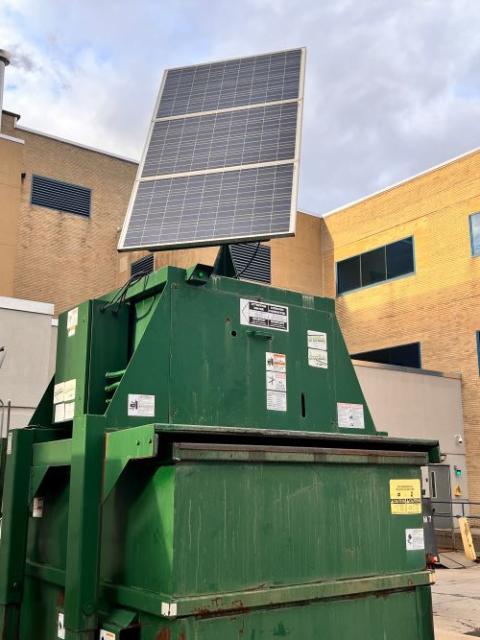
Solar power fuels a waste disposal system at Canisius University (George Cassidy Payne)
"Canisius shows how we care for the world," Lodi-Smith said. "When students see leaders and staff using reusable bottles and mugs, they translate those lessons into their own behavior. When people feel they belong, they embrace these priorities."
Campus cues reinforce that ethic, like bird-friendly spaces, native plantings and refillable mugs. So do moments of wonder outdoors, intentionally cultivated in programs. Lodi-Smith said that it's important to give special consideration to students of color, for whom opportunities to experience national or state parks are not always accessible.
"Creating spaces where they discover joy and belonging in nature is transformative," Lodi-Smith says.
Catholic theologian Luis-Alejandro Dinnella-Borrego places these practices in a wider vision. "Laudato Si' addresses not only the environment but the health of social institutions and communities. Integral ecology insists everything is related — society, human life and the environment. Pope Francis calls for authentic community grounded in love and charity."
Ecological commitment often begins with what people already love, said Katie Mylenbusch, senior director of development for the Laudato Si' Movement, a global network of 900-plus Catholic organizations committed to ecological matters.
"We help people reflect on what brings them joy or healing in nature and connect those values to Catholic teaching and moral responsibility. Even with the loss we've witnessed — species, habitats — there is still time to act," Mylenbusch said.
Conway sees that hope in daily campus life. Dining halls highlight locally sourced ingredients. Students use OZZI reusable containers, exchanging them for clean ones without washing. Teaching kitchens grow herbs and greens. Food scraps become compost.
Advertisement
"Students may not think separating food waste matters, but it does," the Canisius freshman says, pointing to how diverting food from landfills can equate to eliminating tens of thousands of metric tons of greenhouse gas emissions.
Her reflections echo a core Jesuit principle: men and women for others. Caring for the world, she believes, is inseparable from caring for people. "Many on campus are spiritually motivated to make a positive change. Being for each other means being for the world, too."
Conway acknowledges the challenges, too. Habits can be hard to break, and financial realities can slow sustainable initiatives.
"It's hard to show progress, but it adds up. Landfills and waste are pressing issues, and every small action helps," she says.
Efforts like precycling, reducing single-use plastics and consolidating shipments complement larger projects such as community gardens, which support food-insecure neighborhoods and foster cross-generational learning.
Looking ahead, Conway imagines a future student stepping onto campus and experiencing firsthand how environmental stewardship becomes spiritual practice — where caring for creation is seen as inseparable from caring for neighbors, the oneness in community and what it means to live a Catholic life.
"The landscaping is something they take pride in. Some of the compost from food waste is used to plant trees on campus. It shows how circular it can be."