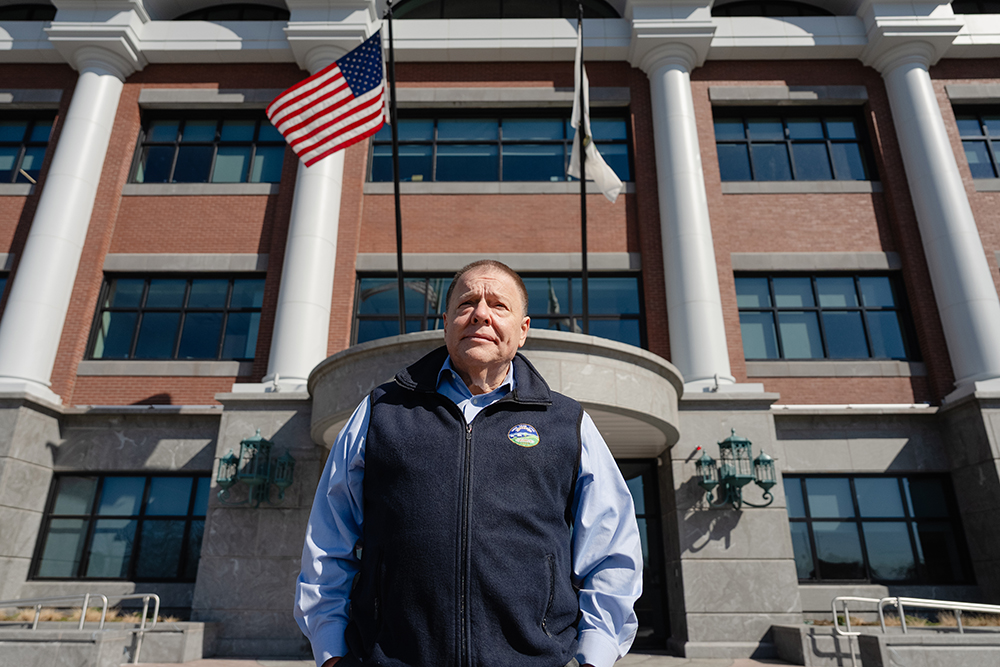
Thomas Koch, mayor of Quincy, Mass., stands in front of the city's new public safety headquarters building where he wants to place two saint statues. (Courtesy of Becket Fund)
by Brian Fraga
Staff Reporter
Join the Conversation
Send your thoughts to Letters to the Editor. Learn more
A legal clash between church and state that has the potential to reach the U.S. Supreme Court is playing out in Quincy, Massachusetts, a medium-sized city 11 miles south of Boston.
Quincy Mayor Thomas Koch, a conservative Catholic who left the Democratic Party in 2018 because of his anti-abortion views and who has blamed "homosexual issues" for the clergy sex abuse scandals in the church, is trying to install two large bronze statues of Catholic saints on the edifice of the city's new public safety headquarters.
Koch and his allies argue that the Italian-crafted statues of St. Michael the Archangel and St. Florian — the respective patron saints of police officers and firefighters — transcend religion and have long-held symbolic meanings of protections for first responders.
"These statues will reflect the values our police officers and firefighters live out every day — courage, sacrifice, and service. Honoring those ideals should unite a community, not divide it," Koch said in a prepared statement.
The American Civil Liberties Union and Americans United for Separation of Church and State have sued to prevent the statues from being erected. In October 2025, a state judge agreed with their arguments and ruled that the statues violate the Massachusetts Constitution's guarantee that all religions are equal under the law.
The state's highest court — the Massachusetts Supreme Judicial Court — agreed to hear the case on appeal, and on May 6 attorneys for both sides, accompanied by Quincy residents and uniformed public safety officials, presented their arguments in a packed Boston courtroom.
"The reason that these figures are being proposed for the building is not because of their religious significance, though they do have that," said Joseph Davis, an attorney with the Becket Fund, the Washington, D.C. law firm known for litigating high-profile religious liberty cases before the U.S. Supreme Court. The Becket Fund is representing Quincy.
Though they have religious roots as Catholic saints, Davis argued that over time Sts. Michael and Florian have "come to take on a broader significance" representing firefighters and police officers more generally.
"These are the figures that embody the virtues they seek to display," Davis said.
Advertisement
Jessie Rossman, legal director of the ACLU of Massachusetts, argued on behalf of 15 Quincy residents who joined the lawsuit asserting that the statues' civic symbolism does not outweigh their religious significance.
"You have two Catholic saints ... whose power to inspire is directly connected to Catholic doctrine, and who are on the outside of a building that is meant to be welcoming and to ensure that people have equal access to public safety services," Rossman said.
The Massachusetts justices peppered both sides with challenging questions. Justice Gabrielle Wolohojian noted that no other fire and police departments in the state had statues of either saint on their buildings.
"Isn't that part of history and tradition as well?" Wolohojian asked. "This would be the first one in the commonwealth."
Justice Serge Georges, Jr., noted that Quincy's contract with the Italian artist who created the statues — at a cost of $850,000 to city taxpayers, according to court documents — refers to them as patron saints.
"If these statues inspire first responders and that depends on their traditional roles as protectors of firefighters and police, is the city then asking us to separate the secular and professional meanings from the religious intersection that gives these symbols their force?" Georges asked.
While grilling Rossman, Justice Scott Kafker raised the question of how the U.S. Supreme Court would look at the case. He noted that the high court in recent years has expressed concerns about government actions that can be seen as hostile to religion.
"We can't allow more hostility to religion than the Supreme Court would tolerate, and they have a very low tolerance," Kafker said.
"We can't allow more hostility to religion than the Supreme Court would tolerate, and they have a very low tolerance."
—Justice Scott Kafker
Rossman responded that government neutrality toward religion "is not the same as government hostility to religion." Later asked about the possibility of the Supreme Court reviewing the case on appeal, Rossman told reporters that there was no "potential violation of federal law" in prohibiting the statues' installation.
Davis, who also addressed reporters on the steps of the courthouse after the arguments, said the nation's high court would look askance at a state court ruling that determined the statutes were unconstitutional because they depict Catholic saints.
"If you had a decision that says [the statues] can't be displayed because they also have a religious meaning to some people, that's hostility to religion," Davis said. "I think that's the kind of thing the U.S. Supreme Court has been quite sensitive to in recent years."
Claire Fitzmaurice, a Quincy resident who grew up Catholic but now attends a Unitarian Universalist church, is one of the 15 city residents challenging the statues. She said the city "does not have the right to elevate one religion above any others, certainly not on my dime."
"To affix these statues permanently onto our new public safety headquarters is to signal that non-Catholics have second-class status in Quincy," she said. "Such discrimination is anti-American."
More than a dozen organizations, including several large firefighter and police unions, submitted amicus briefs asking the Supreme Judicial Court to rule in Quincy's favor. The Knights of Columbus submitted a filing expressing concern that a ruling against Quincy would make it impossible for civil authorities to honor its founder, Blessed Michael McGivney, because he was a Catholic priest.
A decision from the Massachusetts Supreme Judicial Court is expected by the fall.