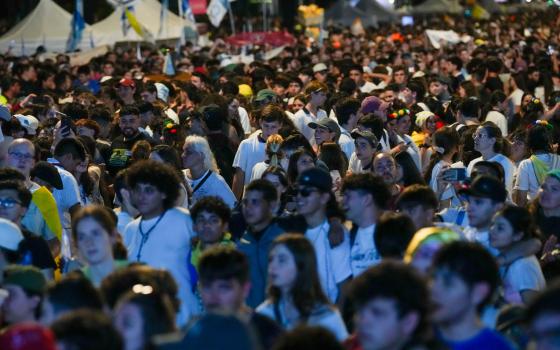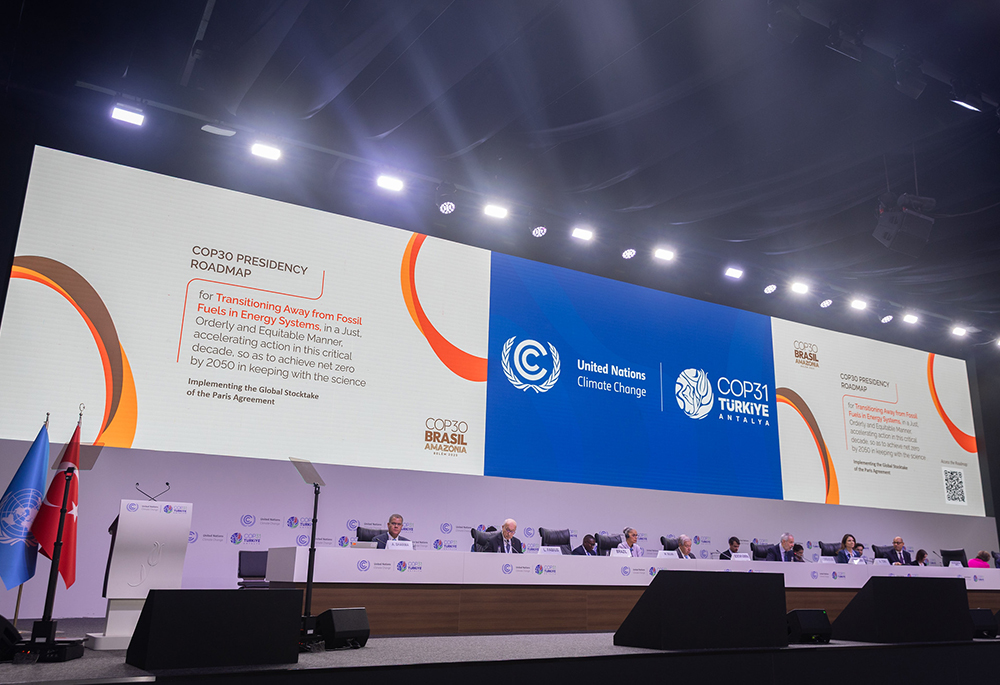
A key focus at COP31 in Antalya, Turkey, will be how countries address means to phase out the use of fossil fuels. Emissions released from burning coal, oil and gas are the main driver of climate change. (Courtesy of UN Climate Change/Kiara Worth)

Join the Conversation
Send your thoughts to Letters to the Editor. Learn more
With wars disrupting oil supplies, AI increasing energy demands and global temperatures on the cusp of breaching a critical threshold, Catholics attending the United Nations climate change summit in Turkey urged countries to refocus on phasing out fossil fuels and delivering funds to communities facing climate impacts.
COP31 began Nov. 9 in Antalya, with Turkey and Australia co-hosting the 12-day conference tasked with enacting the 2015 Paris Agreement on climate. That historic deal committed nearly every nation on Earth to reduce greenhouse gas emissions in order to limit global warming to 1.5 degrees Celsius (2.7 degrees Fahrenheit) above preindustrial times.
The U.N. meeting is the first since scientists acknowledged in August that it is "inevitable" that the world will reach and surpass 1.5 C by 2030, amplifying the risk of destruction from severe weather on societies and ecosystems. It also follows a summer of devastating climate impacts and months after dozens of countries met in Colombia to discuss pathways for a just transition from fossil fuels, the main source of heat-trapping emissions driving climate change. Catholic organizations in Antalya say COP31 must turn the tide from making new commitments to implementing past ones.
"COP31 can be the moment the world moves from recognising the [climate] crisis to responding with the urgency and solidarity it demands," Caritas Internationalis, the church's humanitarian network, said in a statement.
Numerous Catholic organizations have called specifically for COP31 to mobilize greater action on climate finance and a just transition from fossil fuels to renewable energy.
Both goals were included among the seven key priorities outlined by the Network of Catholic Climate and Environment Actors, which collaborates with the Vatican delegation at the climate COPs. The U.S. Conference of Catholic Bishops and its overseas aid agency, Catholic Relief Services, also endorsed them.
"Echoing the call of our Holy Father, we ask leaders to leave Antalya having matched the scale of their commitments to the scale of the need — and to remember, in every negotiating room, that behind every number is a family making difficult, daily decisions on survival amidst more extreme, erratic, and frequent climate shocks," Archbishop Shelton Fabre and Bishop A. Elias Zaidan, chairs of the committees on domestic and international development, said in a joint statement with CRS president and CEO Sean Callahan.
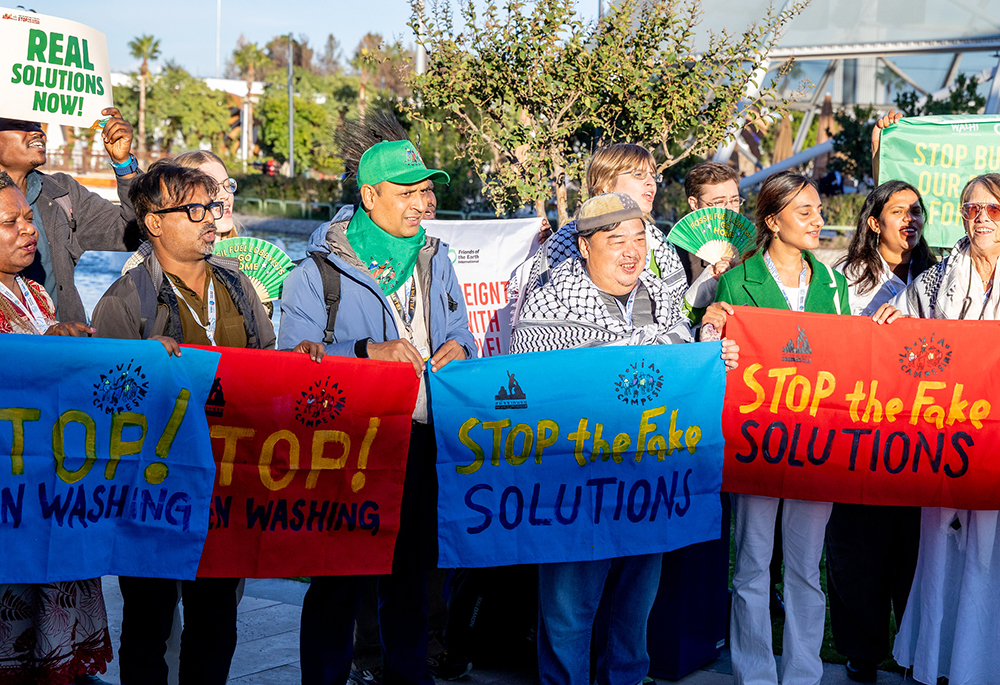
Environmental activists lead a protest outside the main hall at the COP31 United Nations climate change conference in Antalya, Turkey, on Nov. 9, 2026. (Courtesy of UN Climate Change/Kubilay Ciftci)
Catholic groups have called on developed countries to deliver on the past pledge to mobilize $300 billion annually, and as much as $1.3 trillion, in climate financing, primarily in the form of grants instead of loans that push developing countries further into debt. They said funding must also meet commitments to triple funds for adaptation, to at least $120 billion a year by 2035, to assist communities with adapting to the impacts of a heating world.
Caritas called climate finance a matter of "justice, not charity." A 2025 U.N. report estimated adaptation costs in developing nations at $310 billion annually by 2035. In the Pacific alone, where sea rise is threatening island nations, countries face a shortfall of $4.7 billion to $6.3 billion for adapting to more extreme cyclones and drought and recovering losses and damage from more extreme weather, along with adopting renewable energy, according to a report from the New Zealand Caritas chapter.
Global energy investment is projected at $3.4 trillion in 2026, per the International Energy Agency, with $1.2 trillion in coal, oil and gas compared to $665 billion in renewables and $80-plus billion in nuclear.
"We know that there is money in the system because we know that public money continues to support coal, oil and gas. So how do we redirect this flow?" said Gina Castillo, senior climate policy adviser with Catholic Relief Services.
Before COP31 began, Brazil put forward two roadmaps: one to phase out fossil fuels and another to halt and reverse deforestation. Both were proposed at COP30, held in the South American country at the edge of the Amazon rainforest, but ultimately left out of the final texts.
The fossil fuel phaseout roadmap follows the first Conference on Transitioning Away from Fossil Fuels in April that brought together nearly 60 nations, including the Holy See.
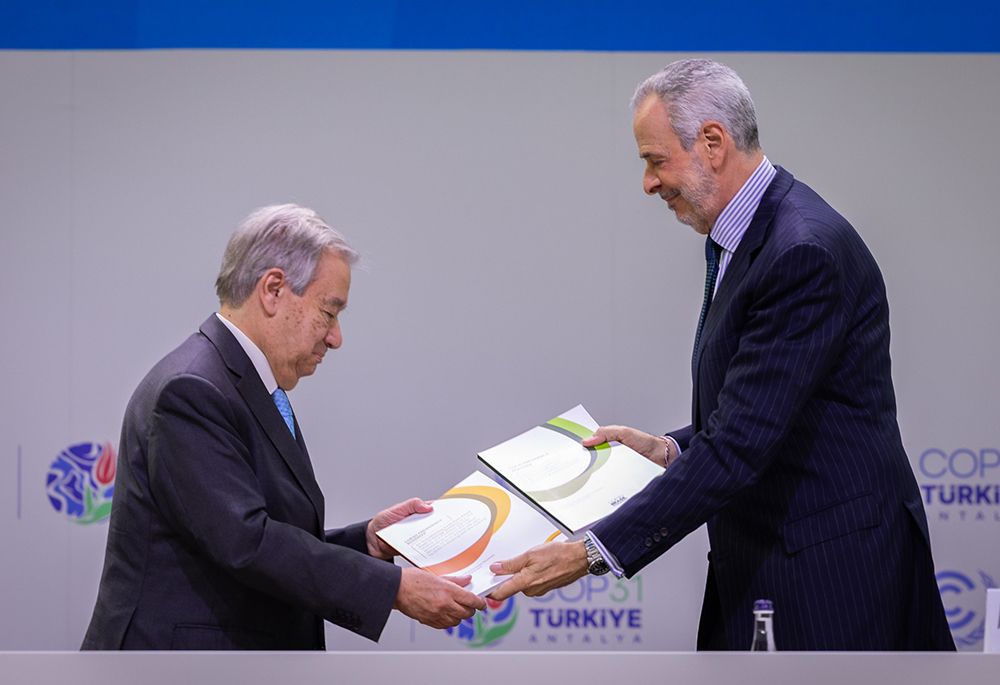
André Corrêa do Lago, the Brazilian diplomat who served as president of the COP30 climate summit, hands two roadmaps to phase out fossil fuels and end deforestation to U.N. secretary-general Antonio Guterres Nov. 10 at COP31 in Antalya, Turkey. (Courtesy of UN Climate Change/Kiara Worth)
A number of countries — among them, France, Germany and the Netherlands — have put forward fossil fuel phaseout roadmaps. More could come in Antalya. While 154 countries have submitted updated national climate plans, covering 70% of global emissions, collective progress in lowering emissions to meet the 1.5 C goal "remains substantially off track," according to an October U.N. progress report.
CIDSE, a European-based network of Catholic social justice organizations, called for governments to align their national adaptation and emissions reduction plans with fossil fuel transition roadmaps. It also endorsed a binding treaty on fossil fuels, calling it "the only credible mechanism to complement the Paris Agreement and as the way to phase out dependency on coal, oil and gas."
Likewise, the Laudato Si' Movement supported the development of a fossil fuel treaty. It also urged COP31 to end new fossil fuel expansion and development and to introduce permanent taxes on fossil fuel profits and other extractive activities as a means to direct funds to communities facing climate impacts.
Advertisement
CIDSE and its member organizations will host four events at COP31 on just transition, including an official side event Nov. 18 that will feature Colombia's former environment minister and Maina Talia, climate and environment minister of Tuvalu, which will co-host in 2027 the next fossil fuel phaseout conference with Ireland.
Catholic organizations have repeatedly emphasized that a just transition must put people first and ensure those most affected — like Indigenous and local communities whose lands are targeted for extracting rare earth minerals, alongside fossil fuel and other industry workers impacted by job losses — have a say in decisions, including the power to reject projects.
"The transition is not simply about changing how economies produce energy or manage resources. It is about changing the way societies value people, share resources and relate to the natural world," Caritas said earlier this month after it issued a report on principles for an integral and just transition.
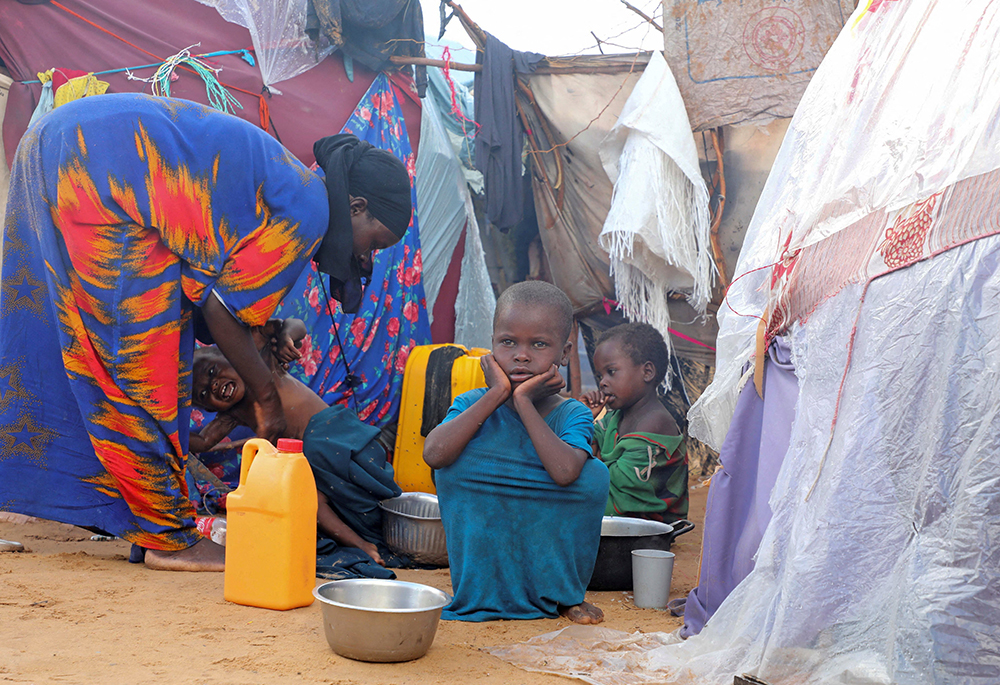
An internally displaced Somali family prepares breakfast outside their makeshift shelter in Mogadishu May 7, 2026. Somalia is nearing the brink of humanitarian catastrophe, aid and church organizations are warning, with nearly 6.5 million people experiencing high levels of "acute food insecurity" and more than 1.8 million children "suffering from acute malnutrition" because of recurrent drought, displacement, prolonged instability and insufficient resources. (OSV News/Reuters/Feisal Omar)
Protecting Africa's vital ecosystems and natural resources, including the Congo Basin, must be central to any climate action plans, said the Symposium of Episcopal Conferences of Africa and Madagascar in a statement outlining its priorities for COP31. The African bishops also backed protecting the rights and lands of Indigenous and local communities and increasing climate financing for the continent.
"Africa must not be viewed merely as a source of natural resources or as a recipient of climate aid. African countries and communities must be recognized as essential partners and stewards in the global effort to address the climate and biodiversity crises," said Cardinal Fridolin Ambongo, SECAM president.
Expectations for COP31 are tempered, with few major outcomes expected. Host countries Turkey and Australia proposed electricity to provide 35% of global energy consumption by 2035, though it's unclear if a final deal will stipulate generation from clean sources and not fossil fuels. Three years ago, countries committed to triple renewable energy by 2030.
In the time since COP30 in Brazil, which marked 10 years since the Paris Agreement was adopted, climate change has been overshadowed by other geopolitical developments.
The U.S. and Israeli war against Iran has upended global oil markets, at a time when countries aimed to be shifting toward clean energy. The war is one factor fueling rising costs of living worldwide while the rapid growth of artificial intelligence has posed questions whether it will hold greater promise or peril for humanity. During recent midterm elections in the U.S. — which withdrew from the Paris accord again under the Trump administration — climate change was a minor issue, with concerns about pollution and environmental damage from data centers, many of which are powered by fossil fuels, a bigger focus for voters.
All the while, the planet continues to heat at unprecedented rates.
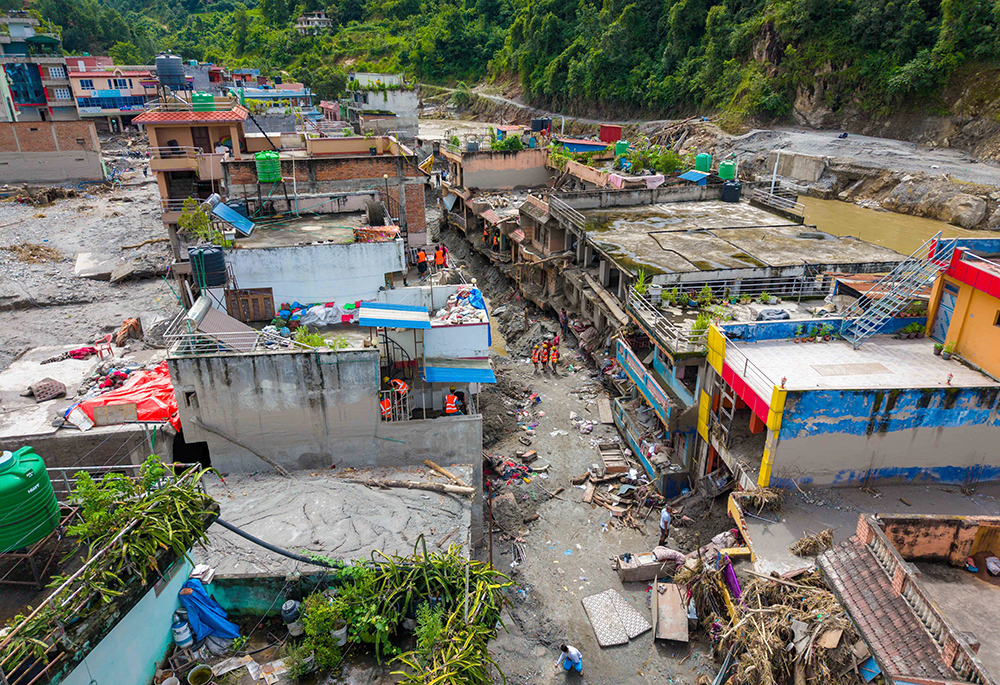
Destroyed buildings are seen in Nepal's Nuwakot region Sept. 2, 2026, following deadly flash floods and mudslides Aug. 26 that tore through Himalayan communities and left more than 1,000 dead. Preliminary analyses cited climate change as a factor in Nepal's devastation, and the issue will be at the forefront of discussions at COP31, in Antalya, Turkey, Nov. 9-20, 2026. (OSV News/Courtesy of Catholic Relief Services/Benny Manser)
Both the U.S. and Europe in 2026 experienced their hottest summers on record. In August a large rock section underneath a melting glacier collapsed in the Himalayas, triggering a massive flash flood and river of debris that killed at least 1,450 people in Nepal and Tibet, with more than 5,200 still missing. Preliminary analyses cited climate change as a factor, though scientists continue to study the collapse.
Catholic officials framed their role in attending the climate summit as connecting negotiators and decision-makers with the realities on the ground of people living right now with the impacts of climate change. Not only how it's affecting them but the solutions they identify.
"Governments negotiate based on what they consider politically feasible. Communities have to live with what is actually happening," said Jesuit Fr. Filipe Martins, director of the Jesuit European Social Centre, in Brussels.
In a newsletter ahead of COP31, Jesuit Fr. Rigobert Minani, regional coordinator for the Ecclesial Network for the Congo River Basin (REBAC), wrote that "The climate crisis cannot be understood as an environmental problem alone. It is also a social, economic, moral and spiritual challenge."
GSR Africa/Middle East correspondent Doreen Ajiambo contributed to this report.