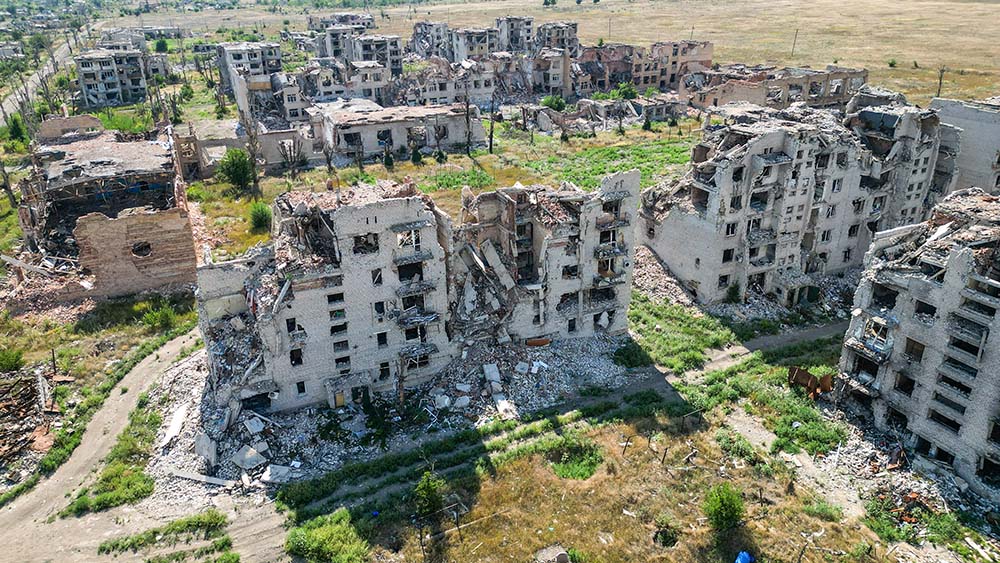
A drone view on Aug. 7, 2025, shows the ruins of residential buildings in the abandoned town of Marinka, Ukraine, which was destroyed in the course of Russia-Ukraine conflict in the Donetsk region, a Russian-controlled area of Ukraine. (OSV News/Reuters/Alexander Ermochenko)
by George Cassidy Payne
Join the Conversation
Send your thoughts to Letters to the Editor. Learn more
The whispered prayers for help from mothers clutching children in Ukraine amid the boom of Russian artillery are echoed here in the United States, thousands of miles from the war-torn region, by those who still feel deeply for their homeland.
In Rochester, in particular, where there is a large Ukrainian Catholic community, that same faith finds expression in the incense-laden liturgies where prayers are joined to those said in bomb shelters and basements back home.
These prayers have had greater poignancy this week, as world leaders gathered in Washington to debate security guarantees and the possibility of a trilateral summit with the leaders of Ukraine, Russia and the United States.
A century of faith on Rochester's East Side
Ukrainian Catholics began arriving in Rochester in the early 20th century, fleeing the upheavals of war, famine and repression. They carried with them an ancient Eastern Christian faith, rich in Byzantine rite and in communion with the Roman Catholic Church.
In 1936, the Ukrainian Civic Center opened in Rochester, serving as a vital cultural and communal anchor — with its library, social halls and even a bowling alley. Subsequent waves of immigrants, from World War II survivors to families escaping Soviet oppression, revitalized the community. Many later moved to Irondequoit, a suburb just outside of Rochester, where they established businesses, a Ukrainian Federal Credit Union, and churches that remain pillars of identity and solidarity.
And today, facing the war in their homeland, and as the White House attempts to broker a peace agreement, these Ukrainians in New York embrace a new mission: to be spiritual and humanitarian bridges, connecting the suffering of Ukraine with the solidarity of their adopted America.
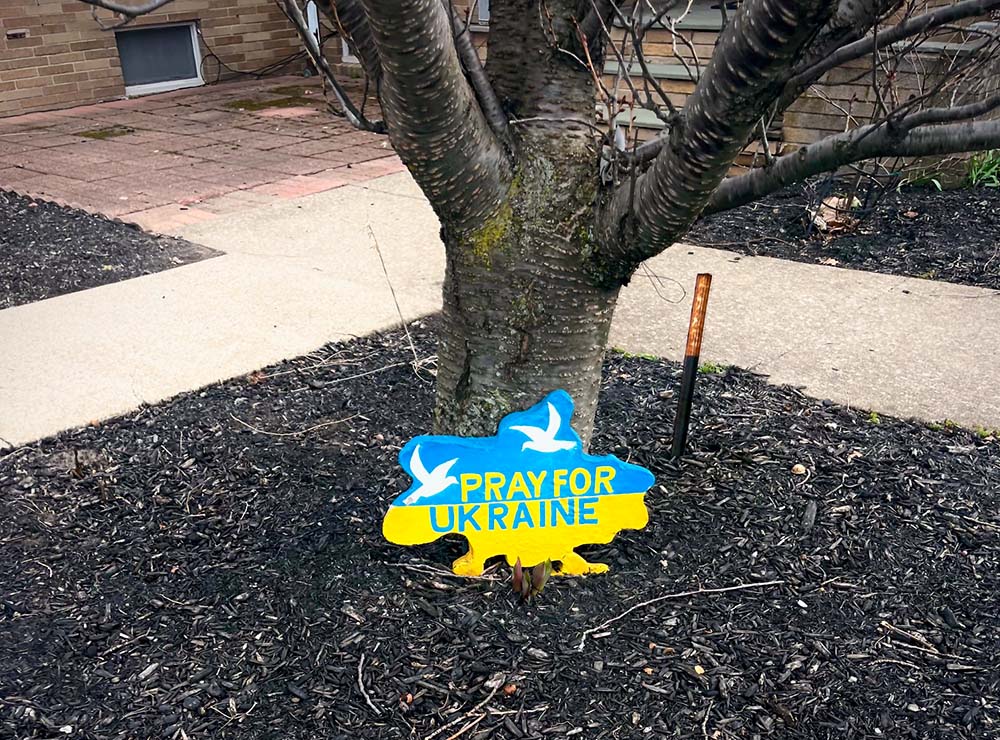
A sign outside St. Josaphat's Ukrainian Catholic Church in Irondequoit, N.Y., carries the hopes and prayers of the community. (George Payne)
At the heart of this mission stands the Ukrainian Greek Catholic Church. With liturgies steeped in Byzantine chant, iconography and fragrant incense, the church is more than a worship space; it is a citadel of memory, hope and defiance.
In Rochester, parishes like St. Josaphat's flicker with candles lit for loved ones still in harm's way. Grief is shared communally. Every Divine Liturgy becomes a quiet yet powerful act of rebellion against despair.
Since Russia's full-scale invasion in 2022, Rochester has welcomed more than 1,500 Ukrainian refugees. Through the federal Uniting for Ukraine program and the dedicated work of Catholic Charities Family and Community Services, these families are rebuilding their lives.
Catholic Charities Family and Community Services has provided transitional housing, employment aid and food security since April 2022. The agency's See Their Stories website offers refugees a place to share their testimonies of survival, resilience and hope.
"Rochester residents, faith communities and organizations are embodying true solidarity," a spokesperson for the agency said. "This is what faith in action looks like."
This war is not new
For many Ukrainian Americans, this brutal invasion is part of a centuries-old struggle against imperial aggression. "It's a persistent effort to erase Ukrainian identity," said Alexander Oryshkevych of the Ukrainian American Community Foundation.
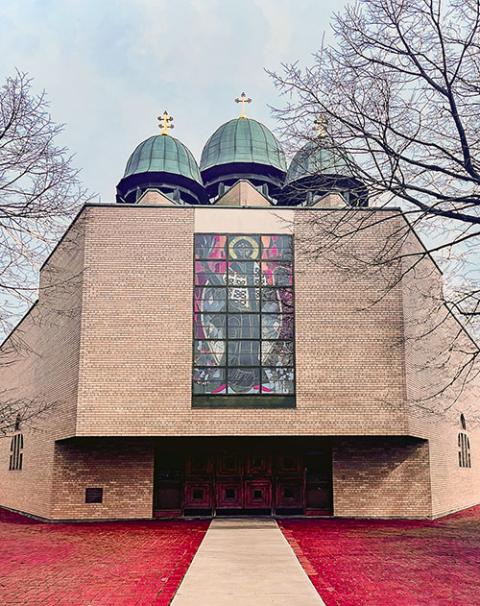
St. Josaphat's Ukrainian Catholic Church in Irondequoit, N.Y. (George Payne)
Second-generation Ukrainian American Bill Bastuk agreed, saying: "Putin fears a thriving democracy on his doorstep. A free Ukraine challenges his authoritarian grip."
For the city's Ukrainian Catholics, faith has become a form of armor, an inheritance passed down through generations, worn anew. They pray, gather, sing and believe, proclaiming that Ukraine's dignity and future are worth defending.
That spirit animates people like Elena Dilai, a Ukrainian American professor at Monroe Community College and board member of RocMaidan, a Rochester nonprofit that provides humanitarian aid to Ukraine.
The group, formed in 2014, raised more than $1 million in its first year and still brings in $300,000 annually, mostly from local residents.
"My birth country is still dear to me. I could not stand by," Dilai said of her involvement with the group, which operates from a donated Xerox warehouse.
At the request of Monroe County Executive Adam Bello, RocMaidan helped send five ambulances to Ukraine. Since then, it has shipped more than 1,350 first aid kits and 600 medical backpacks to frontline medics.
"It's not glamorous work," Dilai said. "But it saves lives."
The voice of a new generation
"We cannot stay silent," said Oleksandra Zakharchyshyn, a Monroe Community College graduate. "Especially now. The outcome of the war depends on it."
This past spring, Zakharchyshyn helped organize "From Ukraine with Love," a charity banquet at her college that highlighted NGO Zemliachky, an effort that provides protective gear to women soldiers.
"This was more than a fundraiser," Zakharchyshyn said. "It was a testament to strength found in unity, culture and purpose."
Advertisement
She spoke movingly about the injustices female soldiers face, from ill-fitting gear to societal invisibility.
"It's heartbreaking," she said. "The testimonies of women in Russian captivity are powerful and demand to be heard."
Zakharchyshyn's commitment is personal. Her paternal grandparents were deported to Siberia after her great-grandfather refused to relinquish their land to Soviet authorities. Another ancestor, a Catholic priest, was punished for resisting forced conversion.
"In Siberia, it was banned even to speak of Ukraine," she said. "When I asked my parents what our family endured because of Russia, that's what made me Ukrainian."
A monument to memory
Outside Irondequoit Town Hall stands a striking monument by sculptor Oleh Lesiuk: three bronze cranes in flight, rising from granite waves, symbolizing 100 years of Ukrainian immigration to Rochester. The Ukrainian trident and American flag rest side by side beneath.
This monument is a bold testament to faith in exile.
And today, as misinformation spreads about the war and people's distance from it can dull their sense of empathy, Dilai emphasized what is at stake.
"A student once asked: 'Is the war still going on?' I was floored," she said. "But I understand. People live in bubbles. Staying informed takes effort."