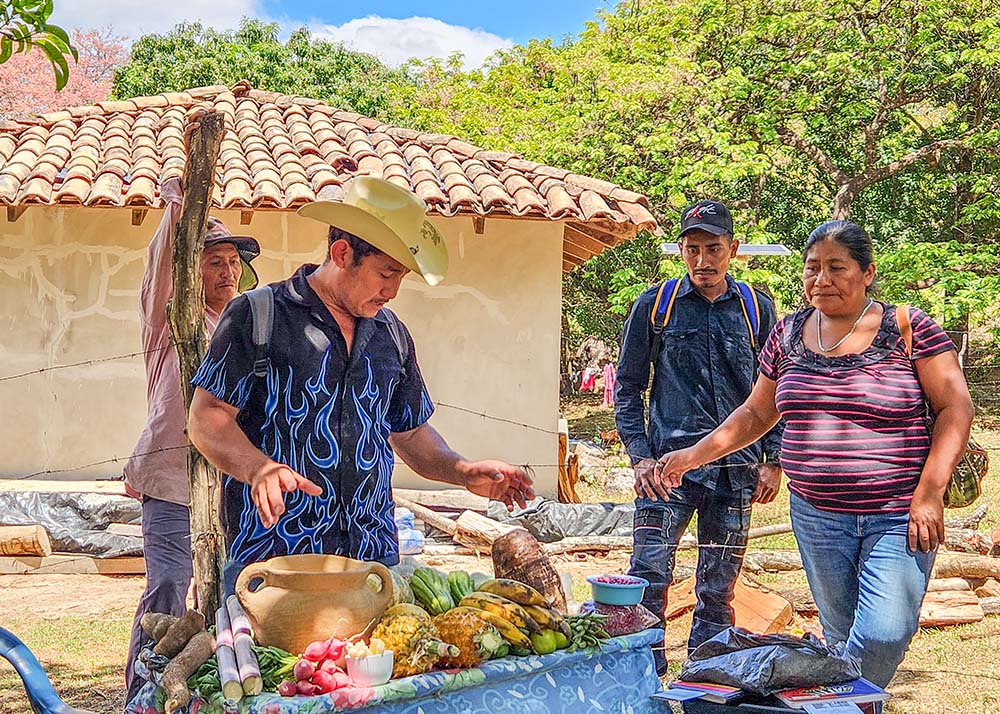
Desiderio Vasquez, a local farmer, shows off a colorful cornucopia of the bounty cultivated and grown partly through a series of irrigation systems the community of Los Hornos, Honduras, built with the help of Catholic Relief Services and local partners. (NCR photo/Brian Roewe)

Join the Conversation
Send your thoughts to Letters to the Editor. Learn more
Across the globe, Catholic Relief Services has worked with impoverished communities to adapt to the impacts of climate change. A new partnership with the world's largest climate fund is boosting those efforts, a year after massive cuts in U.S. foreign aid severely hampered the agency.
CRS, the overseas humanitarian arm of the U.S. Catholic bishops, announced on March 26 that it has received accreditation to the Green Climate Fund. Established in 2010 under the United Nations Framework Convention on Climate Change, the Green Climate Fund provides developing countries financing for projects to reduce greenhouse gas emissions that drive climate change and to build resilience to the impacts of a rapidly heating world. It is the main financial mechanism for the 2015 Paris Agreement.
In the decade since it has been operating, the Green Climate Fund has greenlit more than $20 billion for 354 projects and programs in 122 countries. It estimates those projects have impacted 1.6 billion people and helped avoid more than 1 billion metric tons in carbon emissions, or the equivalent of 22-plus million cars in a year.
As one of the 168 accredited partners to the Green Climate Fund, CRS can apply directly for financing and resources to develop and scale multimillion-dollar climate projects in consultation with national and local governments.
"We've been doing this work. This really does give us a chance to expand that work and ideally be able with this level of funding to take it to a broader number of communities and broader number of countries," said Shannon Senefeld, CRS executive vice president for global programs.
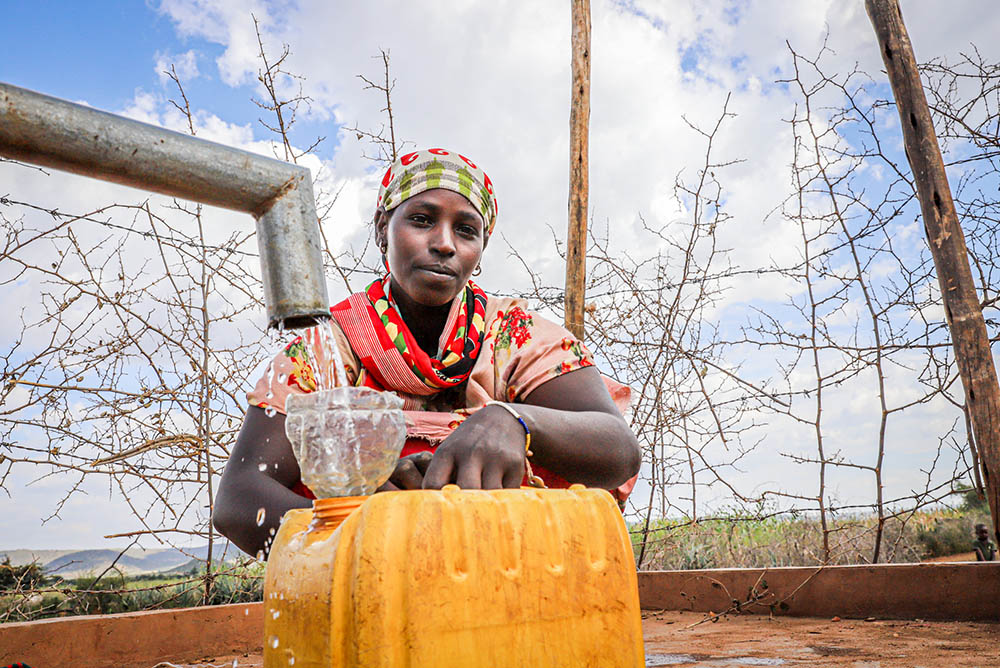
A woman fills a container from a water pump in Oromia, Ethiopia. Catholic Relief Services has worked in the community with local partners and government officials to provide drought-tolerant seeds to small-scale farmers and help them take other measures to make crops more resilient. (Catholic Relief Services/Melikte Tadesse)
CRS' accreditation is focused on communities most at risk to climate impacts — like crop fields decimated by extensive droughts, extreme storms and dried-up watersheds — and those who have been underserved in the past with climate financing.
"This new partnership creates opportunities to expand access to climate finance and support at-risk communities across developing regions," Achala Abeysinghe, director of the Green Climate Fund's department of investment services, said in a statement.
CRS began exploring accreditation with the Green Climate Fund in 2019 as it increased its attention to climate adaptation and resilience. That pivot in priorities was a direct response to the needs its staff witnessed on the ground in nearly all of the 122 countries where CRS operates. Farmers in Honduras and other parts of Central America have faced less reliable rainy seasons while more powerful hurricanes and storms have wiped out whole harvests. In northern Ethiopia, once-fertile landscapes have become barren due to increasing severe droughts followed by flooding that washes away nutrient-rich soil.
"What we're seeing in a lot of the countries where we are working is that the change in climate is negatively affecting overall development aspects and prospects for the poor communities," Senefeld told EarthBeat. "Whether it's recurrent drought or increased cyclones, et cetera, these are having a really negative effect on some of the poorest, most vulnerable communities that are out there.
"So we know that there's a need for some climate-smart work to happen, and CRS has really excelled at doing that to date. And so we think this is a great opportunity to take some of the work that we've been doing to scale within some of these countries."
The partnership with the Green Climate Fund will allow CRS to apply for funds for projects ranging between $50 million and $250 million. While CRS has managed projects with similar price tags, it hasn't done so around climate adaptation.
"We have experienced managing funds that large, but the ability to scale climate work at this level, that will be new," Senefeld said.
What those projects will look like remains undetermined at this stage. Senefeld said CRS hopes to build off its strengths in assisting local farmers, whether through more drought-resistant crop varieties, erosion-reducing measures and watershed management, and training farmers in new techniques and how to quickly identify and respond to threats to crops.
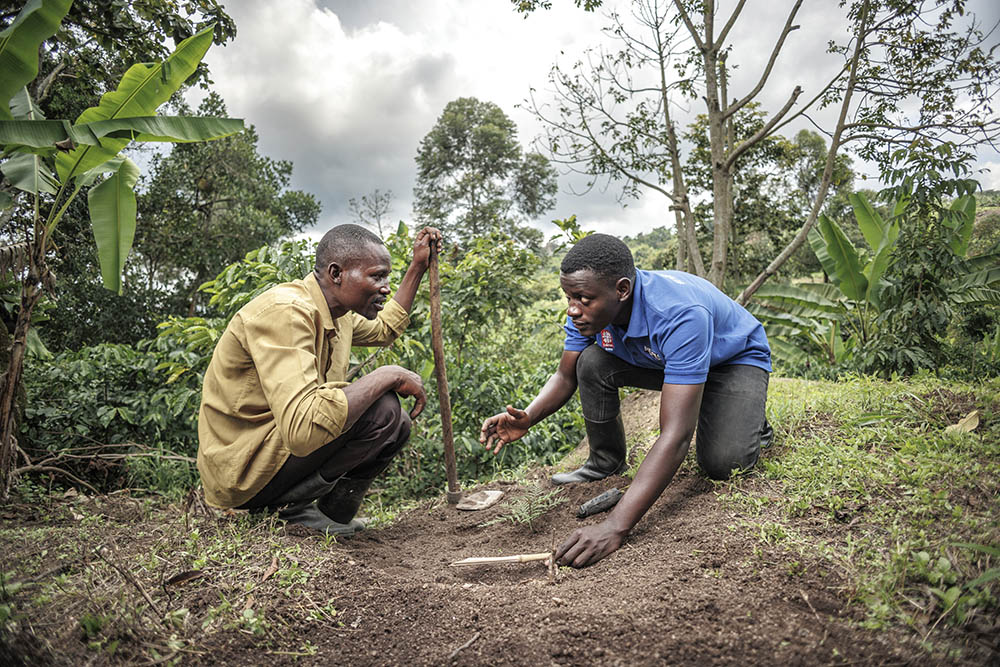
Tumusiime Brian, right, a Catholic Relief Services Uganda project supervisor, examines the progress of sprouting trees with Joseph Kisembo, a participant in the Catholic agency's Restore Africa program that aims to restore 100 million hectares of degraded land on the continent by 2030. (Catholic Relief Services/Jjumba Martin)
The ability to access funds through the Green Climate Fund comes just over a year since CRS operations suffered major losses as the Trump administration canceled the majority of foreign aid the U.S. distributed through the U.S. Agency for International Development, or USAID. A primary target for cuts were climate-related programs, part of President Donald Trump's wider efforts to eliminate federal action on climate change.
CRS was a major USAID recipient, and the foreign aid cuts had a significant impact on its climate programming, which was often integrated into development and humanitarian work, said Robyn Fieser, CRS deputy director for media relations.
Nearly all programs not determined to be lifesaving were terminated, Fieser said, "including those that helped farmers adapt to changing climate, and assisted communities to prepare for weather-related disasters." That included climate-smart agriculture training for farmers and watershed restoration in Ethiopia and Madagascar, and a major program in the Philippines to help cities prepare for and become more resilient to extreme storms.
The U.S., the largest historical source of greenhouse gas emissions, has been criticized for not paying its fair share to climate financing for developing countries, many of which contribute relatively little emissions but face significant impacts. Its total contributions equal $2 billion, according to the World Bank, which serves as trustee of the fund.
Catholic organizations, including CRS and the U.S. Conference of Catholic Bishops, have repeatedly called for the U.S. to pay more into the Green Climate Fund, framing it as a moral obligation for a major contributor to climate change and as a means to address poverty, food security and political instability abroad.
Advertisement
During both his terms in office, Trump has canceled payments to the Green Climate Fund and in January he announced he would withdraw the U.S. altogether from it. That move came alongside a planned exit from the U.N. climate convention, the base treaty for the Paris Agreement.
"These decisions will have painful and direct repercussions on the lives of vulnerable populations and God's creation already suffering from a changing climate," Bishop Elias Zaidan, chairman of the bishops' Committee on International Justice and Peace, told EarthBeat in a statement at the time.
To date, the Green Climate Fund has amassed $20 billion in its portfolio, with an additional $59 billion in cofinancing, according to a report by the fund at its 10-year mark. Roughly $6 billion has been distributed to projects, with the largest share of approved funds ($7.2 billion) directed toward Africa.
Initially, developed countries pledged $100 billion annually by 2020 in climate financing that would be distributed though financial vehicles like the Green Climate Fund. They reportedly met that target two years late, though the financing has been questioned. In 2024, at the COP29 U.N. climate summit, developed countries agreed to $300 billion annually by 2035 in climate financing, well short of the $1.3 trillion developing countries sought and that economists estimate will be required.
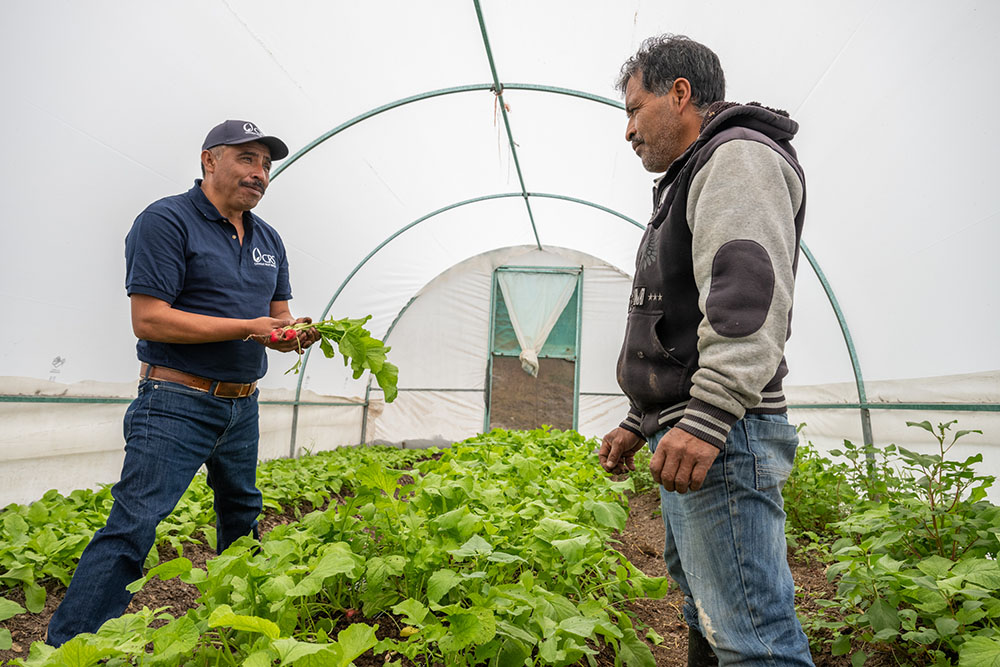
Severiano Martínez, left, technical associate for Catholic Relief Services Mexico, provides technical advice to Jesús José Gómez Rodríguez, a participant in CRS’ Water-Smart Agriculture program, at a greenhouse in San Miguel Chicahua, Oaxaca, Mexico, Dec. 6, 2023. (Catholic Relief Services/Thor Morales)
In the coming months, CRS plans to identify climate projects in consultation with government officials in countries where it's working.
As it completed the application process, CRS reached out to its country offices for ideas on possible projects. Responses were quick and plentiful.
Some proposals sought to expand existing programs in Central America around drought-resistant agriculture, and soil conservation and watershed management in Ethiopia and Madagascar. Others suggested looking at ways to increase sustainability and land management practices with lands owned by the Catholic Church.
"There's no shortage of examples of where our countries would like to go forward and continue this work," Senefeld said.
This article has been updated to add comment from CRS on the effect of foreign aid cuts.