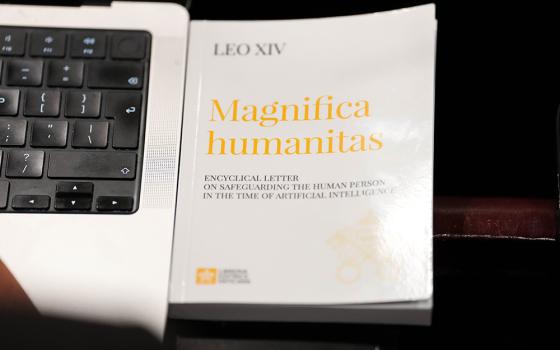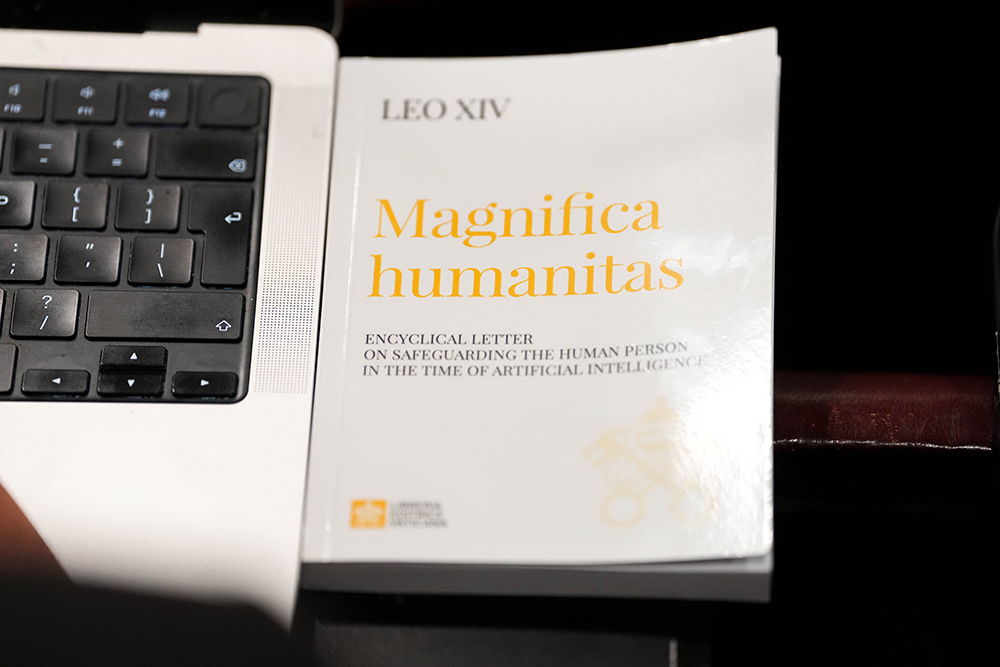
A copy of Pope Leo XIV’s first encyclical, “Magnifica Humanitas: On Safeguarding the Human Person in the Time of Artificial Intelligence,” is seen during a presentation on the document at the Vatican May 25, 2026. (CNS/Lola Gomez)

by Daniel J. Daly
Join the Conversation
Send your thoughts to Letters to the Editor. Learn more
Pope Leo XIV's encyclical Magnifica Humanitas makes several key theological and moral claims that have significant implications for human flourishing in the age of artificial intelligence.
According to Leo, humans flourish when they enjoy personal health and well-being, practice the virtues, engage in dignified work, enjoy leisure and cultivate friendship with God and neighbor. This vision contrasts with the technocratic paradigm, which views technology as the source of all human goods. The contrast becomes especially clear when Leo's vision is set alongside the hopes that animate many of today's most enthusiastic advocates of AI.
Techno-optimists like Ray Kurzweil yearn for a posthuman future involving the complete digitization of the person's essence, which is nothing more than one's ideas and information. Kurzweil argues that AI can free the person from biology and the inevitable decline and death that organic beings suffer. Only when the person's information is captured in silicone will they be optimized and achieve the technological divinization that AI promises to inaugurate.
While transhumanism and posthumanism see a person's humanity as a problem to overcome, Leo's vision affirms the creatureliness and finitude of human personhood. He teaches that finitude opens us to relationship with God and others. Because humans are finite and dependent on others, no one can journey through life alone. In God's great providence, God creates human beings with limitations that drive them to need, and hopefully care for, one another.
Advertisement
The embodied person, with all their limits and sufferings, is not to be surpassed through technological interventions, but an intrinsically valuable creature of God, who "flourishes not despite limitations, but often through them." Consider that paradigmatic acts of flourishing involve meeting others' needs. Doctors and nurses flourish in caring for patients, while parents flourish when caring for children. We all flourish when we forgive those who have sinned against us, feed the hungry, accompany the dying and help a neighbor in need. We flourish not only by performing these acts, but by being recipients of them. Being cared for, forgiven, fed, accompanied and helped are also instances of flourishing because humans are fulfilled in relationships of mutuality.
Giving and receiving care for the imperfections that mark the human condition is at the core of human flourishing. Aristotle reminds us that the flourishing of a creature is related to its nature. The conditions for a dog's flourishing are not the same as those for a dogwood tree. Human beings, as finite and flawed creatures, flourish by loving God, self and neighbor in light of their limitations because these are indelible aspects of human nature.
Because posthumanists aim to free the person from their mortal coil, their target is not human flourishing, but rather, the optimization of a disembodied human consciousness. Posthumanism does not promise the enhancement of human persons, but rather, their annihilation.
Leo recognizes that the longings for flourishing and transcendence embedded in the thought of AI-utopians like Kurzweil speak to the universal human desire for more than this life can offer. However, instead of a technological divinization, Leo contends that grace is the answer to the yearning for more. Echoing St. Thomas Aquinas, he writes, "When we embrace the possibility of transcending ourselves through God's grace, we do not deny our nature, nor do we become less human." Human beings are fulfilled by being drawn out of themselves, by God, to befriend God and others. Leo's spiritual father, St. Augustine, recognized that happiness is a relational reality when he wrote in Confessions, "You have made us for yourself, O Lord, and our hearts are restless until they rest in you." Humans flourish with God, not alone.
AI, inequality and flourishing
Leo also invites us to ask: who will flourish in the age of AI? Will AI reduce or exacerbate the scandalous levels of poverty and inequality in the world? In one of the most important passages of the encyclical, Leo rejects the techno-optimist dogma that AI will produce a rising tide that lifts all boats. He writes:
While some regions spend heavily on superfluous interventions or dreams of individual enhancement accessible only to a select few, other parts of the world lack the essential equipment needed to save millions of human lives. To think that new technologies will automatically benefit everyone is to ignore the evidence. Unless transformations at the design stage prioritize the prevention of new and further disparities, technological progress will inevitably produce structural inequalities.
It is a profound injustice that while the privileged leverage AI for human enhancements and even a posthuman future, others starve, die of preventable and curable diseases, and live stunted and diminished lives. Magnifica Humanitas underscores that God intends the goods of the earth and cultural products to support the health and well-being of every person. The universal destination of goods extends to AI, which should be developed and distributed to promote the flourishing of every person, especially those whose basic needs are unmet. AI is not exempt from this moral guideline and must be evaluated in light of it.
AI, work and flourishing
As expected, Magnifica Humanitas considers how AI transforms human work. The encyclical emphasizes that human beings can flourish through their work. Leo does not present an idealized portrait of work, recognizing that work is often oppressive and that "new forms of slavery" have emerged in relation to digital supply chains.
However, following St. John Paul II, Leo notes that work is a necessary part of a fulfilling life. People develop skills, discover interests, exercise and extend capacities, cultivate moral virtues, and foster friendships through their work. It is through work that human beings contribute to the common good.

A welder works while building a bus frame at the BYD electric bus factory in Lancaster, Calif., July 1, 2021. (OSV News/Reuters/Mike Blake)
Leo's intervention here is important, as AI developers such as Elon Musk claim that work will be "optional" in the coming decades. Bill Gates predicts that by 2035, human physicians will be obsolete due to AI-powered robots. Because labor is a necessary part of a flourishing life, a world without work is not a utopia; it is a nightmare.
Some AI commentators have suggested that AI-related job displacement will create post-work societies, which will need to institute a universal basic income for residents. Although Leo is in favor of "financial assistance to the poor … in emergencies," he rejects the claim that such assistance should be the normal mode by which people provide for themselves and their families. Earning a wage that enables oneself and one's children to develop produces a healthy sense of accomplishment and self-esteem. In addition, many people experience work as an act of love for others. Why do we work? In part, we work for our children and all those who depend on us for their own flourishing. A society that fails to provide individuals opportunities to work is impoverished on multiple levels.
Pope Leo XIV's Magnifica Humanitas invites readers to reflect on how AI can both contribute to and threaten human flourishing. The pope surfaces important moral values and personal and social realities that the human community considers as it discerns the role of AI in society.