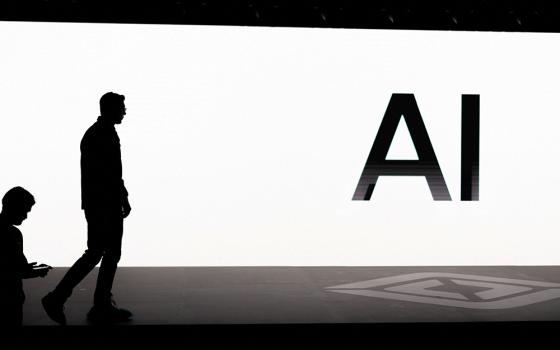
A screen reads "AI" as attendees gather at Rivian's first Autonomy and AI Day in Palo Alto, California, Dec. 11 2025, showing developments in self-driving technology. (OSV News/Reuters/Carlos Barria)
The reception of Pope Leo XIV's first encyclical Magnifica Humanitas is encouraging in that it appears to have captured the attention of Catholics and others who see in the rapid advancement of artificial intelligence a challenge for all of humanity. Continuing the tradition set by Pope Francis with Laudato Si', Leo has brought the full force of the church's intellectual tradition to bear on an emerging contemporary issue and gained the ear of the world. What happens in the coming months and years, however, will determine how much impact Leo and the church will have in the broader discussion around AI.
Think pieces, social media reels and university panels are helpful in bringing Leo's over 42,000-word encyclical to a mass audience, but alone, those kinds of engagement with the encyclical will not achieve its end. Magnifica Humanitas is ultimately asking for one very simple, yet very difficult result: conversion. And Leo is not directing his message only to tech giants, think tanks or legislatures. He wants conversion from us.
Leo sets before us a choice. We can toil in vain on behalf of the ever-rising Tower of Babel — that monument to hubris which echoes the serpent's original lie: "You will not certainly die. … You will become like God." Or, we can "get our hands dirty on the 'construction site' of our time" building the City of God, one brick at a time, where every hand is needed and used.
For Leo, the City of God looks like people in communion, bringing the light of the Gospel to bear on concrete situations, working together in service of neighbor and for love of God. However, the technocratic paradigm threatens to obscure even the most fundamental characteristics of humanity: mortality, limitation, dependence. That "overcoming" is an ancient desire until now only sublimated and expressed in stories of serpents in gardens, Faustian bargains, vampirism and alchemy. But now, our Tower of Babel is teetering precariously on the edge of catastrophe.
The church's social justice tradition offers a cure: a widespread metanoia, a popular recommitment to being entirely human. The charism and charge of Magnifica Humanitas are neither frictionless nor efficient. Rather, they compel us to commit ourselves to slow, faithful work. Anyone who has ever committed to the hard work of building something by hand — a stone wall, a patch of garden, even a homemade meal — knows the labor that goes into such human endeavors. Like the cathedrals of old, Leo invites us to consider the human work that goes into constructing something grand, the completion of which we may not live to see. In that sense, the encyclical is a meditation on tradition — the keeping alive and handing on of a precious flame.
Those with the power and means to initiate epochal change are unlikely to step back from building the Tower of Babel. As Anthropic, OpenAI and SpaceX vie for potentially some of the largest initial public offerings in history — estimated in billions of dollars, up to over $1 trillion — it will remain up to us to curb their excesses, imagine alternatives and remember what is in danger of being forgotten.
Leo has done what he urges us to do with the publication of Magnifica Humanitas — initiating a process of discernment focused on how we can remain both human and humane when ideals about what it means to be fully human are not fully embraced by those with the power to shape society.
Advertisement
Leo wants us to remember that as created, human beings, our interactions with one another matter more than our economic output. Writing about the irreducible value of physical gatherings, Leo calls them "signs of a humanity that continues to believe that every person's body is a dwelling place of God and a temple of the Holy Spirit."
All Catholics and all people of good will must ask ourselves: How will I be a sign of humanity today?
There are things that we can do right here and right now. First, in the face of unrelenting messages about optimizing our lives and transcending our limits, we must remind ourselves daily that we are human, that we are frail, fallible and sacred. We depend on God for all meaning and hope. When our devices deliver messages that condemn our humanity, we need to remind ourselves that those messages are inadequate and even treacherous. To be human is to struggle and suffer and grow old, but it is also to know love, joy, peace, patience, kindness, goodness, faithfulness, gentleness and self-control.
The fostering of a pro-human movement will require evangelization. And there too, Leo gives us a road map.
Then, there are daily decisions.
We can practice self-control by scrolling past the AI-summary of our search engine results and instead seek out information to consult, evaluate and synthesize ourselves forming original opinions and expanding our horizons.
We can cultivate patience by reading primary sources, for instance Magnificas Humanitas, before opening Instagram and ingesting the equivalent of empty calories.
We can be kind by renouncing outrage, and grow in gentleness by thinking of others as collaborators rather than opponents.
We become good by serving the poor, and engaging on a human scale. In addition to our monetary donations, perhaps direct service will rekindle a spark of humanity.
What it comes down to is that we must take responsibility for our humanity. We must accept our limitations, occupy our dignity and develop our potential. And all in service to others for the love of God.
The fostering of a pro-human movement will require evangelization. And there too, Leo gives us a road map. We do not impose the truth but witness to it, and we embrace its many sides, each of which is uniquely suited to a particular context. We listen and we learn. We do not avoid conflict but enter into it so as to transform it.
Perhaps the most powerful tool will be inviting people to embark on the process of remembering their humanity. To re-member ourselves will take time; time, which as Pope Francis taught, is greater than space.