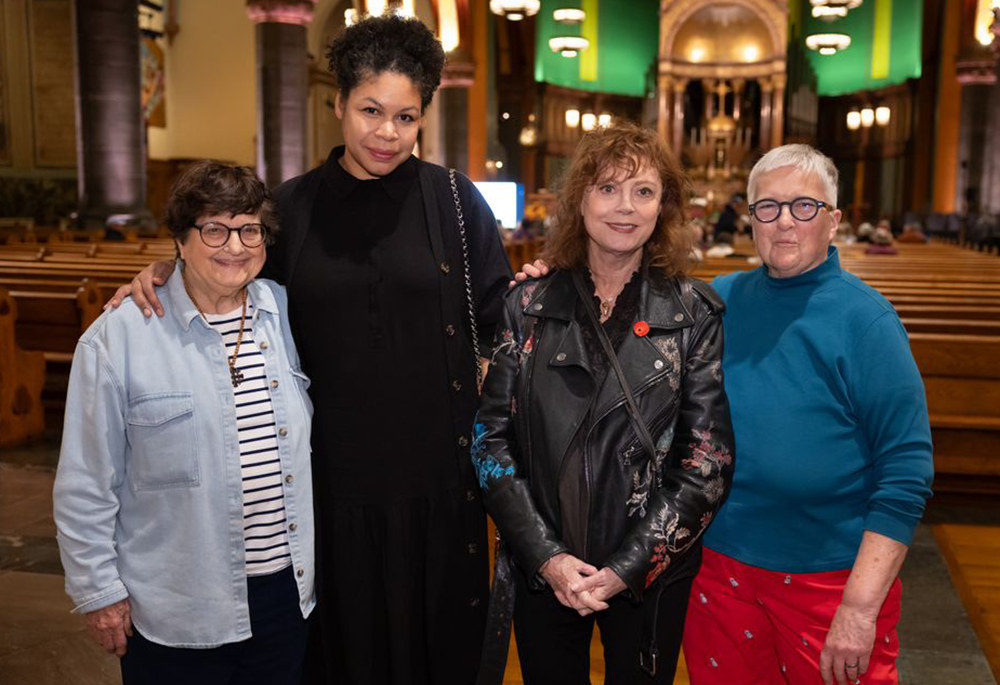
From left: Sr. Helen Prejean, Dead Man Walking author; Catherine Anyango Grünewald, illustrator for the new graphic edition; actress Susan Sarandon, who portrayed Prejean in the 1996 film; and Rose Vines, who adapted the text for the graphic novel, pose Nov. 6, 2025, at the book launch in Manhattan. (Fordham University/Leo Sorel)

Join the Conversation
Send your thoughts to Letters to the Editor. Learn more
How does a reader new to the world of graphic novels and memoirs approach an adaptation of a contemporary classic like Sr. Helen Prejean's Dead Man Walking?
The worry is this: Will the groundbreaking 1993 death row memoir — since adapted to the screen, stage and opera house — get flattened out or be lost in the combination of text and graphics?
My concern was based on being especially moved by both the Oscar-winning film and the opera adaption of Prejean's memoir of her ministry as spiritual adviser to death row inmates.
I needn't have worried.
Perhaps the new 304-page volume – published by Random House last year with a smart script by Rose Vines and illustrations by award-winning artist Catherine Anyango Grünewald – does not make the same demands a book without graphics makes. But, and it is a very substantial but, the new iteration of Prejean's now-classic text about Louisiana's death row is very much grounded in the original memoir.
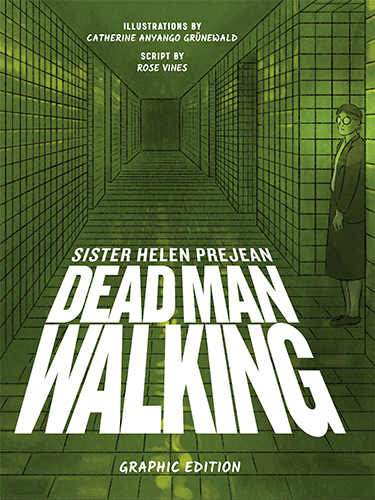
And at a moment when so much around us denies humanity to so many (and as state-sanctioned executions continue despite growing opposition to the practice), this new and arresting rendering of Dead Man Walking pierces the conscience.
It will no doubt find its intended audience — younger readers who were not born when the memoir, film and opera all entered public consciousness. But older readers like myself who are open to a new way of approaching a book can also find pleasure in the new volume.
Though there are new expansions to the original text — including a timeline on developments about the death penalty since 1993 — the memoir's moral core is very much intact. This is a story that respects and affirms the humanity of everyone: victim and perpetrator, survivor and witness.
As someone new to the world of graphic storytelling, I found Grünewald's finely etched illustrations handsomely amplify the text, and at times highlight details that might otherwise have been overlooked.
Just one example of a telling detail: After the execution of defendant Elmo Patrick Sonnier, the first death row inmate Prejean knew, an illustrated panel shows the St. Joseph sister meeting reporters after Sonnier's execution. She is asked whether she was in love with the defendant. "He said he loved you, didn't he?" one reporter asked, seeking a sensational angle to the story.
A panel shows Sr. Helen thinking "Oh, wouldn't they love that!" with an image of a National Enquirer front page depicting her in full habit with a headline screaming "Nun Falls for Murderer."
Advertisement
If that small detail has a knowing cast about American journalism, others are strikingly poignant, particularly as we read of the second case of Prejean's memoir, that of Robert Lee Willie, convicted of murder and rape.
A two-page dark blue and green color panel movingly and effectively evokes, rather than depicts, Willie's crimes. Before we turn the page, we see Prejean saying, "My heart freezes at the thought of a relationship with this man."
And indeed, the new rendering of Dead Man Walking does not simplify the complexities and considerable challenges of Prejean's ministry. Particularly memorable is Prejean's calling out Willie's criticism of Vernon Harvey, the stepfather of murder victim Faith Hathaway, who spoke out publicly on the need for Willie's execution.
"The girl's dead now, he just needs to let it go, man," the death row inmate tells Prejean. Prejean shoots back, "You realize you are the last person on earth with the right to say that to Vernon Harvey." Privately she muses that "Robert Willie should fall on his knees, begging forgiveness from these parents."
Elsewhere, in a beautifully rendered set of details, Hathaway's mother Elizabeth Harvey speaks to Prejean about the last time she saw her daughter, and how she noticed the girl's torn right sandal and suggested she should change her shoes.
"You don't know when your child leaves through a door that you are never going to see her alive again," Harvey tells Prejean. "If I had known, I would have told her how much I loved her. My last words to her — the last she ever heard from me — were about her sandals."
The startled reader is left to reflect on the text while scanning an illustration of the broken sandal.
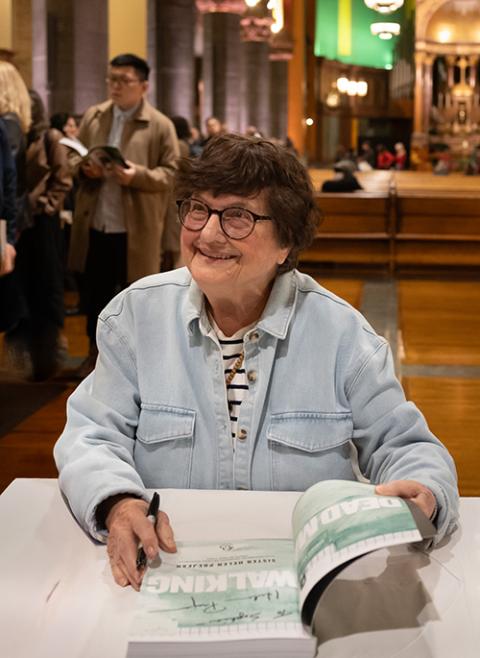
Sr. Helen Prejean autographs the graphic version of Dead Man Walking during a Nov. 6, 2025, book launch at St. Paul the Apostle Church in Manhattan, sponsored by the Fordham Center on Religion and Culture. (Fordham University/Leo Sorel)
Those familiar with Prejean's story know that, in addition to her growing awareness of the unjust system that undergirds the death penalty, a moral core of the book is the fear of betraying the victims. And, even more poignantly, Prejean's slow recognition — too slow, she acknowledges — of the need to reach out to the victims' families. (Prejean eventually organized a group to help family survivors.)
In the first case, Prejean said she cannot accept that the state of Louisiana "plans to kill Patrick Sonnier in cold blood."
Still, she says the young victims haunt her. "When I think of them, why do I feel as if I have murdered someone myself? The victims are dead and the killer is alive and I am befriending the killer? Have I betrayed the victims?"
Later, she says, "I've been avoiding the victims because I'm afraid they'll turn on me and attack me. I fear their anger and rejection. Plus, I feel so helpless in the face of their suffering. I can't begin to know how to help them."
As in life, the book shows quotidian and larger, expansive realities mixing seamlessly. In a series of panels showing Prejean preparing a meal, chopping tomatoes, she muses that an encounter with the Harveys was one of the most painful experiences of her life. "Never have I met such bottomless grief," she says.
Prejean reflects: "The Harveys' desire for retribution is so understandable, so natural. I find myself sucked into their rage." But in the end, Prejean still cannot "countenance" the state's planned execution.
"We don't bash someone accused of assault. We don't burn down the home of an arsonist. Why then, do we kill someone who kills? Why do we take on the moral mantle of murderers?" she says.
Though there are plenty of such private musings, the book also does a fine job of depicting the death penalty's wider historical context. Seeing Supreme Court Justice William Brennan's visage and reading his passionate dissent from a 1976 decision affirming the constitutionality of the death penalty quite effectively distills Prejean's moral argument.
"The fatal constitutional infirmity in the punishment of death is that it treats 'members of the human race as nonhumans, as objects to be toyed with and discarded,' " Brennan, a Catholic, wrote, citing a previous statement. "Justice of this kind is … no less shocking than the crime itself."
If that stands out for moral clarity, so do the reflections of the writer Albert Camus (whose father was sickened by witnessing an execution by guillotine). And there are Prejean's acknowledgments of the religious justifications for state-sanctioned executions – whether it be the book of Exodus, the thought of Thomas Aquinas or the Catechism of the Council of Trent. (The text notes, approvingly, that in 2018, Pope Francis became the first pontiff to declare that the death penalty is "inadmissible.")
Such stark history points to one reality of religious tradition. But another is distilled when Prejean is shown praying before a hearing of a pardon board that refused to spare Sonnier's life.
"Just this space, this time now, not yet in the rapids, not yet in the fire of debate," Prejean prays. "Only me here and you, God of life, give me words, essential words, words to pierce the conscience, to turn the heart."
Like Prejean, the reader is left alone in quiet and prayer – something that happens frequently in reading this seamless combination of text and illustration.