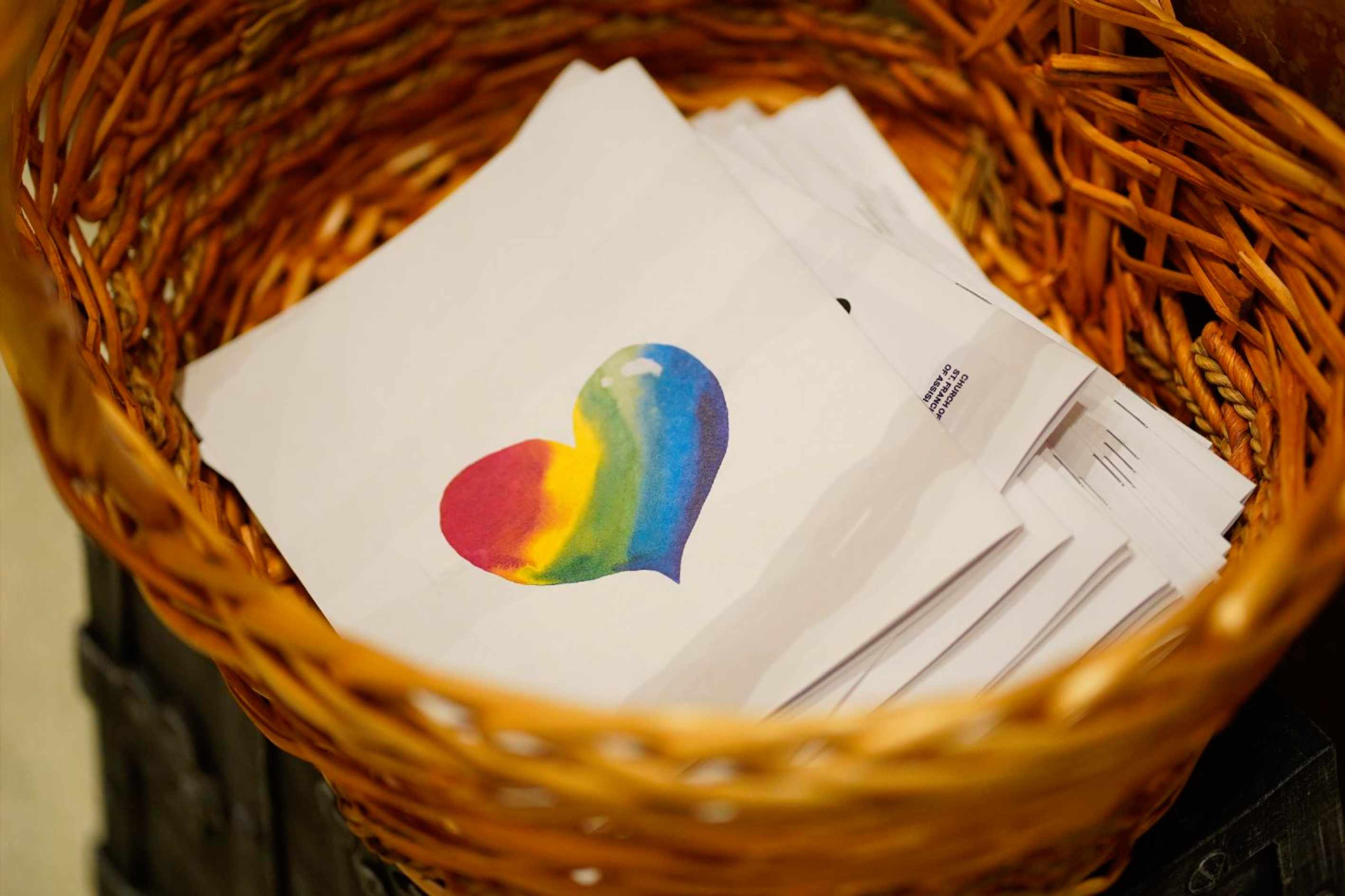
Programs are seen in a basket prior to the annual "Pre-Pride Festive Mass" at St. Francis of Assisi Church in New York City June 29, 2024. (OSV News/Gregory A. Shemitz)

by Maxwell Kuzma
Join the Conversation
Send your thoughts to Letters to the Editor. Learn more
The publication of the Synod on Synodality's Study Group 9 report has generated familiar debate. Some welcomed its inclusion of LGBTQ Catholics who spoke candidly about their experiences of faith, exclusion and belonging. Others objected that the report privileged certain voices while neglecting those who embrace more traditional approaches to sexuality. The controversy has since expanded into broader arguments about transgender people, pastoral ministry and the limits of doctrinal development.
At first glance, these disagreements appear to concern sexuality. But beneath them lies a far more fundamental theological question: Who has the authority to contribute to the church's discernment of truth?
This question reaches beyond any single synod document. It also explains why recent discussions surrounding LGBTQ Catholics so often feel like conversations happening at cross purposes. Too frequently, marginalized people are treated primarily as objects of theological reflection — problems to be solved, moral questions to be adjudicated or pastoral situations to be managed. Our lives become evidence for someone else's argument rather than sources of theological insight in our own right.
During his life, Pope Francis consistently proposed a different way of proceeding.
His vision of synodality was never merely about making ecclesial governance more participatory. It reflected a theological conviction that the Holy Spirit speaks through the lived experience of the entire People of God, especially those whose voices have long been overlooked. Francis repeatedly urged the church to move from abstraction to encounter, insisting that genuine discernment begins not with ideological certainty but with listening.
That instinct has surfaced in a variety of places. Antonio Pagliarulo's recent book Queer Saints explores the deep traditions of folk Catholicism and popular devotion, arguing that holiness has often been recognized first among ordinary believers before receiving institutional affirmation. Likewise, recent reflections on Catholicism's sacramental imagination have reminded us that the church has never been sustained by philosophers and theologians alone. Pilgrims, mystics, women, laborers and the poor have all shaped Catholic life through practices of faith that emerged from lived experience rather than academic speculation.
At its best, Catholic theology has never imagined itself as a closed philosophical system possessing exhaustive knowledge of God. Rather, it begins with the conviction that God always exceeds the limits of human understanding.
Catholic theology has long recognized that every human description of God remains incomplete. The Fourth Lateran Council declared that "between Creator and creature no similitude can be expressed without implying an even greater dissimilitude." Thomas Aquinas likewise argued that we know God more readily by recognizing what God is not than by imagining that our concepts can fully contain the divine mystery. We can truly know God, but never exhaustively. Every doctrine speaks truthfully, yet always points beyond itself to a reality greater than human language can encompass.
If this is true of God, then it also shapes how we understand the human person. The categories through which we organize human life are neither arbitrary nor meaningless, but neither are they exhaustive. They remain open to refinement as the church recognizes historically ignored or marginalized human experiences and continues its discernment under the guidance of the Holy Spirit.
This is where queer theology enters the conversation.
Advertisement
Contrary to some caricatures, queer theology is not simply the rejection of norms for the sake of perpetual transgression. Properly understood, it begins from a profoundly Catholic insight: our theological categories are always partial because God is always greater than our descriptions. When people's lives expose the limits of our existing frameworks, the appropriate Christian response is not immediate dismissal but deeper discernment.
Catholic social doctrine offers precisely this method. Pope Leo XIV's recent decision to speak of "Catholic Social Doctrine" in his first encyclical, Magnifica Humanitas, underscores that the church possesses not only a body of social teachings but a way of doing theology. It asks Catholics to interpret reality from the perspective of those most readily discarded by society, trusting that the margins reveal truths the center cannot always perceive.
Liberation theology, disability theology, Black theology and feminist theology all emerged from this same conviction. They do not replace Catholic theology. They invite it to become more fully itself by allowing those historically excluded to participate in the church's pursuit of truth.
Queer theology insists that LGBTQ Catholics are not merely recipients of pastoral care but participants in theological discernment. Our lives are not obstacles to the Gospel but places where the church may discover dimensions of the Gospel it has not yet fully seen.
Much of the criticism directed toward the Synod Study Group 9 report has centered on whether the Vatican listened to the "right" LGBTQ Catholics. Yet beneath that disagreement lies an important concession: nearly everyone involved now recognizes that testimony itself matters. The disagreement concerns whose testimony should count.
The Church has faced similar questions before. Again and again, doctrinal development has been preceded by encounters that pushed against the boundaries of long-held assumptions. The experiences of workers informed modern Catholic social teaching. Conversations with people of other faiths impacted Catholic approaches to religious liberty. The witness of the poor reshaped the Church's understanding of justice. The church has not remained unchanged in 2,000 years.
If queer theology has anything to offer Catholicism, it is not because it encourages rebellion against every norm. It is because it reminds the church that those most easily dismissed by both church and society are not simply problems to be solved. They are indispensable conversation partners in the church's search for truth.
To recognize this is not to abandon Catholic tradition. It is to embrace one of its oldest convictions: that Christ is continually encountered where we least expect him.