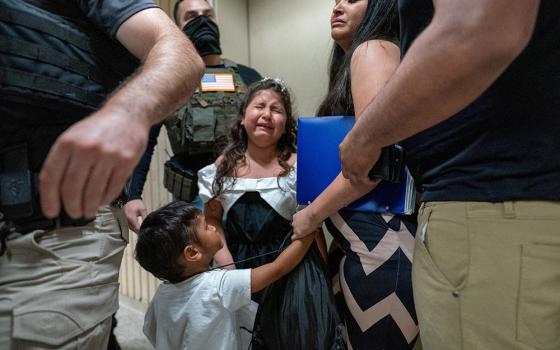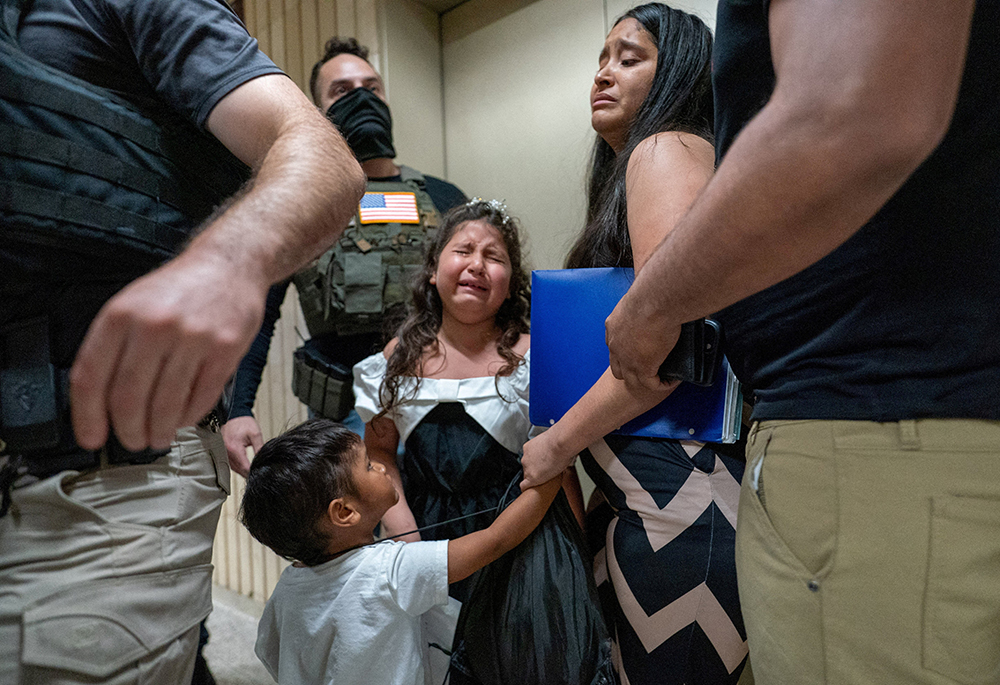
A child weeps as her father is detained by federal immigration officers at U.S. immigration court in the Manhattan borough of New York City July 25, 2025. (OSV News/Reuters/David 'Dee' Delgado)

by Jean Welch Hill
Join the Conversation
Send your thoughts to Letters to the Editor. Learn more
This election season, many voters, including Catholics, will consider the current status of our bank accounts, but will we also have the courage to address the greater good of our nation, to ask ourselves consistent with our faith, what kind of country do we want to be? One that welcomes the poor and struggling, confident in our ability to foster human initiative and help people rise to their full potential? Or one that has strict requirements for entrance, a gated community that would turn away Jesus, Mary and Joseph and arrest the good Samaritan? More critically, are we Americans content to allow the "land of the free and home of the brave" to become known more for its cruelty than its freedoms?
The social doctrine of our church establishes that "An authentic democracy is not merely the result of a formal observation of a set of rules but is the fruit of convinced acceptance of the values which inspire democratic procedures: the dignity of every human person, the respect of human rights, commitment to the common good as the purpose and guiding criterion for political life" (Compendium of the Social Doctrine of the Church, 407).
Consider whether current immigration enforcement practices uphold the dignity of every human and human rights. Our nation is actively sending thousands of individuals to countries in turmoil and from which many sought and continue to seek to escape, with valid concerns for their safety. It detains people without criminal records in facilities with complaints or reports of substandard conditions. Our government is detaining individuals who are trying to follow the law and show up for their immigration appointments; separating families, detaining children and sending kids into courtrooms without lawyers; snatching people as they contribute to their workplace, drop off their kids at school or buy food to feed their families; and taking violent action against people who are understandably frightened when groups of masked, armed men approach aggressively.
Cruelty is not policy. It is a tactic usually reserved for totalitarian or failed governments. In a democracy, it undermines the moral authority government might have claimed and gives ample cause for the governed to question the legitimacy of its actions. After all, if government is resorting to cruelty to govern people whom it could easily serve with some long overdue upgrades to its legal immigration system, what keeps it from expanding its actions against the rest of us.
Advertisement
Some of our political leaders claim the current level of cruelty is necessary to protect our borders and maintain order. Separating families and frightening children is not required to keep the peace in any nation. Arresting people who are actively contributing to our communities through their work, raising strong families, and living out their faith cannot be justified as necessary for public safety.
Indiscriminate detention and deportation of people who have lived in the U.S. for decades with no criminal history does not make us safer. Rather, these methods reveal a level of contempt for human life that should concern anyone who believes government's role is to preserve and protect life, not destroy it.
That one of the richest and most powerful nations in the world is seeking to address immigration concerns by terrifying people who believed a better life was possible in our country undermines our collective credibility. Our elected leaders can and must modernize our outdated immigration system without resulting to the tactics of countries that lack our vast resources and democratic form of governance.
As we head to the ballot box, we must recall the words of Pope Leo XIV:
We cannot remain as unengaged spectators; rather, we must listen with our hearts, allow ourselves to be challenged, and become involved. With Christ and sustained by the power of his Spirit, believers are called to take on the burdens of their brothers and sisters, especially those who are crushed by injustice, discrimination and violence.
Each of us must ask: Will the people we are voting for work to make life more affordable for us as individuals? But we must also ask: Will they build a nation that respects and protects the dignity and sanctity of the lives of my neighbors — the people who care for my loved ones, harvest the food that I buy, toil at the businesses I frequent, build businesses that serve my community, and enhance the cultural, social and economic lives of all of us?
Will our leaders rebuild our credibility as a nation focused on human flourishing, or continue on the path of cruelty for cruelty's sake? It is our decision to make.