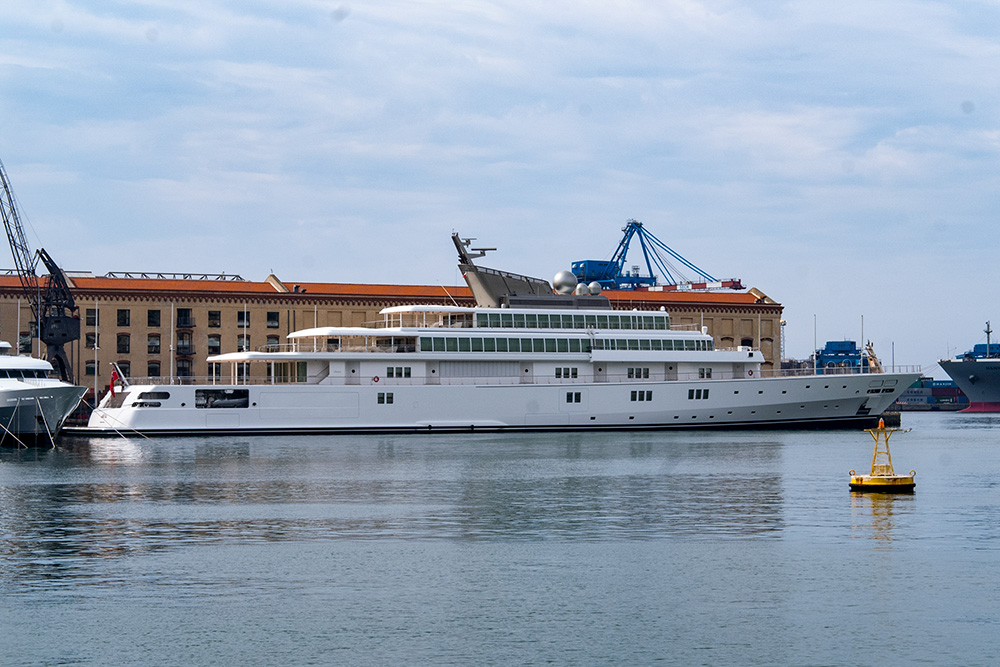
Rising Sun, a yacht built in 2004 for Larry Ellison, and now owned by David Geffen, docked in Genova, Italy, in 2012 (Wikimedia Commons/Christopher Schriner)

Join the Conversation
Send your thoughts to Letters to the Editor. Learn more
About 10 pages into Evan Osnos' The Haves and Have-Yachts: Dispatches on the Ultrarich you'll want to grab your pitchfork. In elegant prose and with an eye for the details pregnant with deeper significance, Osnos catalogs the excesses of those whose excessive riches permit them to do as they please.
The opening chapter, which lends the book its fabulous title, focuses on the yacht industry, from those who build them and staff them to the shell companies that mask the ownership for fear of political instability. This last concern has become pronounced since many of the largest superyachts are owned by Russian oligarchs with close ties to Vladimir Putin and, so, are subject to seizure since the invasion of Ukraine.
"For the moment, a gigayacht is the most expensive item that our species has figured out how to own," Osnos explains. A gigayacht is a ship more than 295 feet long and there are about 100 of them sailing the seas. They routinely fetch more than $250 million and this is considered part of their allure. "Rationally, it would seem to make sense for people to spend half a billion dollars on their home and then fifty million on the boat that they're on for two weeks a year, right?" a Silicon Valley CEO told Osnos. "But it's gone the other way. People don't want to live in a hundred-thousand-square-foot house. Optically, it's weird. But a half-billion-dollar boat, actually, is quite nice." I am sure it is.
'If the rest of the world learns what it's like to live on a yacht like this,' says American yachtsman Bill Duker, 'they're gonna bring back the guillotine.'
Size is not the only allure of yachting. The service provided by the crew is beyond anything you get landside, and crewmembers sign nondisclosure agreements so that a guest who does too much cocaine, or brings a sex worker on board, doesn't have to worry about seeing a report in the newspapers. Yachts are status symbols, to be sure, but "these shrines to excess capital operate, as vast fortunes do, in a principle of controlled visibility, radiant to the right audience, but veiled from the wider world," Osnos writes.
Sometimes, a yacht owner or passenger perceives a value in providing a leak about a yacht's guest list. Most famously, in 2017, shortly after leaving office, Barack and Michelle Obama were photographed on David Geffen's 454-foot yacht Rising Sun in French Polynesia. With them were Oprah Winfrey, Bruce Springsteen, Tom Hanks and Rita Wilson. Yachting is nonpartisan.
"If the rest of the world learns what it's like to live on a yacht like this," says American yachtsman Bill Duker, "they're gonna bring back the guillotine." At least some of the ultrarich, and the yachtsmen they employ, grasp the danger of the income inequality that permits them such luxuries.
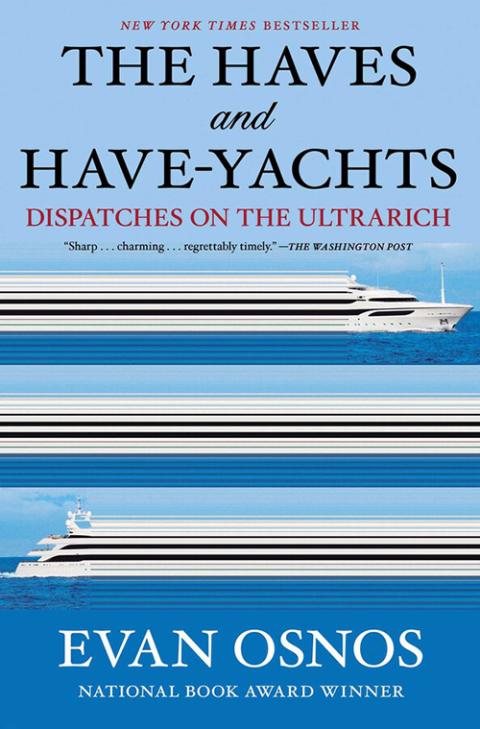
The cover of The Haves and Have-Yachts: Dispatches on the Ultrarich by Evan Osnos (Simon & Schuster)
Osnos has a whole chapter on the growth of survivalism among the ultrarich. Steve Huffman, cofounder and CEO of Reddit, explains to Osnos, "I own a couple of motorcycles. I have a bunch of guns and ammo. Food. I figure that, with that, I can hole up in my house for some amount of time."
Huffman is not an outlier. "In private Facebook groups, wealthy survivalists swap tips on gas masks, bunkers, and locations safe from the effects of climate change," Osnos writes. "One member, head of an investment firm, told me, 'I keep a helicopter gassed up all the time, and I have an underground bunker with an air-filtration system.' " New Zealand has become a hotspot for the ultrarich to buy homes in case civilization collapses elsewhere. The Survival Condo Project, which converted an abandoned Atlas missile silo in Kansas into a 15-story luxury apartment complex, works for those who don't want to fly all the way to the South Pacific.
Osnos not only possesses a nose for the illustrative story. He also notices some of the deeper cultural storylines that emerge from his reporting. For example, in the chapter on survivalism he asks, "How did a preoccupation with the apocalypse come to flourish in Silicon Valley, a place known, to the point of cliché, for unstinting confidence in its ability to change the world for the better?" He poses that question to some of the people he interviews, and comes to realize that technological innovation requires people to "imagine wildly different futures." Those who flourish in that environment do not have a hard time rushing into utopian, and dystopian, visions.
Apparently, all that time in STEM classes did not acquaint these masters of the universe with the humanities, at least not enough to instruct them on the inherent, crippling danger of entertaining utopian or dystopian visions. Is anyone surprised? Am I the only person who hopes — and thinks — these technocrats will someday, perhaps someday soon, answer to bosses with degrees in English literature and Renaissance art?
Advertisement
The chapter on trusts made me angrier than any other. The depravity of the ultrarich that Osnos surveyed in this chapter — he focuses on the heirs of John Paul Getty — was no worse than in the other chapters, but in examining the ability of the wealthy to avoid taxes, he implicates the politicians who have made the tax code increasingly regressive in the past 60 years. They have devised an ever increasingly large number of loopholes that allow the wealthy to avoid paying taxes.
"In 1976, about 139,000 American households were eligible for the estate tax; by 2020, it had been loosened and punctured by so many exemptions that only 1,275 households nationwide had to pay," Osnos reports. The founders were nearly unanimous in their concern that too much inherited wealth would create an aristocracy of money rather than one of virtue and talent. Their fear is our reality.
So many of the nation's ills, from the lack of funding for basic infrastructure to the resentment of those for whom the American dream turned into a nightmare, are rooted in the demise of the progressive tax system the country had in the immediate postwar period. Those years witnessed enormous economic growth, low unemployment, decreasing income inequality and higher productivity.
Not only should everyone read this book, they should pass it to a friend, and then to another friend. Its indictment of the sociopathic behavior of some of the ultrarich may ignite the fire to force a renegotiation of the social contract. And if the barons of Wall Street and titans of Silicon Valley think they can escape to New Zealand, let them know that they make pitchforks there too.