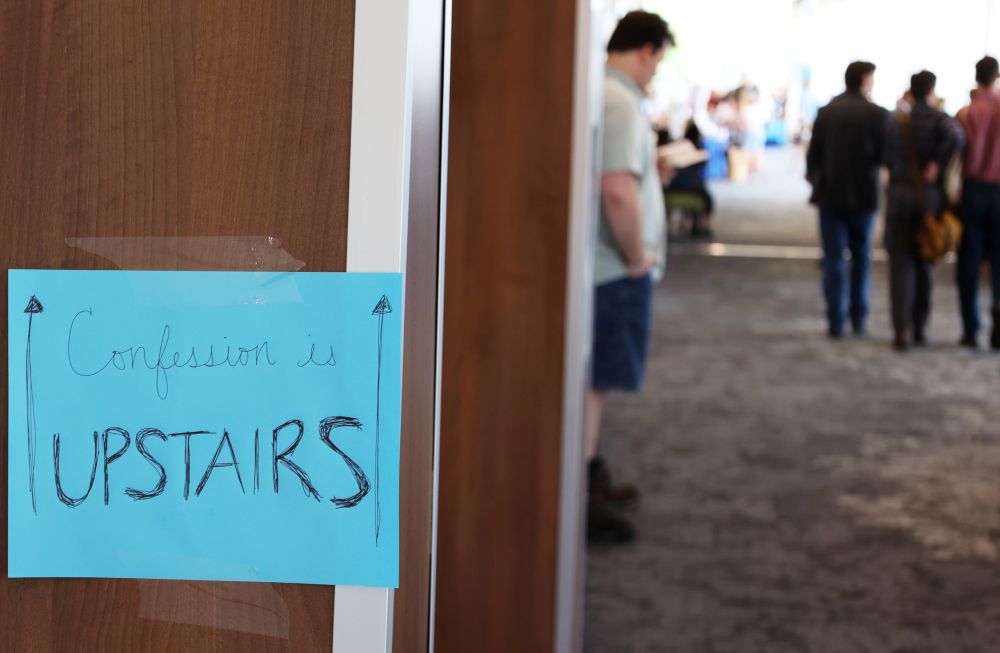
A sign in the convention center at the La Crosse convention center in Wisconsin points attendees at the "Zeale for America 250 Rally" to a space upstairs where the sacrament of confession is available. (Martyn Smith)

by Karen E. Park
Join the Conversation
Send your thoughts to Letters to the Editor. Learn more
On June 13, I attended the Zeale for America 250 Rally in La Crosse, Wisconsin, a rally organized by CatholicVote in partnership with Cardinal Raymond Leo Burke and the Shrine of Our Lady of Guadalupe. Billed by organizers as the only Freedom 250 event in the country that was specifically Catholic, it brought together over 700 attendees who paid $26 per ticket for a day of speeches, prayer and Catholic country music.
Inside the convention center, visitors encountered a mix of political and religious vendors and displays. There was a large exhibit on the Shroud of Turin alongside a Catholic market featuring an entire clothing line dedicated to "keeping men out of women's sports"; Catholic books published by Sophia Institute Press, and a large display of statues, medals, and red white and blue rosaries from the Our Lady of Guadalupe Shrine gift shop. Parked outside the convention center was one of PragerU's six traveling Freedom Trucks. These trucks are a fleet of "mobile museums" featuring AI-generated Founding Fathers narrating a providential and sanitized account of American history.
The event brought together traditional Catholic devotional practices, conservative political activism and a broader narrative of American patriotic renewal. But in addition to the Freedom 250 and America Prays contexts, the Zeale 250 event must be contextualized in light of the consecration of the U.S. to the Sacred Heart of Jesus. The night before the La Crosse rally, instead of attending the official consecration in Orlando, Florida, Burke led his own consecration of the nation to the Sacred Heart of Jesus at his shrine in La Crosse.
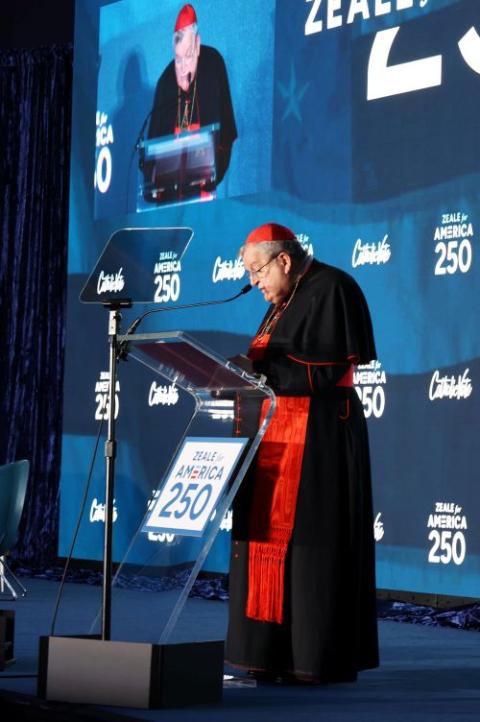
Cardinal Raymond Leo Burke addresses attendees at the "Zeale for America 250 Rally" held June 13 at the La Crosse convention center in Wisconsin. (Martyn Smith)
For organizers, as well as for some of the attendees, the two events were closely connected. Suzanna Kim, vice president of marketing for Zeale for America, described Burke's consecration as "Part 1" and the rally as "Part 2." Burke's consecration homily reflected the elevated devotional language that has long characterized his public preaching: "The Heart of Jesus seated at the right hand of God the Father in glory never ceases to beat with love for us, drawing all hearts, one with the Immaculate Heart of His Virgin Mother, to His Heart and pouring forth from His Heart into our hearts, without measure, the sevenfold gift of the Holy Spirit."
In the same homily Burke made a connection between June 12's consecration and June 13's rally as he prayed, "May the fruits of today's Holy Mass be manifest, in a special way, in tomorrow's Prayer Rally for our homeland."
Conversations with attendees revealed some ambiguity. Most said that the consecration was enormously important for the nation and its future, yet many struggled to articulate how consecration differed from the "rededication" language employed at other America 250 events.
In her address to the rally, CatholicVote president Kelsey Reinhardt described the previous day's consecration of the nation to the Sacred Heart of Jesus as "the most important thing this nation has experienced since its founding … " She argued that America had always been deeply Catholic, citing place names such as St. Augustine, St. Louis and Sacramento as evidence of the nation's Catholic foundations. Invoking St. Margaret Mary Alacoque, Reinhardt suggested that France paid dearly for the failure of King Louis XIV to consecrate that country to the Sacred Heart, and also pointed to the 1984 consecration of Russia to the Immaculate Heart of Mary as a catalyst for the collapse of Soviet communism. "Let yesterday's consecration be a lightning strike," she urged.
The image at the center of the devotion is not a triumphant heart but a wounded one, pierced by a lance and encircled by thorns.
Other speakers were more concerned with hot-button cultural issues. Daily Wire host Michael Knowles, one of the most prominent Catholic voices in conservative media, stated in his keynote address that "the sexual revolution is dying" and "transgenderism is dead" both of which drew loud applause from the crowd. He also said that "the more conservative one becomes, the more one feels the pull of Rome" and that "the (American) Constitution leads to Catholicism." Gen Z conservative influencer Isabel Brown called for a moral revolution in the country, and claimed that "the hottest club for young people is the Catholic Church."
For his part, Burke devoted much of his own lengthy address to natural law, objective truth, and the fragility of democracy when detached from moral foundations as he defined them. And while Burke's address repeatedly invoked the language of the common good, the concrete threats he identified solely focused on the issues of abortion, marriage, sexuality and family life. Other concerns commonly associated with Catholic social teaching and the common good — including poverty, immigration, war, labor and economic justice — were absent from his remarks, and absent from the rally as well.
Like the rhetoric at the "Rededicate 250" rally, at Zeale for America 250, the charge that America was in crisis, while simultaneously being the greatest nation on earth, was made repeatedly. America has lost its way. Christian values have eroded. The culture has become confused. Yet, as emcee Steve Cortes put it, "We are doubly blessed because as Catholics we are children of the Heavenly Father AND we get to be Americans."
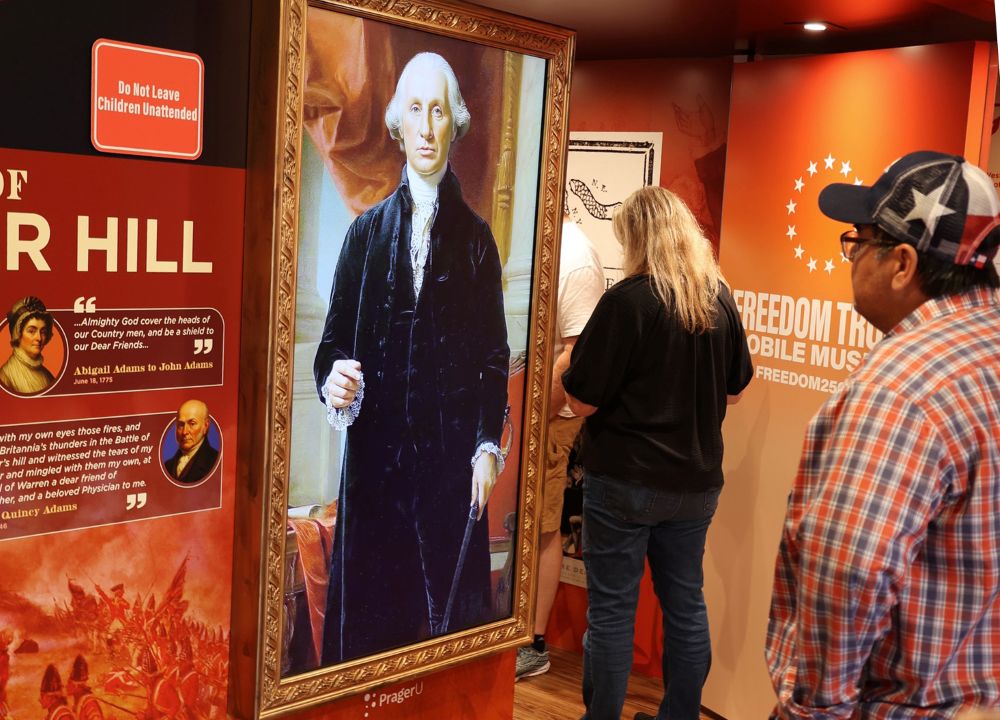
A visitor stands in front of an AI-animated image of George Washington inside the "Freedom Truck" parked at the La Crosse convention center for the "Zeale for America 250 Rally." (Martyn Smith)
Despite the rally's repeated emphasis on national and spiritual crisis, the language of repentance, which is central to the Sacred Heart devotion, was largely absent.
This absence becomes particularly clear when the La Crosse Zeale for America 250 rally is read alongside the homilies delivered at the consecration ceremonies in Orlando and La Crosse.
Archbishop William Lori's homily at the Orlando consecration Mass struck a very different tone from the speakers at the Zeale for America 250 rally. "We consecrate our nation, not because it is perfect," Lori said, "but because it is beloved by God." He also said "if we are honest, we must acknowledge that neither our nation nor the Church has always clearly reflected (Christ's) love … to consecrate ourselves and our nation is to place our wounds, our shortcomings, and our sins before the One whose love is greater than all of them."
Lori's homily returned repeatedly to the language of wounds, shortcomings, failures and sins. The Sacred Heart that emerges from his preaching is not primarily a symbol of national greatness or cultural restoration. It is, instead, a symbol of divine mercy offered to a wounded people.
Burke's consecration homily in La Crosse contained no such acknowledgment of a national need for repentance. While he described the consecration as an act of reparation "for the indifference and offense with which we have so often responded, in our nation, to the love of the Sacred Heart," unlike Lori's homily, Burke's contained no acknowledgment of the nation's faults, much less those of the church.
Advertisement
Unlike dedication, consecration is more than a declaration that something belongs to God. Consecration is an act of entrustment that presumes a need for grace. In the tradition of the Sacred Heart, consecration has long been associated with reparation, repentance and conversion. The image at the center of the devotion is not a triumphant heart but a wounded one, pierced by a lance and encircled by thorns.
The rally did offer a diagnosis of what is wrong with America. Speakers and vendors repeatedly pointed to abortion, same-sex marriage and transgender identities as the main evils in American society. These concerns dominated the presentations and generated enthusiastic applause from the audience. Yet there was no discussion whatsoever of other wounds that Catholics might identify within the nation's life — indeed no mention of the concerns most often named by Pope Leo XIV, namely: poverty, war, economic exploitation, racism, environmental degradation, or the treatment of migrants and refugees.
Nor was there much sense that those gathered at the rally might also be collectively implicated in the nation's failures. The emphasis fell overwhelmingly on what America had lost because of what others "those with rainbow hair and 37 pronouns" as Brown put it, had done to the nation.
Renewal and repentance are not the same thing. One seeks to recover a lost inheritance. The other starts by acknowledging uncomfortable truths about the self, the nation and the church. The consecration of the United States to the Sacred Heart was intended to mark the nation's 250th anniversary with something deeper than celebration. Whether Catholics ultimately understand that act primarily as a call to restoration of a lost greatness, as the Freedom 250 trucks claim, or as a call to repentance for our nation's sins and shortcomings, remains an open question. The events in Orlando and La Crosse suggest that the answer is far from settled.