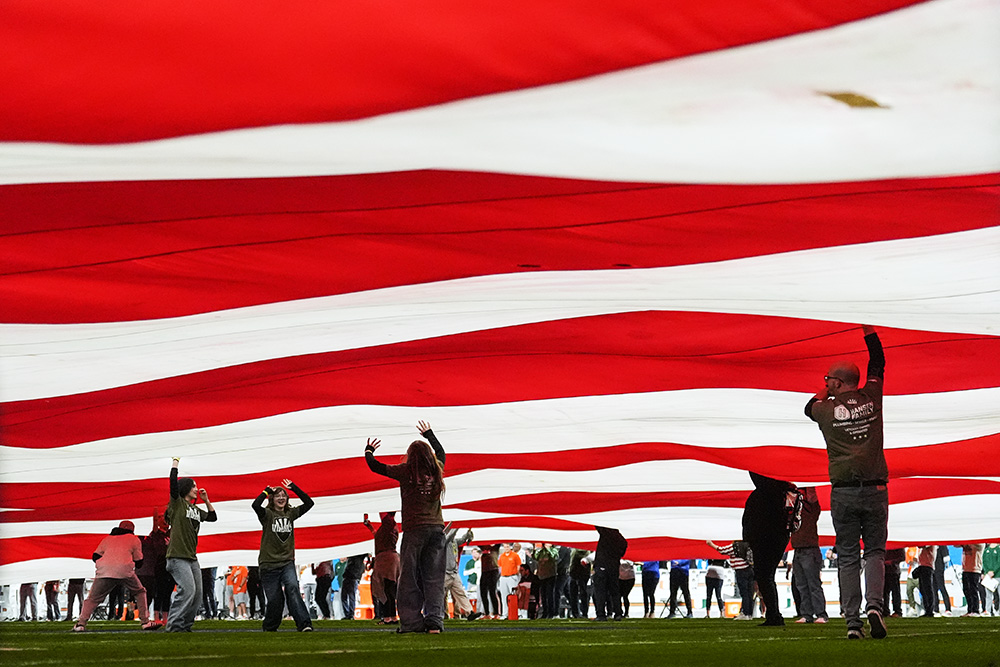
People support a large American flag on the field before the Fiesta Bowl NCAA college football playoff semifinal game between Miami and Mississippi Jan. 8, 2026, in Glendale, Ariz. (AP/Ross D. Franklin)

by John McCarthy
Join the Conversation
Send your thoughts to Letters to the Editor. Learn more
Ask anyone in your life and they'll tell you the United States does not feel especially "united" right now. And if you press a little further, they'll often say something else too: They are exhausted. Exhausted by the constant overstimulation of public life. Tired of feeling like they can't talk to their neighbors, and tired of walking on eggshells around friends and family while worrying about what might set someone off.
As we approach the 250th anniversary of the country, I'm not sure that many would say we feel especially star-spangled, or that we're living inside that "more perfect union."
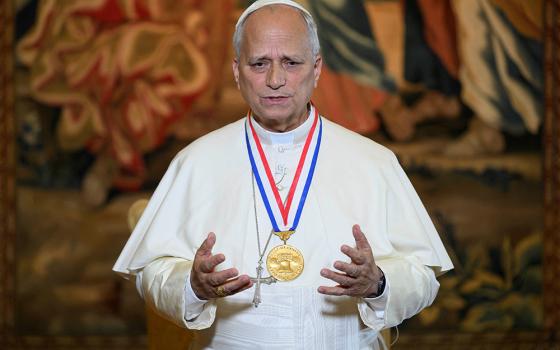
The world's most famous American Catholic must feel much of this as well. Pope Leo XIV recently shared, "Today, the temptation to gain popularity by fanning the flames of polarization seems to have grown rather than diminished, and human dignity continues to be violated."
Like the Holy Father, I'm a proud American, and a proud Catholic. At a moment like this — of intense polarization and stalemated politics — I think our faith has something to say. A set of practices and traditions that can help us find our way back to each other.
Three in particular come to mind.
The first is charitable assumption. St. Ignatius Loyola, founder of the Jesuits, wrote, "It is necessary to suppose that every good Christian is more ready to put a good interpretation on another's statement than to condemn it as false." If you don't understand how someone came to their belief, he says, ask them to explain it. And if, after that, you still find them in error, correct them with kindness and charity.
Advertisement
It sounds simple, but that posture has become genuinely rare. Too often, we skip past disagreements entirely and go straight to assuming the worst about who someone is as a person. What Ignatius offers instead is a discipline: begin with generosity, stay curious long enough to actually understand, and only then correct with care.
The second is holding solidarity and subsidiarity together. America lives in a constant tension between the individual and the collective, and election after election becomes a debate over where that line should fall.
In the Catholic tradition, these instincts aren't opposed. Solidarity calls us into community, reminding us that we are bound to one another. Subsidiarity calls us to work at the local, individual level to uphold the dignity of the person. Held together, they describe something like a complete picture: We are called both to walk with people who are suffering and to take seriously the structures that shape that suffering.
Too many people in this country feel like no one is really with them, and too many others feel like the country is moving in a direction they cannot recognize. Both of those things can be true at the same time, and pretending otherwise is part of what keeps us stuck.
The third is forgiveness, and I mean that plainly. We cannot go on like this. Neighbor against neighbor is not a sustainable way to live in a country as large and diverse as ours, and the work of rebuilding some basic sense of shared life is the social justice work of our time.
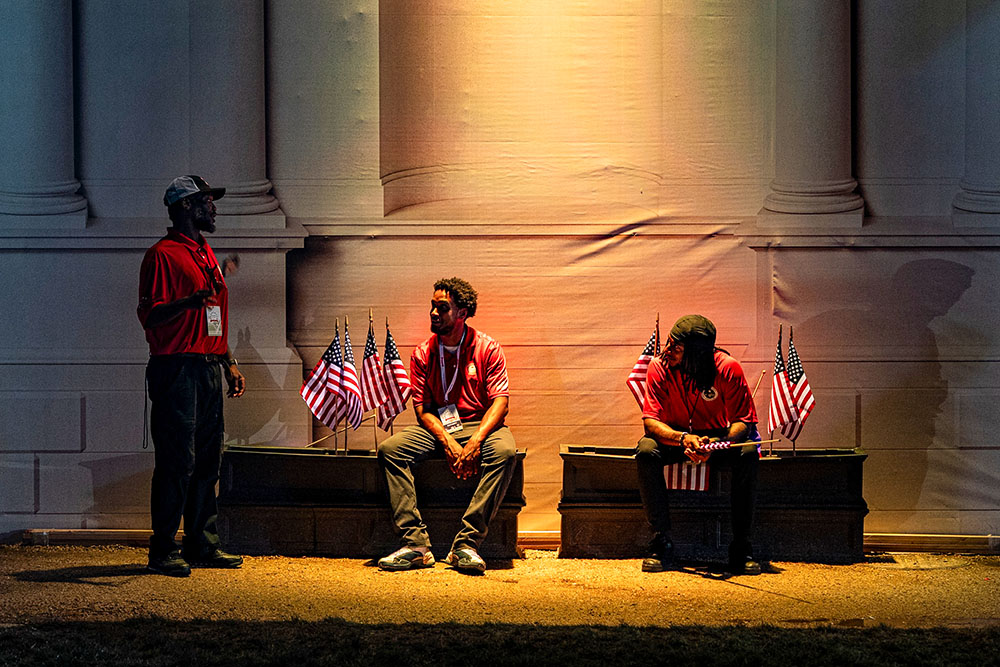
Workers rest after the Great American State Fair on the National Mall closed for the day, June 29, 2026, in Washington. (AP/Jen Golbeck)
It has to begin with humility. In the Our Father, we ask God for mercy ("forgive us our trespasses") and then immediately place alongside it a responsibility of our own, "as we forgive those who trespass against us." This is not easy work. But if we are serious about turning the page, we have to recover some willingness to see each other as neighbors before we see each other as enemies.
All of this connects to something broader about what it means to be an American citizen. People are social by nature, and therefore political. As Pope Francis writes in "The Joy of the Gospel," "Responsible citizenship is a virtue, and participation in political life is a moral obligation."
But we have blurred the line between being political and being partisan. Politics is the shared work of organizing our common life, and it has real consequences for the dignity of every person. Partisanship, at its worst, corrupts that work and sorts us into tribes where we can no longer see the neighbor standing right in front of us.
A spirit of extremism is pulling us apart, and Catholic social thought offers a different path forward, one rooted in dignity, responsibility, and the hard work of staying in relationship with people we disagree with.
Servant of God Dorothy Day, founder of the Catholic Worker movement, put it simply: "We have all known the long loneliness and we have learned that the only solution is love and that love comes with community."
Our Union is our community. As we approach America's 250th, American Catholics should feel a particular responsibility to that idea. Not as commentators on division, but as people willing to resist division in their own lives, in how we speak, in how we listen, and in how quickly we assume the worst or the best of one another. A more perfect union is not only a constitutional aspiration. It is a calling rooted deeply in our own faith.