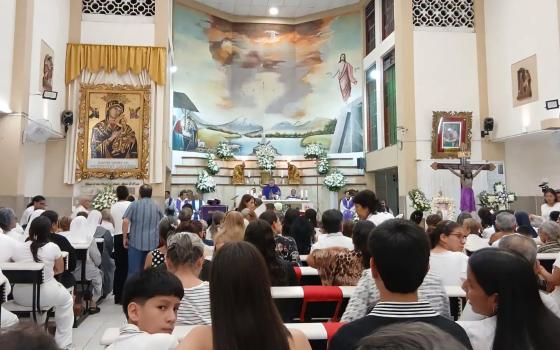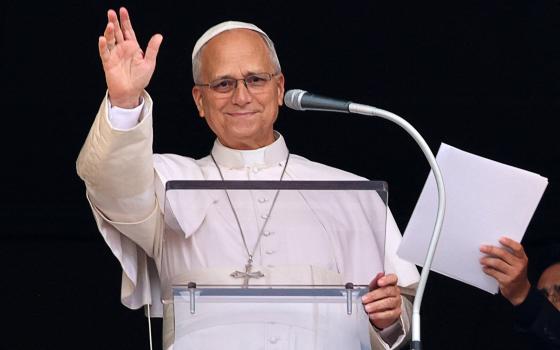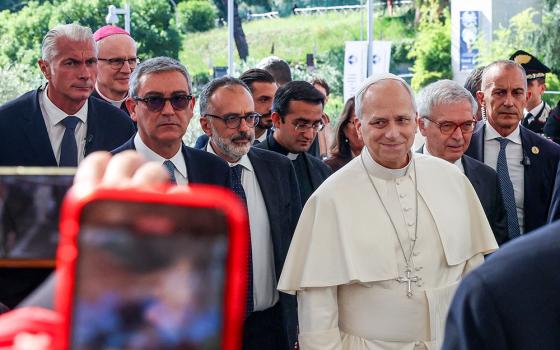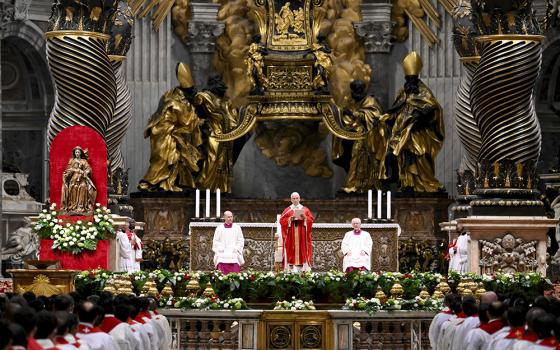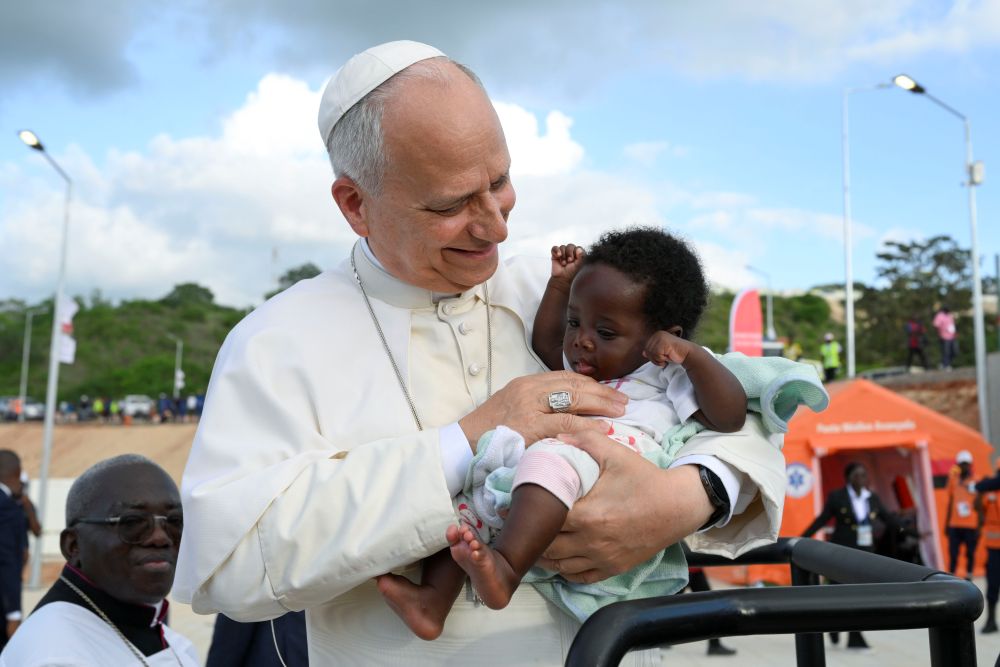
Pope Leo XIV holds a baby at the Sanctuary of Our Lady of Muxima in Muxima, Angola, April 19, 2026. During his visit to Angola, Leo prayed at a Catholic shrine located at the site of an important hub of the African slave trade. (OSV News/Vatican Media/Simone Risoluti)

by Sally J. Scholz
Join the Conversation
Send your thoughts to Letters to the Editor. Learn more
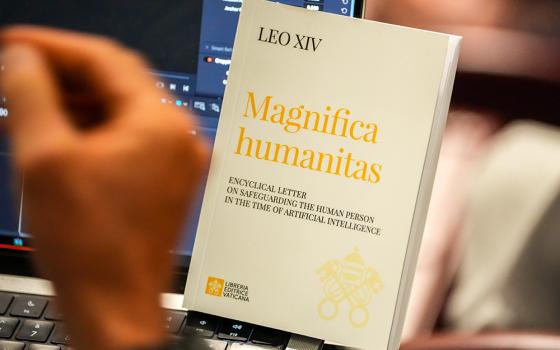
With his first encyclical's vivid imagery of two contrasting construction projects, Pope Leo XIV invites all people of good will to resist indifference and challenge the apparent inevitability of events in the world. In one project, the people of Babel looked on in awe and fear as a tower, constructed to display the people's greatness, dominated their social existence. In the end, the people were dispersed and alienated from one another. The effort to create earthly dominance resulted in chaos. In contrast, the people of ancient Jerusalem undertook a seemingly unfeasible building project upon finding their city in ruins after returning from exile in Babylon. Rather than disorder, they found hope and unity.
The pope asks us to consider what accounts for this difference. In the second construction project, the people divided the tasks and "through the shared responsibility of all," the city was reborn. They built, the pope explains, communion: "the harmony that arises when all persons assume their own role and recognize that their strength comes from the Lord."
These images convey the message that the magnificence of humanity and fulfillment for each human, true fulfillment, "is found where freedom and responsibility are intertwined with mutual care and true solidarity, and where progress is measured by the dignity of each person and the good of all peoples."
In addressing our fears about "new things" in the AI era, the pope urges us toward hope; he presents a concise and compelling summary of the principles of Catholic social teaching — always directing our attention to the common good and the impact of decisions on the poor, the vulnerable or excluded — to provide a blueprint for our efforts to build hope together. "True solidarity" involves the choice to take up one's human freedom and responsibility, to resist indifference, and for each of us to use our unique human capabilities to build the human unity that is both the promise of and essential for peace. We build not to dominate but to unite, and in doing so we rediscover the essence of humanity in love. "True progress always stems from a heart open to others, an intelligence willing to listen and a will that seeks what unites rather than what separates," Leo writes. Solidarity is active social love, continually renewed in collective construction of social unity.
The construction project has begun. Each of us now must ask ourselves, "How will I contribute to building hope in solidarity?"
Within the tradition of the church's social doctrine, solidarity plays many roles. It indicates that we are one human family called to see the "other" as "neighbor" and "helper" to whom and for whom we are responsible. It indicates the urgency of assisting those who suffer in poverty or exclusion while also addressing the conditions — including structures of sin — that create that suffering. Solidarity is an individual virtue that orients each person to all others, a value that ensures that decisions incorporate recognition of the interdependence of human beings as well as responsibilities to our common home and future generations. It is also a goal: a unity that celebrates our differences, that makes history through popular movements and establishes the foundations for peace.
Magnifica Humanitas beautifully synthesizes the tradition, affirming that "Solidarity is expressed when each person, both individually and collectively, takes part in the life of the community — by staying informed, engaging with others, making their voice heard and contributing to public decisions and choices — while also assuming real responsibility so that the common good is achieved through shared decision-making."
Just as the people of Jerusalem responded to the needs of their collective existence by each person contributing in their unique way, we are called to examine our hearts, to educate our minds, and to be present in personal and embodied ways to contribute to the common good. We do that when we welcome the stranger or build a connection with the lonely, as well as when we participate in institutions, communities, states, and the international community to make the world more hospitable so that all members of our human family may also contribute to our collective unity. Each encounter with another provides an opportunity to construct peace.
Citing Pope Francis' Fratelli Tutti, Leo writes:
Faith invites us to see this reality as a call: we are not merely neighbors to one another, but entrusted to each other, so that each of us may take responsibility, as best we can, for the lives and wounds of our brothers and sisters. Solidarity arises precisely when we decide not to remain indifferent to what happens to our neighbor but instead to transform unavoidable bonds — economic, cultural and technological — into paths of sharing, cooperation and mutual care, embracing the idea of "thinking and acting in terms of community."
Advertisement
The encyclical itself might be seen as an enactment of concrete solidarity as well. By confronting the church's failures and contributions to structures of sin, the pope demonstrates the importance of conversion, an honest self-examination leading to a change of heart, essential for true solidarity. Acknowledging the sexual abuse scandal that damaged so many children and other vulnerable people, the pope calls out the church's failures; he also seeks pardon for the church's role in justifying and validating the practice of slavery. In solidarity, freedom is an engaged freedom that acknowledges human connectedness. Actions that violate or betray the social trust inherent in that connectedness must be confronted and real transformation enacted. In addition, responsibility in solidarity requires not merely acting on a perceived duty but dialogue and listening that leads to careful discernment of one's role while working with others to understand the truth about what is needed and how to build community together.
The pope reminds us that solidarity is built and he encourages us to "cultivate relationships." He invites us to "cherish places and times where physical presence remains crucial." Adding to a tradition that honors the human person as rational and as worker, the pope offers a message of solidarity that amplifies "the very essence of our humanity" in the "capacity for relationship and love." Hope is present and grows in that foundation of social love.
Ending with a five-point program for navigating the new challenges to our collective humanity, the pope offers concrete proposals for building toward unity and peace. The third point, "The construction site of our time," overflows with collective calls for action in solidarity: Together we can "remain faithful to the truth," "invest in education," "cultivate relationships," "love justice and peace."
Solidarity urges us to resist claims that a particular vision of the future is inevitable. Rather, we are the builders, and our small actions — including our words — contribute to constructing a world in which the common good and care for the most vulnerable among us are the real measures of our success, our magnificent humanity. The construction project has begun. Each of us now must ask ourselves, "How will I contribute to building hope in solidarity?"