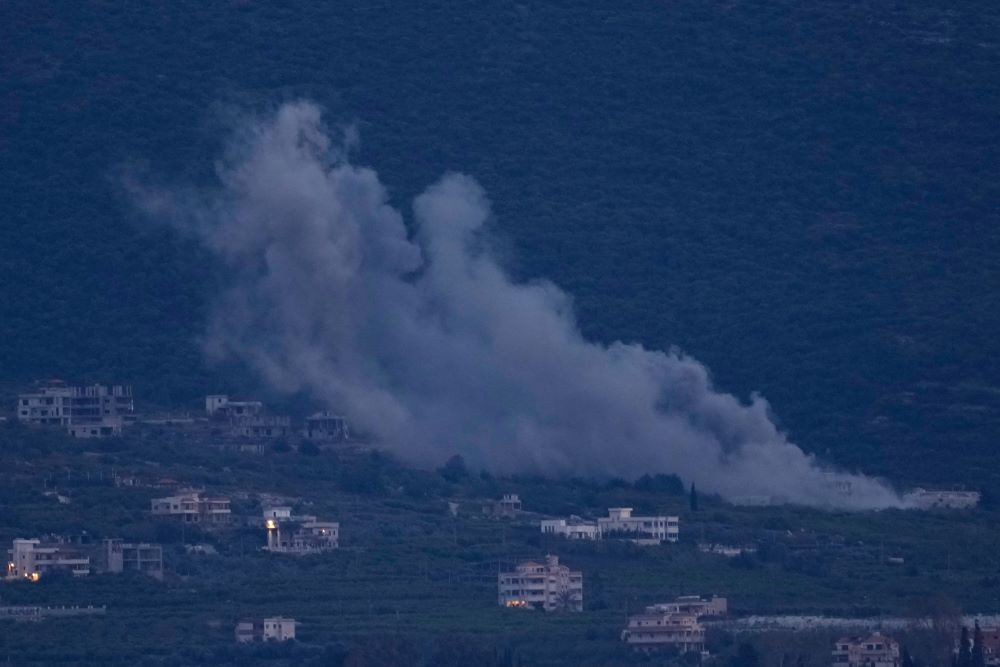
Smoke rises from an Israeli airstrike that hit Mansouri village as it is seen from Tyre city, south Lebanon March 26, 2026. (AP/Hussein Malla)

by Eli McCarthy
Join the Conversation
Send your thoughts to Letters to the Editor. Learn more
The church's oral tradition is moving toward what Pope Leo XIV described as a "disarming peace" in his 2026 World Day of Peace message. He explains that "the Gospels do not hide the fact that what troubled the disciples was his [Jesus'] nonviolent response: a path that they all, Peter first among them, contested; yet the Master asked them to follow this path to the end."
This "unarmed and disarming peace" is echoed in moves to center active nonviolence, peacebuilding and just peace praxis.
Meanwhile, in the context of the war with Iran where the U.S., Israel and Iran each claim "legitimate defense," some Catholic voices, including NCR's Michael Sean Winters, continue the discourse of debating whether the war meets certain criteria, such as immediate threat, right intention, proportionality, probability of success, legitimate authority and last resort.
I have been living in D.C. and participating in direct advocacy to U.S. government officials since 2012. Most politicians are fine with such "just war" discourse because it allows those with direct decision-making responsibility to interpret and even spin these criteria to maintain their war-making, either now or in the future. We've seen this dynamic play out many times in history, especially in the U.S. One of the many concerns with centering just war theory is that it functions to keep the war industry and cultural legitimation going to prepare for that apparent "just war." Meanwhile, many wars grow out of this structural and cultural violence, as we see today.
This type of discourse narrows the political debate to vital national interest, military objectives, funding, legality, supporting our troops and maybe tactical "war crimes." We hear leaders consistently tout "peace through strength" to seemingly legitimate military power and domination. These dynamics distort the truth.
One of the many concerns with centering just war theory is that it functions to keep the war industry and cultural legitimation going to prepare for that apparent "just war."
Some may say, "Well, these are just politicians" abusing the moral tradition. Yet, this is a consistent pattern with enormous and horrendous consequences for many people, generations and the earth, as seen in Gaza and now in Iran and Lebanon.
Unfortunately, some writers continue to frame the issue as a choice between "just war" or "pacifism." That argument is a straw man and a distraction that fails to address core questions. What approach is consistent with human dignity? What will illuminate the way of Jesus? What will better prevent and defuse ongoing war? What is the role of the church? The Catholic Nonviolence Initiative, of which I'm a part, has been arguing for a shift in focus for the church, a recentering of active nonviolence and just peace. Active nonviolence entails a positive reverence for human dignity and life; and just peace reasoning draws on comprehensive active nonviolence for effective practices to engage conflict constructively, break cycles of violence and build sustainable peace.
Unsurprisingly, this strawman framing goes along with Winters' fundamental misunderstanding of nonviolent resistance. He claims that "just war reasoning must remain the principal Catholic approach" because there are leaders who are "evil," "apocalyptic" or "murderous." He points to the regimes in Iran and Russia as examples. Yet, robust empirical research has shown that successful nonviolent resistance is not primarily dependent on how authoritarian the adversary is or even on changing their mind; rather it is primarily dependent on strategically diminishing key sources of power the regime relies on, building broad-based coalitions, generating defections, and reaching about 3.5% consistent participation from the population.
Winters argues on the one hand that just war reasoning is intended to prevent or restrain violence; yet, on the other hand, what has brought it back in vogue is the war in Ukraine — a war that seems for some to meet its criteria, or in other words, its apparent ability to justify war. So, which is it? There is little evidence that just war theory has functioned in any adequate way to prevent war. And there are serious moral questions about that particular war, which I have written about previously, including probability of success, rejecting diplomatic off-ramps and patterns of effective nonviolent resistance during the war.
The primary issue isn't whether some rare war in the past, present or future seems to meet the "just war" criteria. The larger issue is that this discourse plays into the hands of warmakers, and limits our political imagination to presumably containing or regulating violent conflict, rather than breaking cycles of violence and building sustainable peace.
Pope Francis was clear: He not only consistently critiqued war itself and the arms industry, (as Pope Leo does) but also argued that we should no longer even be using the language of "just war" (and proclaimed three times that no war is just). And Jesus certainly didn't use or signal such language —which should be a central driver for Christians.
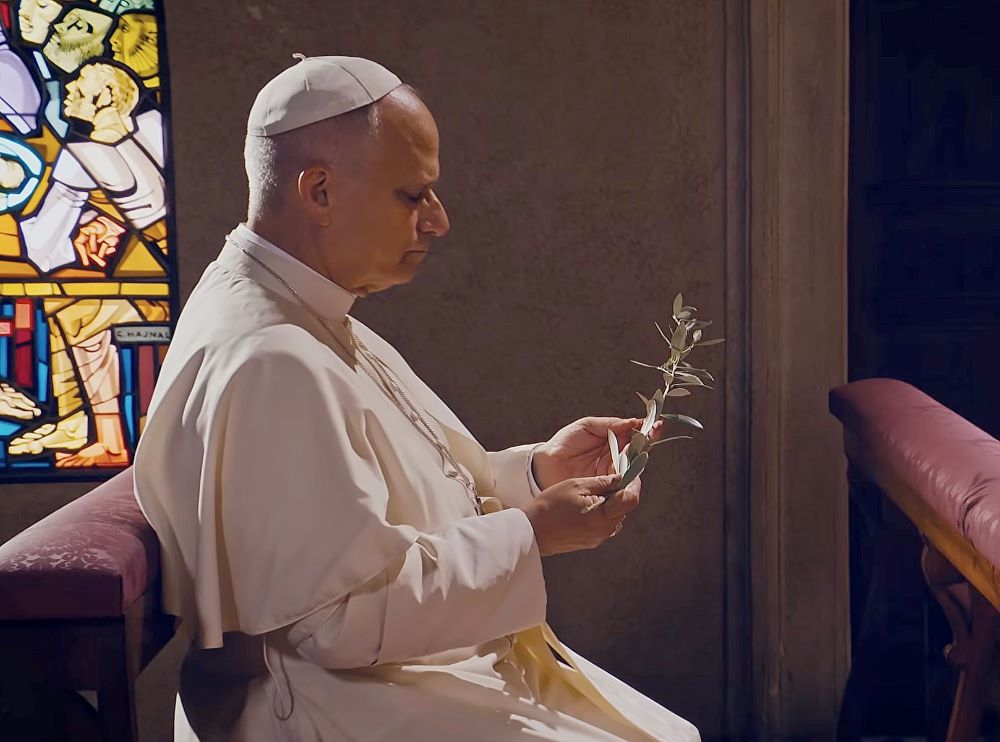
Pope Leo XIV prays for world leaders to "abandon projects of death" in a video message released by the Vatican March 5, 2026, asking people around the world to pray for peace. (OSV News screenshot/Pope's Worldwide Prayer Network)
If we want to shift the ground of these political leaders and increase our chances to prevent or defuse an ongoing war, then it seems critical we shift the discourse and the power dynamics. We can draw on valuable insights from the moral tradition, such as "right intention" for just peace, and reorient our discourse to practically make that more plausible.
In turn, an alternative approach for our discourse and practices to better shift the power dynamics within U.S. culture and policymaking is to focus on a just peace framework. This approach focuses on norms to engage conflict constructively, break cycles of violence, and build sustainable peace. It is rooted in the empirical research of effective strategies, and illuminates the dignity of all people, even our adversaries. The framework or process has arisen from and within a pastoral approach that listens to the experiences and voices of people in conflict situations across various cultural spaces.
Just peace norms operate in three distinct categories that may overlap in time and space. They apply to all stages of conflict. Strategies and actions chosen must enhance or at least not obstruct these norms. The first step in this moment is to focus on breaking the cycle of violence, with norms such as reflexivity (keeping means consistent with ends), rehumanization of all parties, conflict transformation, acknowledging responsibility for harm, nonviolent direct action, and what Francis has highlighted in the Catholic tradition, integral disarmament.
The present militarized, lethal strategy fails to enhance and even obstructs some of these norms by increasing trauma, bitterness, distrust and dehumanization. Thus, it moves us much further away from an integral disarmament, and may even exacerbate the arms race. It also significantly increases the inconsistency between means and claimed ends, such as sustainable peace. Thus, a just peace ethic can show us this war is unjust, without centering just war reasoning.
Advertisement
With a focus on just peace praxis regarding the war with Iran we can activate nonviolent direct action to shift power and policy in the U.S., generate independent initiatives to transform conflict, acknowledge responsibility for harm, rehumanize our language and narratives about the adversary, and re-engage in constructive diplomacy.
We have an incredible opportunity with the moves of Pope Francis and now Pope Leo. It is vital for U.S. Catholics and the U.S. church to lean in and embrace Leo's vision for a disarming peace articulated in his World Day of Peace message:
He (Jesus) firmly repeats to those who would defend him by (violent) force: 'Put your sword back into its sheath.' The peace of the risen Jesus is unarmed, because his was an unarmed struggle in the midst of concrete historical, political and social circumstances. Christians must together bear prophetic witness to this novelty …
Christ is calling us: You've been told an eye for eye, but I tell you to assert our sacred dignity and resist with creative, active nonviolence. This is the path to breaking cycles of violence, and to living out the mission of the church.