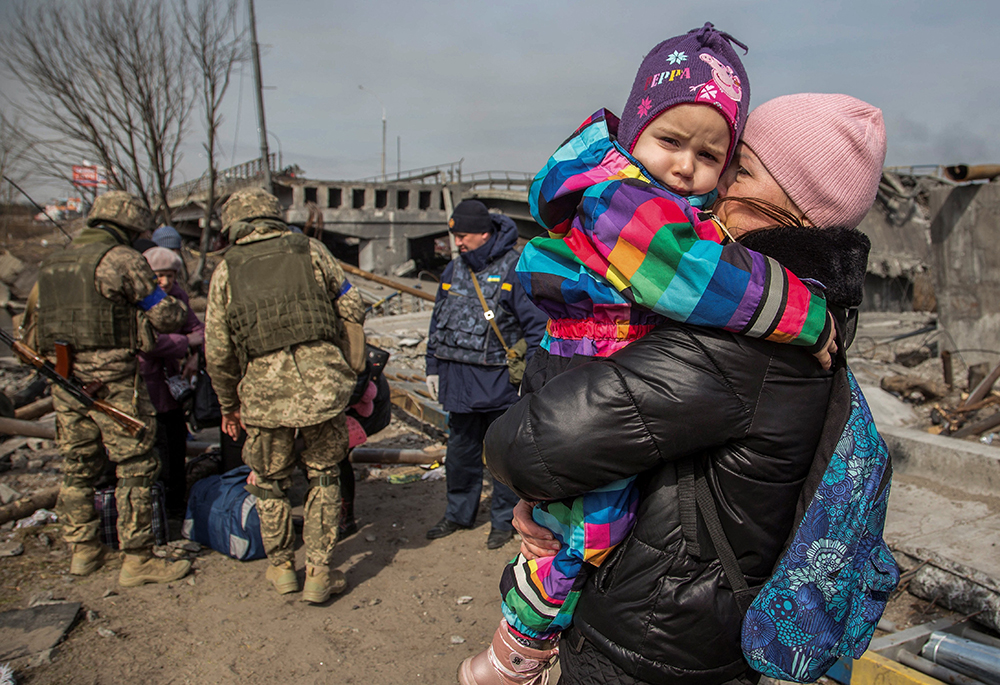
A woman holds a child next to a destroyed bridge during evacuation from Irpin, Ukraine, March 28, 2022, as Russia continued its attack on the country. (OSV News/Reuters/Oleksandr Ratushniak)

Join the Conversation
Send your thoughts to Letters to the Editor. Learn more
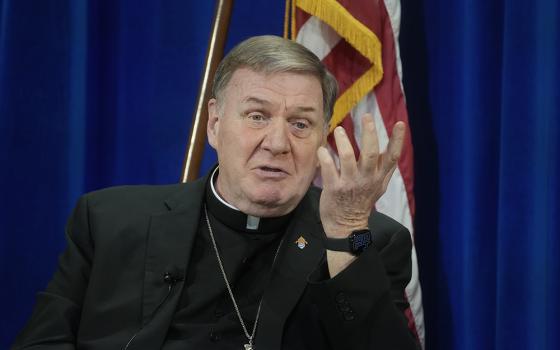
Cardinal Robert McElroy, archbishop of Washington, invoked just war theory in a recent interview about the war in Iran, rightly concluding that this war failed to meet several key criteria of that theory.
Just war theory is back; not that it ever really left. But in recent years, there has been an effort to replace it as the principal means by which the Catholic Church addresses issues of war and peace in favor of the idea that pacifism should be the only appropriate stance for Catholics.
In 2016, Pope Francis wrote a letter to a gathering of peace activists in which he told them, "Your thoughts on revitalizing the tools of non-violence, and of active non-violence in particular, will be a needed and positive contribution." The conference organizers went further. They sought a "new articulation of Catholic teaching on war and peace, including explicit rejection of 'just war' language."
Four years later, Francis wrote in Fratelli Tutti that is it "very difficult nowadays to invoke the rational criteria elaborated in earlier centuries to speak of the possibility of a 'just war' " (Paragraph 258). NCR's editors opined at the time: " 'Very difficult' may be a step away from 'impossible,' but it's only a small step."
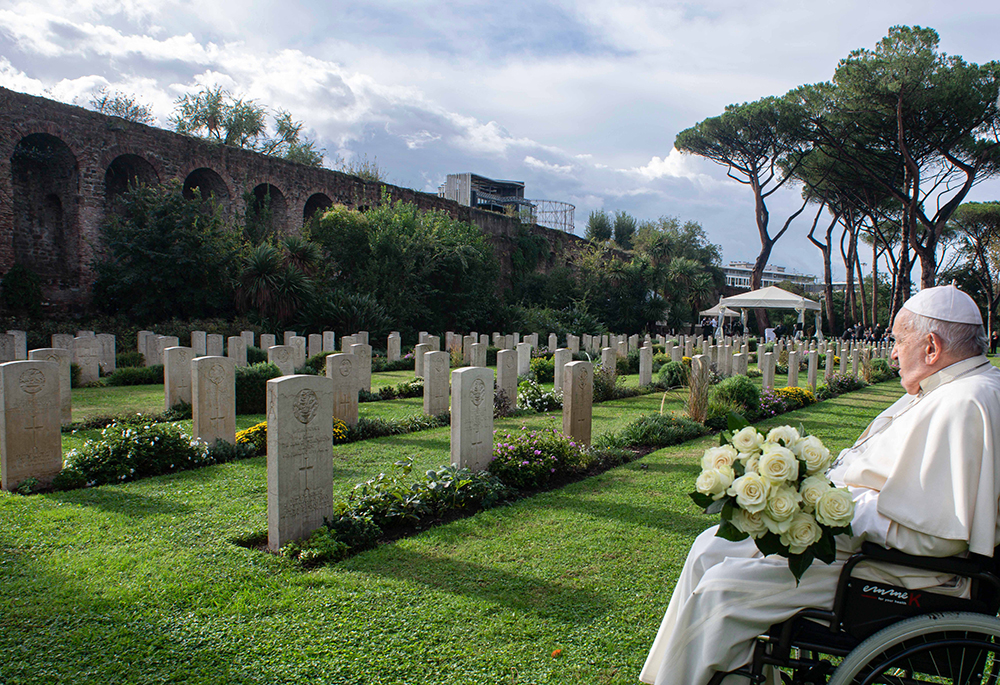
Pope Francis holds a bouquet of white roses as he visits the graves of members of Commonwealth military units who died during and immediately after World War II and now rest in the Rome War Cemetery where the pope celebrated Mass Nov. 2, 2023, the feast of All Souls. (CNS/Vatican Media)
And, in 2024, McElroy told the inaugural meeting of the Catholic Institute for Nonviolence in Rome that just war theory had become "devalued as a moral instrument."
That last claim is true.
Many people have reduced just war theory to a single criterion, just cause, and failed to note the other criteria: War must be a last resort, and a war must be winnable to be just, and the warmakers must have a right intention. Modern abuses of just war theory, as well as its critics, miss the fact that the theory as a whole is intended to make it more difficult to go to war, that just war theory is itself a practical tool for avoiding violence and for restraining it once begun.
Why, then, is just war theory back? Why has a commitment to nonviolence not supplanted it? In a word: Ukraine.
All of the six requirements of just war theory were met by the Ukrainian people's decision to defend their homeland. The cause is just as they were defending themselves from unjust aggression. The war was declared by legitimate legal authority. The intention was right, protecting innocents from aggression and defending Ukrainian national sovereignty. War was a last resort: Vladimir Putin was not inviting the Ukrainian government to any negotiations.
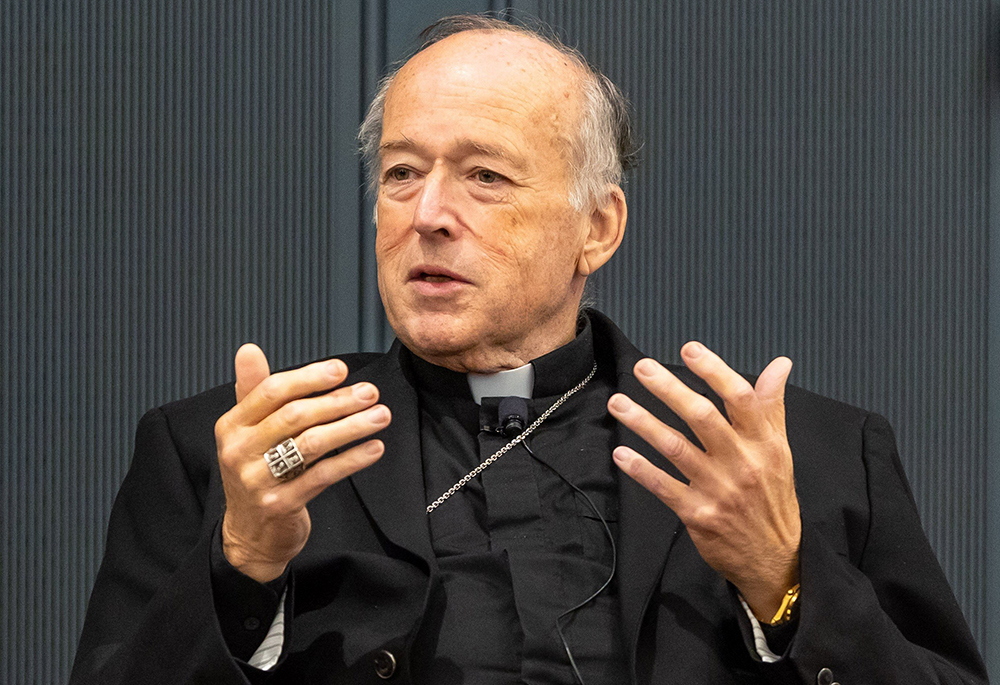
Washington Cardinal Robert W. McElroy speaks during an Oct. 17, 2025, event at the University of Notre Dame in Indiana. (OSV News/Michael Caterina, Courtesy of University of Notre Dame)
Although the destruction the war entailed was expected to be grim, and has been proven to be so by events, the destruction of surrendering to Putin would have been yet more catastrophic. The last criterion — a reasonable chance of success — was not evident at first to many outsiders, but the bravery of the Ukrainian people was rightly judged by its leaders, and they have fought tenaciously. Yes, provinces in the southeast of the country have been lost, but Putin's armies were marching on Kyiv.
The deeper reason why just war theory must remain the principal Catholic approach to these issues is that it more accurately accounts for the human condition. We may wish everyone in a position of authority had an irenic spirit but they don't. Some people and some regimes are built on evil, even apocalyptic, objectives. It is one of the ironies of the current war in Iran that, with the exception of North Korea, there might not be a more evil regime than the one in Tehran, but the ham-fisted way the Trump administration has approached this conflict is likely to strengthen the hold the regime has on the people of Iran. Nor can we expect the regime to abandon its efforts to export its apocalyptic vision to others in the region.
Putin is a different kind of threat. His vision is not apocalyptic, but it is murderous. He is willing to kill anyone who stands between him and his goal of restoring Russia to its Soviet-era boundaries. Nor is there any reason to think he would stop at the old Russian border with Poland, still less at the borders with the Baltic states. Keeping him within his current borders is achievable, if President Trump was more resolute in defense of Ukraine.
Advertisement
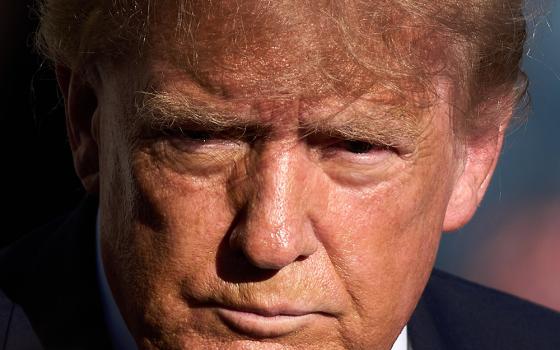
In addition to regimes that intend evil, there are countries that lull themselves into thinking war is an acceptable means of achieving certain geostrategic objectives. I suppose our own country is in that camp. We made mistakes during the Cold War when our leaders were motivated by a commitment to human freedom but lost sight of other human realities, like the tenacity of a people to resist foreign intervention, even well intended intervention. Now? The president is not particularly committed to freedom here at home, let alone promoting democracy abroad. Examining Trump's motives is not a job for a political analyst so much as for a psychologist.
Pacifism can't wrestle with such difficulties. George Orwell was correct when he said during World War II that pacifism was "objectively pro-fascist." Similarly, pacifists who urged the Ukrainians to avoid taking up arms and embrace nonviolence stand convicted by the exact same moral reality.
That can't be said about the war in Iran.
This war is unjust because, as McElroy pointed out, it fails key criteria for just war theory. It was a moral mistake as well as a strategic one. And it would be a grave mistake for the Catholic Church to abandon its just war tradition in favor of pacifism. Instead, the church should teach what just war theory really demands, that war is a monstrous evil, an evil that should be avoided, but also a reality which, in certain strict circumstances, remains the only morally viable option.