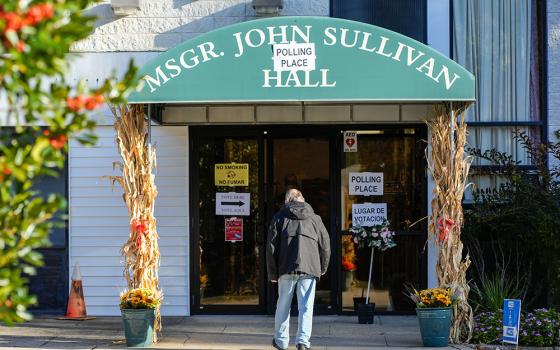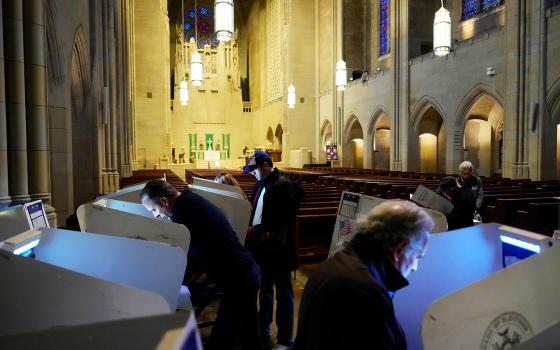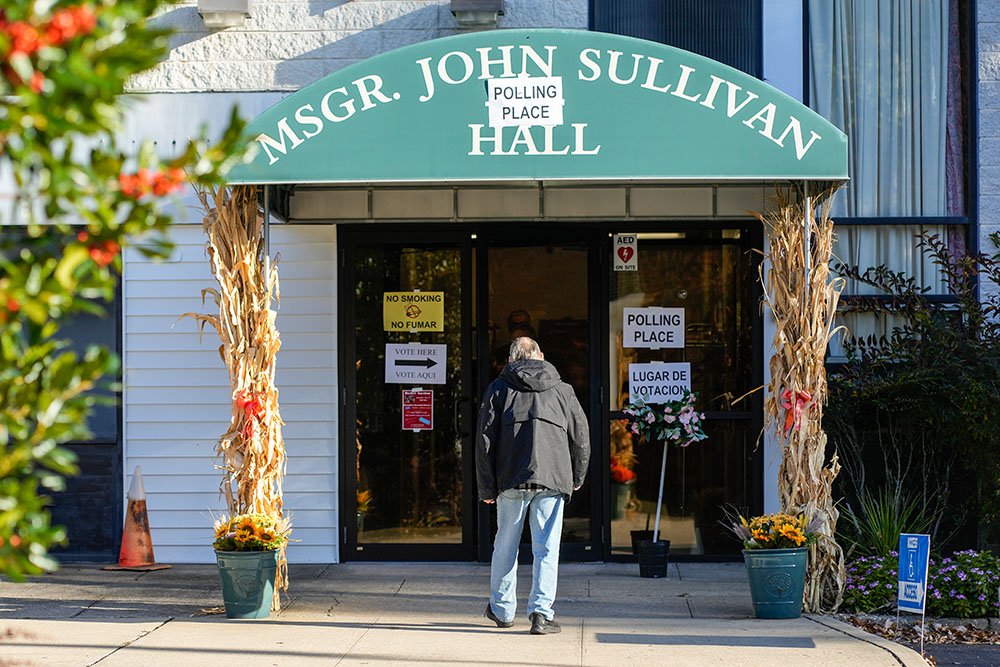
A voter enters the parish hall at St. John the Baptist Church in Wading River, N.Y., on Election Day, Nov. 3, 2026. The parish serves as a Suffolk County, N.Y., voting location. (OSV News/Gregory A. Shemitz)

by Joe Ferullo
Join the Conversation
Send your thoughts to Letters to the Editor. Learn more
In a blue tsunami that saw dramatic shifts among nearly every major voting category, one group decided to merely dip its toe in the water: Catholics.
Last Tuesday's vote was the largest congressional landslide in 50 years, with enormous double-digit swings to the Democrats from Black, Latino and Asian voters. But the Catholic vote pretty much ended up where it almost always does, right down the middle: 50% Democrat, 49% Republican.
To be fair, that does represent a move left from 2024, when Catholics backed the GOP and Trump, 56% to 42% — but this is not nearly as dramatic as the realignments among other voting groups.
For years now, political analysts have insisted that the Catholic vote does nothing more than reflect the vote of Americans as a whole, and the fairly even red-blue split typical of the last 25 years is simply a mirror of an electorate that is closely divided overall. In June 2000, as the country rolled toward what would become the notoriously tight contest between Al Gore and George W. Bush, Washington Post columnist E.J. Dionne wrote a column published with this now-famous headline: "There is no 'Catholic vote.' And yet, it matters." He argued that Catholics are no longer die-hard Democratic and working class — they now vote just like anyone else, vacillating from one party to the other.
But that didn't happen this year. Catholics pulled the lever as if this were just another midterm election, while the rest of the country changed the map in wildly unexpected ways.
To begin to figure out what might have happened, look toward the groundbreaking 2004 book by Thomas Frank, called What's the Matter With Kansas? In it, Frank wonders why Kansans — and others in solid red states — consistently vote against their own economic self-interests. They choose candidates who side with big business, resist hikes in the minimum wage, and frequently attack Social Security.
What he argued — and this seems second nature to us now — is that cultural questions matter just as much as pocketbook issues, sometimes much more. Voters, he said, are always weighing economic concerns against those issues that signal the kind of society they want to live in. In 2004, those were same-sex marriage, reproductive rights, and the morality of stem cell research. Bush won a second term despite ongoing and expensive wars in Iraq and Afghanistan.
Unlike most other voters, many Catholics may have maintained sharp focus on those culture war issues in this election. The United States Conference of Catholic Bishops remains dominated by more conservative prelates. The U.S. bishops continue to label abortion their "preeminent" issue, even after the fall of Roe v. Wade and prodding by both Popes Francis and Leo XIV to widen their social justice aperture.
At the same time, surveys indicate that most new priests in the U.S. are significantly more traditional than those who came before, emphasizing a stricter take on faith and obedience to their congregations.
The strongest clue may come in the demographic breakdown of the 2026 Catholic vote itself. An analysis by the Center for Applied Research in the Apostolate shows a strong turnout for Democrats among Black and Hispanic voters, and among voters 18-29 and 18-44. These results actually do adhere to the electorate at large. The big shift toward Republicans comes among White Catholics. They went 56%-43% for the GOP.
Advertisement
One other Catholic category also went substantially red: Catholics aged 65 and older.
Those two groups pretty much describe the church in America. Despite the growth in Latino Catholics, whites represent the largest percentage of U.S. Catholics: 12% of the U.S. population versus 8% for Latinos. And white American Catholics are the oldest religious group in the country, with a median age of 58 in 2023, up from 53 ten years earlier. That's a formula for conservative voting, apparently even in 2026.
But there are signs this may change. Several dioceses report record numbers of younger people joining the church. A poll last November by NCR and the Wittcoff Foundation showed Gen Z college-age Catholics had both a strong interest in church traditions and a dedication to Catholic social justice.
At the same time, Leo is appointing a new generation of American bishops, younger and more diverse, many immigrants themselves to the United States. Messages coming from Catholic leadership should eventually change, although it will take a while for the Leo generation to step into important roles.
As for Kansas, well, since Frank's book, that state has voted for Democratic governors, and of course, this past Tuesday, chose Democrat Adam Hamilton as its new senator. He'll be the first Democrat to represent Kansas in the Senate since 1932, ninety-four years ago.
Hopefully, it won't take Catholic voters that long. The church may think in centuries, but — as Tuesday showed — changes in American politics can literally happen overnight.