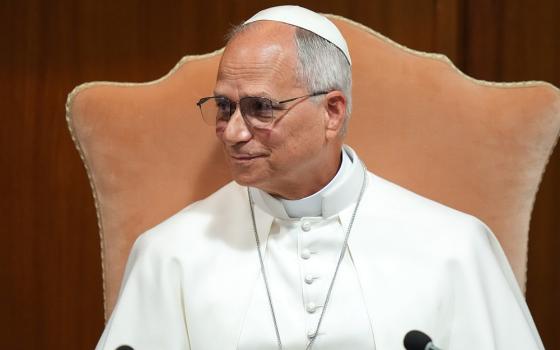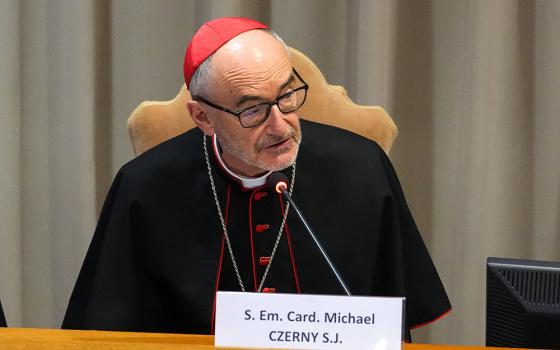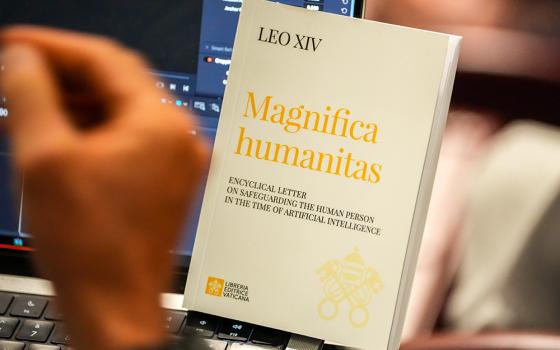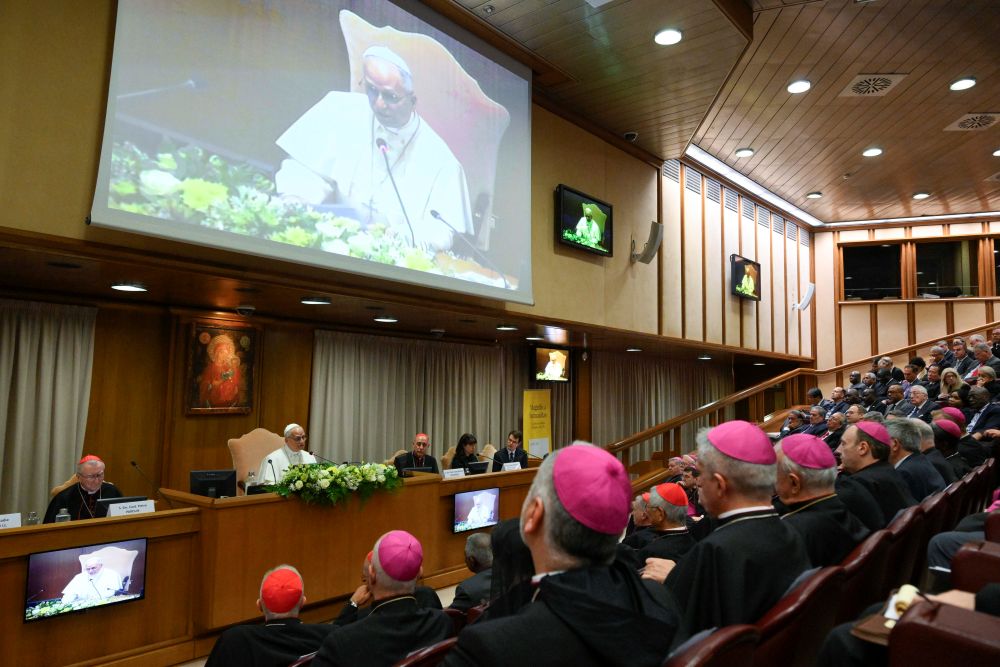
Pope Leo XIV speaks during the presentation of "Magnifica Humanitas" at the Vatican's Synod Hall May 25, 2026, the first encyclical of his papacy, which focuses on the rise of artificial intelligence. (OSV News Vatican Media/Simone Risoluti)

by Daniel P. Horan
Join the Conversation
Send your thoughts to Letters to the Editor. Learn more
There has been a lot of media attention paid to Pope Leo XIV's encyclical Magnifica Humanitas ("On the Safeguarding of the Human Person in the Time of Artificial Intelligence.") Indeed, it is a teaching document that speaks to the "signs of the times" that understandably captures the attention of both artificial intelligence enthusiasts and skeptics alike. Both religious publications and secular news outlets have reported on the contents of the text and the pope's historic presentation of the publication alongside theologians, church leaders, and the co-founder of the AI company Anthropic, the 33-year-old atheist Christopher Olah.
Among themes the press has most frequently highlighted so far are the concerns Leo raises about AI (including growing inequality, the likely loss of jobs and the environmental impacts), the idolatry of profit in the corporate world, the dangers of transhumanism, the protection of the most vulnerable in society, acknowledgement of and an apology for the church's complicity in the practice of slavery, violence and the limitations of the just war tradition, among other topics.
However, one dimension of Magnifica Humanitas that has not yet received as much attention as I believe it should have is the spirituality that undergirds the Leonine analysis of the promise and threat of AI among other concerns in our contemporary age. In particular, there is a thread of what I might call "incarnational spirituality" that runs throughout the lengthy document. This kind of spirituality is distinctive in that it prioritizes our corporeality, embodiment and the central Christian doctrine of the Word's incarnation.
For some, it may seem obvious that materiality and embodiment are centered in discussions of Christian spirituality. However, rarely has that been the case over the centuries. Instead, the theme of spirituality has a longstanding history of being viewed through a dichotomous lens that results in a dualistic caricature that pits "the spiritual" against "the material." We've seen this play out in other binaries too, such as between "the sacred" and "the profane."
So good is the created world and our embodied experience as humans that God entered this world to share in the vulnerability, precarity and community of creaturely life as a human being.
As the sociologist Meredith McGuire once put it, "Many of us were brought up thinking that the spiritual realm is completely set apart from the material realm. Perhaps even opposed to it." This has led many religious adherents — including, and perhaps especially, Christians — to deny their material creatureliness, separate their sense of the spiritual or noumenal from their corporeality, and seek escapist approaches to the spiritual life.
Fortunately, there has been a growing awareness of the problems with this way of thinking in both academic research and pastoral practice. In fact, the Society for the Study of Spirituality and the Spirituality Institute for Research and Education are co-sponsoring an international colloquium on embodiment in Christian spirituality next month in Dublin, Ireland. I'll be attending it, along with about 35 other scholars from across the globe.
Because I have been thinking about the relationship between our inherent materiality and its inextricable relationship to Christian spirituality, I was especially sensitive to this aspect of Magnifica Humanitas. And I was pleased to see that one of the overarching concerns raised in this magisterial document is the danger of discounting our intrinsic embodiment.
The theme of spirituality doesn't appear explicitly in Magnifica Humanitas until the conclusion, where Leo discusses the Incarnation, the Eucharist and ways forward in constructing a life of Christian practice on behalf of the common good. In this concluding section the pope lays out a beautiful vision of Christian life, which can only be understood properly in terms of Jesus' own earthly life and ministry. He writes: "At the heart of everything is the mystery of the Incarnation, the Word who became flesh and dwelt among us."
Leo contrasts this incarnational vision of embodied spirituality with the false promises of technology that seek to minimize our vulnerability and materiality, calling this lure of transhumanism "an enhanced and almost disembodied humanity." He goes on to present an incarnational spirituality modeled on the kenosis or "self-emptying" of God in Christ, which stands in stark contrast to what we might identify as the pseudospirituality ushered in by the "technocratic paradigm" that both he and his predecessor, Pope Francis, warned us about:
Contrary to this, the mystery of the Son of God entering into our human condition promises something quite different. The living God descends into our history in order to free us from all forms of slavery. He takes upon himself our weakness and transforms it into a setting for salvation. There is no moment or human situation that is not worthy of God. "According to the teaching of our faith, we have and adore, in our mysteries, a God who is born in a manger, a God who lives and travels in Judea, a God who dies on the cross, a dead God who lies in the tomb." The future of humanity, therefore, finds its standard in the ability to welcome this divine way of drawing near, of sharing the burden of the world, of transforming relationships from within. "O wonder ... man is God and this God-Man passes through all those stages, endures all those states and ennobles them, sanctifies them, deifies them in himself!" What saves humanity is the divine love that descends into the most fragile point of our history and renews it from within.
While this incarnational spirituality becomes clear in the closing paragraphs of Magnifica Humanitas, it is present throughout the entire text, knitting together the pope's wide range of analyses and reflections. For example, in Chapter 4, which focuses on what the pope calls "safeguarding humanity at a time of transformation," he notes that the concerns raised are interconnected and threaten dehumanization when "technology becomes the ultimate criterion" without the necessary reflection, justice and community required for sound discernment.
Earlier, in Chapter 3, when addressing the subject of AI most directly, Leo critiques those who subscribe to a technocratic paradigm and argue for unfettered progress in the effort towards developing the "more than human." He notes that such a framework is dangerous when limited to "technological promise" alone, which signals the possibility of disintegrating the unity of body and spirit and the rejection of our creaturely nature. Drawing from the rich tradition of recognizing God's grace building on our embodied human nature, the pope offers a response grounded in this incarnational spirituality:
[H]umanity — in all its grandeur and woundedness — must never be replaced or surpassed. We can embrace the technological progress that alleviates suffering and unlocks new possibilities, provided that we do not abandon the very essence of our humanity, namely the capacity for relationship and love. This leads to a crucial question: if an authentic "more than human" exists, where is it to be found? The Christian faith answers that question by pointing to a fulfilment that does not arise from a technological divinization, but through God's grace received in Christ (126).
In addition to the important tradition of Catholic social teaching upon which this encyclical builds and to which it contributes a significant amount, we might also note that this teaching document draws from and supports a more fundamental Christian doctrine: the inherent goodness of creation generally and our own materiality in particular. In fact, so good is the created world and our embodied experience as humans that God entered this world to share in the vulnerability, precarity and community of creaturely life as a human being. This is what it means to talk about an incarnational spirituality and it is clear that Magnifica Humanitas conveys this way of seeing ourselves, one another, the rest of creation and God.
Advertisement