A worker carries lumber at a highway construction site in Stony Brook, N.Y., Aug. 30, 2022. (OSV News/CNS/Gregory A. Shemitz)

Join the Conversation
Send your thoughts to Letters to the Editor. Learn more
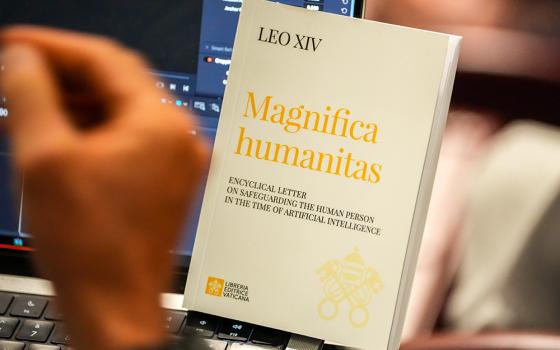
Why settle for artificial intelligence when you can have divine wisdom? Better to say, if you must confront artificial intelligence, and it is almost impossible to avoid, you'd better bring divine wisdom to the task of engaging it. This is the central theme of Pope Leo XIV's first encyclical, Magnifica Humanitas.
It is difficult to imagine a more countercultural title of a papal document. We look around the world and see wars, gross income inequality, lurking environmental disaster, all three largely the result of human decision-making. Yet the pope reminds us of what we were created and are called to be: magnificent.
Three particular themes in the encyclical are of special note, and each in its way, points to the unique magnificence of humankind: Our anthropological vocation grounded in the revelation of Jesus Christ, our ability to collaborate with our creator God and our capacity for belief in that which we cannot see.
In the very first paragraph, the pope quotes the words of Gaudium et spes that indicate the true vocation, the character and calling of the human person. "Whenever humanity is in danger of marring its true identity, we Christians lift our eyes to the Incarnate God, knowing that it is 'only in the mystery of the Word made flesh that the mystery of humanity truly becomes clear.'" Of all the texts of the Second Vatican Council, this was the passage most cited by St. John Paul II and it offers a key to the first, most striking theme of the document: The issues raised by AI are not merely ethical but anthropological.
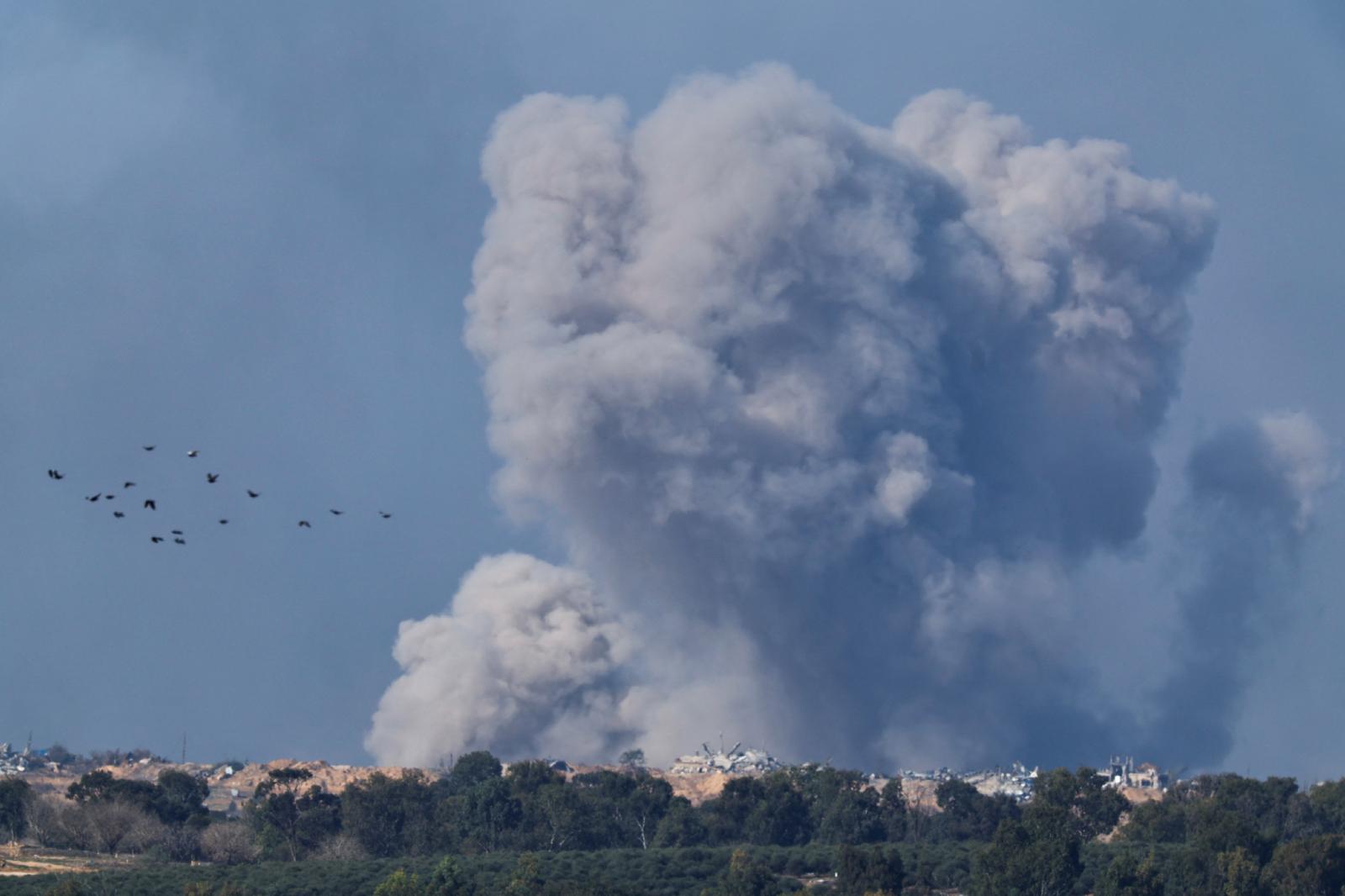
Smoke rises in the Gaza Strip as seen from southern Israel Dec. 20, 2023, amid the ongoing war between Israel and the Palestinian militant group Hamas. (OSV News/Reuters/Clodagh Kilcoyne)
"So-called artificial intelligences do not undergo experiences, do not possess a body, do not feel joy or pain, do not mature through relationships and do not know from within what love, work, friendship or responsibility mean," Leo writes. "Nor do they have a moral conscience, since they do not judge good and evil, grasp the ultimate meaning of situations, or bear responsibility for consequences. They may imitate language, behavior and analytical skills, or even simulate empathy and understanding, but they do not understand what they produce, for they lack the affective, relational and spiritual perspective through which human beings grow in wisdom."
Leo warns against "the search for ready-made answers" and the ability of modern technology to "weaken personal creativity and judgment." He notes that the "answers" AI yields "reflect the cultural assumptions of those who designed and trained them, with all their strengths and limitations." Most strikingly, the pope warns: "When words are simulated, they do not build genuine relationships, but only their appearance. The artificial imitation of care or support can become particularly risky when it enters contexts where real relationships and emotional bonds are lacking. Here, the danger is not so much that a person may believe they are communicating with another person, but rather that they may gradually lose the very desire to form genuine human connections."
Leo rightly worries that these new technologies are largely in private hands, not even subject to the accountability of government. "[W]hen AI systems present themselves as neutral and objective, they end up reflecting and reinforcing the stereotypes or ideological bias of their designers and developers." And he is concerned that "If a system is designed or used in a way that treats some lives as less worthy, or excludes them without the possibility of appeal, then it is not merely a tool 'to be used well,' since it has already introduced criteria that contradict the inalienable dignity of the human person."
Leo acknowledges the ability of technology to improve lives and find cures to diseases and other evils that give rise to suffering. But, again, he prioritizes the singularly human dimension of life. In one of the most striking sentences in the entire document, he writes: "To eliminate suffering entirely would mean, in the end, extinguishing love and desire as well."
These dangers do not primarily concern what the human person ought and ought not to do, but who the human person is and the need to differentiate between authentic and artificial human relationships. They are anthropological and they precede ethics.
I wonder if the modern world has the ears to hear these concerns. The de facto stance of religion in the public square of modern, pluralistic societies is that of an ethical authority. Divorced from their dogmatic roots, ethics inevitably becomes a contest of ideas in which anyone's opinion is as good as another's. When religion is reduced to ethics it is incapable of generating the kind of humane culture without which we will all soon be at the mercy of the merciless technologies and those who control them.
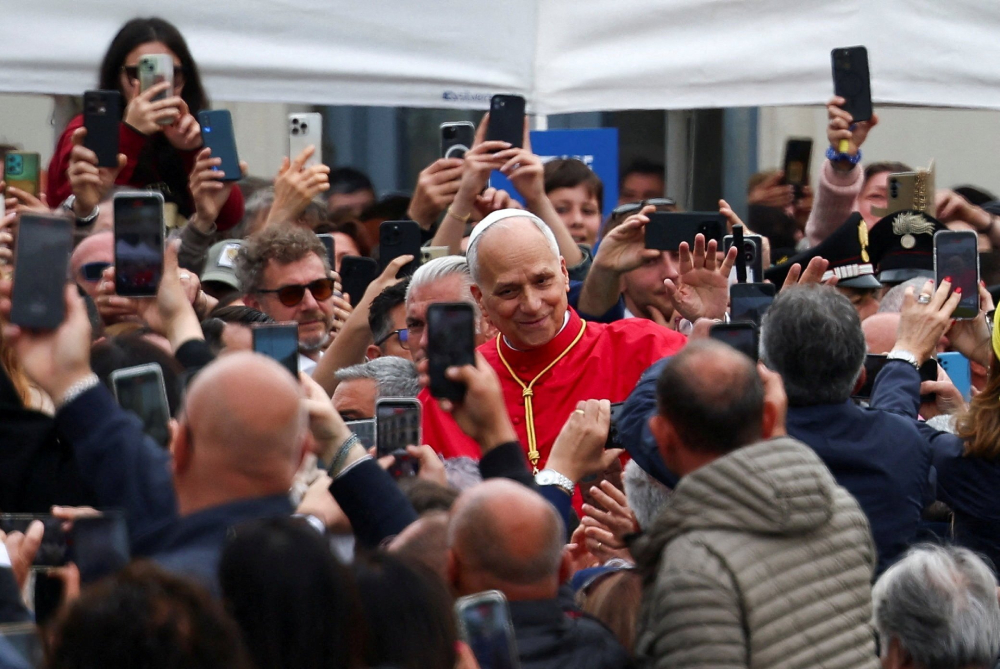
Pope Leo XIV arrives to celebrate Mass in Piazza Bartolo Longo in front of the Pontifical Shrine of the Blessed Virgin of the Rosary of Pompeii near Naples, Italy, May 8, 2026, on the first anniversary of his election as the first American pontiff. (OSV News/Reuters/Guglielmo Mangiapane)
The second theme, one also deeply rooted in the church's tradition of Catholic social doctrine is the significance of human work. Like his namesake, this Leo asserts that work is "the essential key" for understanding social questions, the guarantee that the human is not simply exploited for the profit of others. The priority of labor over capital is no late 19th century fantasy, but is deeply rooted in our human self-understanding:
"Created in the image of the Creator, our own work in some way continues his, for thereby we contribute to the progress of society and the common good, put to good use the capabilities we have received, improve and beautify the world, support our families, engage in cooperative relationships and, through listening and dialogue, learn to build together something that no one could achieve alone."
Magnifica Humanitas recalls, but does not develop, the deeply personalistic understanding of work that John Paul II articulated in his first social encyclical, Laborem Exercens. Work "expresses and enhances the dignity of our lives," the pope writes, and he examines the threats to employment that AI raises, calling for "social criteria for innovation" that would require assessment of potential damage to the workforce of a particular innovation in advance.
The pope reaffirms the church's consistent support for organized labor but also, rightly, calls for new collaborative efforts between labor, government, business and educational leaders. His comments on the modern economy are consistent with those of his predecessors, as when he states, "justice concerns every phase of economic activity, from resource acquisition to financing, and from production to consumption; every choice has moral consequences." There is an entire section devoted to new forms of slavery and the clamant need to confront them.
All of this is enough to get Leo condemned as a socialist in some circles but, still, I wish he had spent more time on this section. The defining characteristic of the political crisis in Western democracies is the polarization between the working class and the middle and upper middle class, between those with academic degrees and those without them. Forging bonds of solidarity between the two groups is vital, yet it receives little attention in this encyclical and will, hopefully, be the subject of subsequent magisterial teaching.
The third theme of special note points to our human capacity for belief and for recognizing the claims divine revelations places upon us. We usually refer to "Catholic social teaching," but Leo repeatedly refers to "Catholic Social Doctrine." This is a welcome development, a reminder that this body of ideas are not optional, add-ons, nor are they merely ethical. They are at root doctrinal, rooted in Christian concepts about creation, sin, the incarnation, the Paschal mystery and the eschatological destiny of the human person.
The pope explains how the church's social doctrine develops to address specific issues of the day, but does so by applying eternal truths derived from faith and reason. But he also demonstrates how this is so, citing insights from previous popes that remain especially relevant. For example, from Pope Leo XIII's Rerum Novarum, Leo XIV observes:
While many of the historical conditions described by Leo XIII have changed, at least two insights remain highly relevant today: the primacy of human labor over any mindset focused solely on finance or productivity — with the consequent attention to the people and families most susceptible to exploitation — and the inseparable link between proclaiming the Gospel and pursuing a more just social order.
Drawing from the teachings of Pope Pius XII, Leo cites three still relevant ideas: "the need for law to take precedence over interests; the awareness that economic disparities are a breeding ground for tension and violence; and the necessity of a network of associations capable of mediating between the individual and the State." And, he commends Pope Benedict XIV for "showing that development, justice, institutions and the market are not neutral realities, but spaces where charity in truth must find historical expression." And, Leo highlights the concept of "integral ecology" that emerges in Pope Francis' Laudato Si'.
Although the document is long, and sometimes seems bogged down by context and clarifications, it is a teaching document and, just so, that context and those clarifications are important. And there are moments when a certain lyric quality shines through. For example in paragraph 15, we read:
In the era of artificial intelligence, when human dignity is threatened by new forms of dehumanization, ours is the pressing duty to remain profoundly human. We must lovingly safeguard the grandeur of humanity bestowed upon us and revealed in its fullness in Christ, the splendor of which no machine can ever replace.
This beautifully harkens back to the opening quote from Gaudium et spes, highlighting the integral link between Christian faith and humanism.
Advertisement
What might have been said differently or better? Discussing the principle of subsidiarity, the pope states, "According to this principle, whatever can be carried out by individuals, families, intermediary organizations and local communities should not be carried out by higher-level authorities." That is true, but the implied corollary is that whatever cannot be carried out by individuals, families and the like may require the intervention of higher-level authorities, not to infringe but to empower. Such an important point should be stated explicitly not implied.
The section on AI and war is vitally important as the prospect of automated killing, without human decision-making, is truly frightening. The pope, however, goes beyond that narrow window and states: "Today, more than ever, without prejudice to the right to self-defense in the strictest sense, it is important to reaffirm that the 'just war' theory, which has all too often been used to justify any kind of war, is now outdated." There is no question that just war theory needs updating but it remains a necessary tool of analysis as the pope's conditional phrase "without prejudice to the right to self-defense" implies. Just war theory has been abused and the abuses should be addressed. Just as a prescription drug can be abused, but is nonetheless capable of helping someone in pain, just war theory remains essential to the church's moral compass.
Because AI is such a profound issue, shaking so many cultural foundations at once, this encyclical will likely gain more of a hearing than most such teaching documents. The long section that explains the development of Catholic social doctrine should not deter anyone but, instead, affirm the deep continuity among the very different pontiffs who articulated that doctrine and to which Leo is now custodian. His unique contribution is to focus that tradition on AI and to ground the analysis in foundational, anthropological concerns and not stand by as a mere ethical authority. There are deep ecclesial as well as cultural undercurrents in this text, and Leo will be steering the church through them in the years ahead. If this is his map, we have the right helmsman at the wheel.