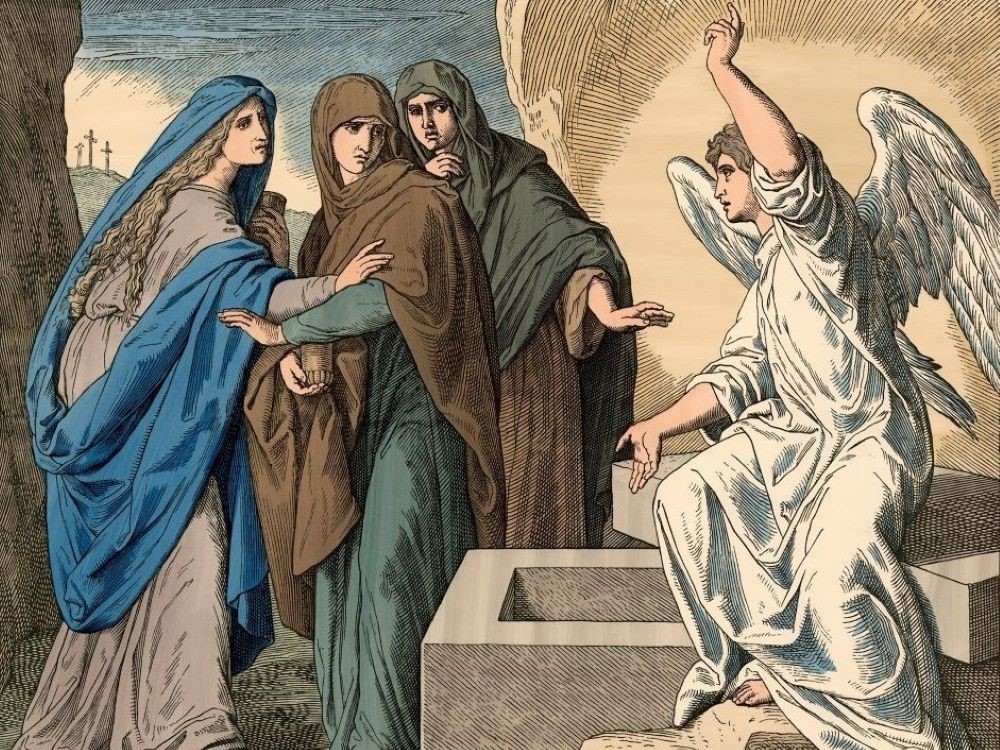
"An angel declareth the resurrection of Christ" (1888) by Julius Schnorr von Carolsfeld rtvee)

Join the Conversation
Send your thoughts to Letters to the Editor. Learn more
Christ is risen. He is risen indeed. Alleluia.
Easter is the day of triumph over sin and death. Jesus, the stone which the builders rejected, has become the cornerstone. God, by overturning the world's verdict against Jesus of Nazareth, has revealed the depths of his love and mercy, and done so definitively. The stone has been rolled away and the tomb is empty.
But the world has not rolled away. Jesus preached, "Repent, the Kingdom of God is at hand" but the evidence of Christ's kingly reign is often perceived only dimly, and is sometimes overshadowed by the world's tenacious grip on our human frailty. We still wander in the wilderness, despite Easter. His kingdom has come, but it is not yet here in its fullness. This is the essential tension of the Christian life.
We still wander in the wilderness, despite Easter.
This tension emerged early in the life of the Catholic Church. They expected Christ to return in glory, and to return soon. Reading the church fathers, the sense of expectancy shines through. They thought it was imminent. But, soon enough, people delayed being baptized until late in life, for fear that any sins committed after baptism might doom them to hell. Eventually confession emerged to cope with this tension between God's commanding grace and our human sinfulness.
By the early fourth century, the bishops gathered at Nicaea captured the tension in five lines in the creed:
He ascended into heaven
and is seated at the right hand of the Father.
He will come again in glory
to judge the living and the dead
and his kingdom will have no end.
The kingdom has come but not come. His reign has begun, but is not complete. As Paul wrote to the Corinthians: "At present we see indistinctly, as in a mirror, but then face to face. At present I know partially; then I shall know fully, as I am fully known." How true those words remain for us all these centuries later.
Advertisement
This Eastertide, the not yet seems especially prominent and painful. War is destroying lives in so many places. Human trafficking shows no signs of abating. Man's cruelty dominates the headlines, while acts of kindness or forbearance are lucky to make it to Page 7. The exploitation of the planet continues, threatening untold human and nonhuman suffering. Our country is polarized and that polarization has made its evil way even into our church where the ties of political affiliation outweigh the ties of baptism. Families continue to struggle against all the many pressures that confront them.
In the face of all this evil, it takes effort even to discern the in-breaking of the kingdom. St. Pope John XXIII introduced the notion of the "signs of the times" in his 1961 encyclical Mater et Magistra, indicating an inductive method of discerning the reign of God, which was further developed by Vatican II in Gaudium et Spes. Some theologians criticized the approach as too sociological, lacking a theological and biblical basis. As Cardinal Michael Czerny and Fr. Christian Barone explained in their book, Siblings All, Sign of the Times: The Social Teaching of Pope Francis, "Paul VI inherited this awareness of the 'signs of the times' from John XXIII and the Second Vatican Council, but he also perceived its ambivalence. His magisterium sought to clarify the category, so that it would not be reduced to a mere recording of 'facts,' but that in it one would perceive that abundant 'more' that signals God is at work." When we look at the signs of the times, we are looking for evidence of grace, for evidence of God's superabundant presence in this fallen world.
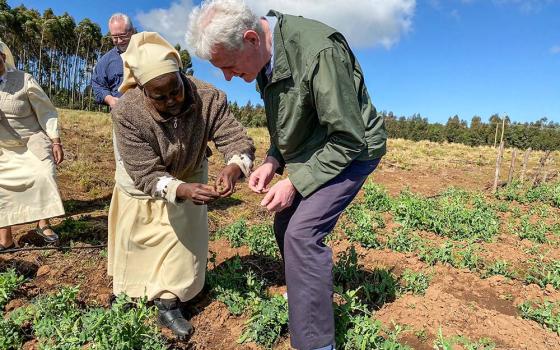
We see such evidence in the witness of our religious women who give their lives to help the poor and afflicted. We see it in the work and words of a new archbishop, handing out food to families in need and reminding the church: "We do not gather as 'them' and 'us.' It's simply us together, todos, todos, todos, everyone together." We see it in the work of Catholic Charities and the stories of hope that emerge from that work. We see it in Pope Leo's Easter message: "We have seen how God responds to the hardness of sin — which divides and kills — with the power of love, which unites and restores life."
None of these examples are abstract. All involve, like the original revelation, human mediation of the divine. They are what keep us Christians going as we wait for Jesus to come again in glory, or for ourselves to cross the abyss and, hopefully, see him face to face.
You are reading a selection from Michael Sean Winters' weekly newsletter. To get the full edition — including the "In the News" link roundup — delivered 24 hours before it appears online, sign up here!