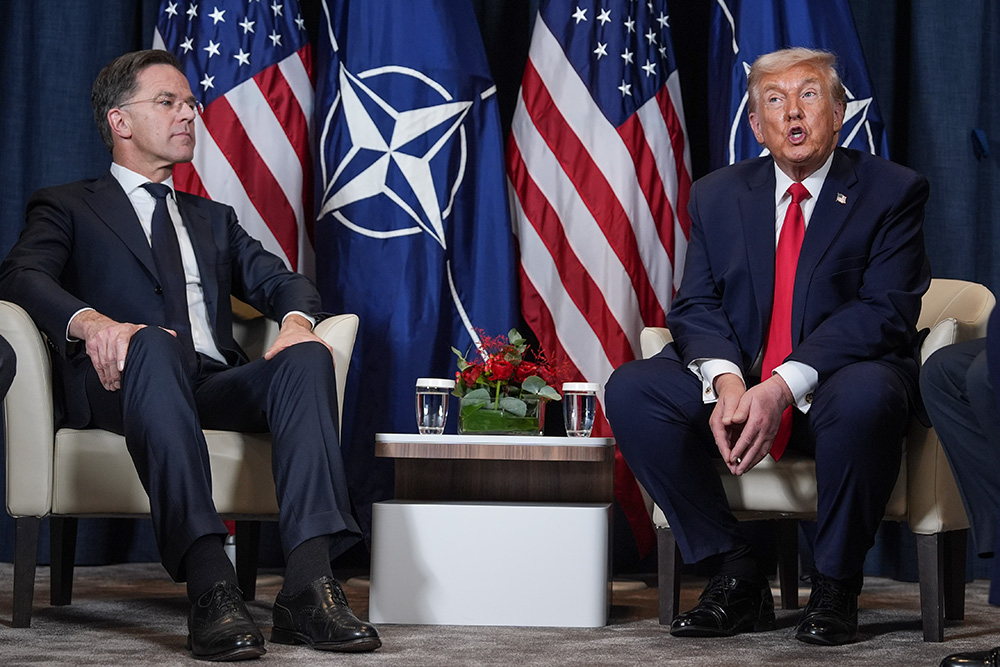
President Donald Trump, right, meets with NATO Secretary General Mark Rutte on the sidelines of the Annual Meeting of the World Economic Forum in Davos, Switzerland, Jan. 21, 2026. (AP/Evan Vucci)

Join the Conversation
Send your thoughts to Letters to the Editor. Learn more
President Donald Trump is tossing around the idea of pulling the United States out of NATO. After a meeting last week with the alliance's secretary general, Mark Rutte, Trump complained on social media, "NATO WASN'T THERE WHEN WE NEEDED THEM, AND THEY WON'T BE THERE IF WE NEED THEM AGAIN. REMEMBER GREENLAND, THAT BIG, POORLY RUN, PIECE OF ICE!!!"
It comes as no surprise that a narcissist like Trump fails to grasp how an alliance works. Had he consulted with NATO leaders before his decision to attack Iran, which he acknowledged he did not do, he might have reason to complain. He made that acknowledgement during a meeting with the prime minister of Japan, adding a crass joke about Pearl Harbor. The body language of Japanese Prime Minister Sanae Takaichi in that clip spoke for all U.S. allies: extreme discomfort dealing with this buffoon of a president.
NATO was formed in 1949 to unite the countries of Western Europe in a defensive alliance against the Soviet Union and to prevent the outbreak of a nuclear war. In my diplomatic history course as an undergraduate, I remember the professor explaining to us that any foreign policy that lasts 10 years should be considered a success. NATO not only survives to this day, it achieved the two objectives for which it was created, containing Soviet expansionism in Europe and avoiding a nuclear war. NATO then adjusted to the post-Cold War world by extending its reach into the countries of Eastern Europe, confronting the neofascist regime in Serbia, assisting the U.S. in the war in Afghanistan, and coordinating aid to Ukraine in its effort to defend itself from Russian aggression.
Advertisement
Back in 1949, however, none of this was a given. Russia had been allied against Nazi Germany and Italy in World War II, but as the end of the war came into prospect, it became obvious that the Western democracies and Soviet Russia shared nothing except a common enemy, and that enemy would soon be defeated. Hopes for a working relationship with the Soviets after the war were crushed in the rubble of Warsaw where, after the Red Army reached the city and encouraged the Polish patriots to revolt against the Nazis to take back the city, Stalin ordered the army to halt. The Nazis killed the leaders of Polish society before leveling the city while the Red Army stood a few miles away. Stalin even refused to allow British or American planes to refuel at airfields they controlled after the Allied planes dropped aid to the Poles fighting for their lives and their future. Any remaining hope that the Soviet Union would respect the freedom of the peoples of Eastern Europe was drained out in the streets and sewers of Warsaw with the blood of Polish patriots.
British Prime Minister Winston Churchill sent a telegram to U.S. Gen. Dwight Eisenhower on April 2, 1945, urging him to send his armies to Berlin, and to hurry, not toward Dresden as Eisenhower intended. "I deem it highly important that we should shake hands with the Russians as far to the east as possible," Churchill wrote. Regrettably, Eisenhower demurred, failing to grasp the relationship of military to political objectives. The Russians captured all the great capitals of Eastern and Central Europe: Warsaw, Bucharest, Sofia, Budapest, Prague and Vienna.
Stalin was able to keep as large an army in Eastern Europe as he wanted while the U.S. sent its troops home. What is more, much of Western Europe lay in ruins. The year before NATO was created, the United States began the Marshall Plan, investing massively in the rebuilding of the European economy. The aid was offered to the countries under Soviet domination as well, but they refused. The plan, crafted by Gen. George Marshall, chief of staff during World War II and President Harry Truman's secretary of state, was among the most enlightened acts of statesmanship in history. Truman rightly said of Marshall that he was "one of the greatest Americans of all time."
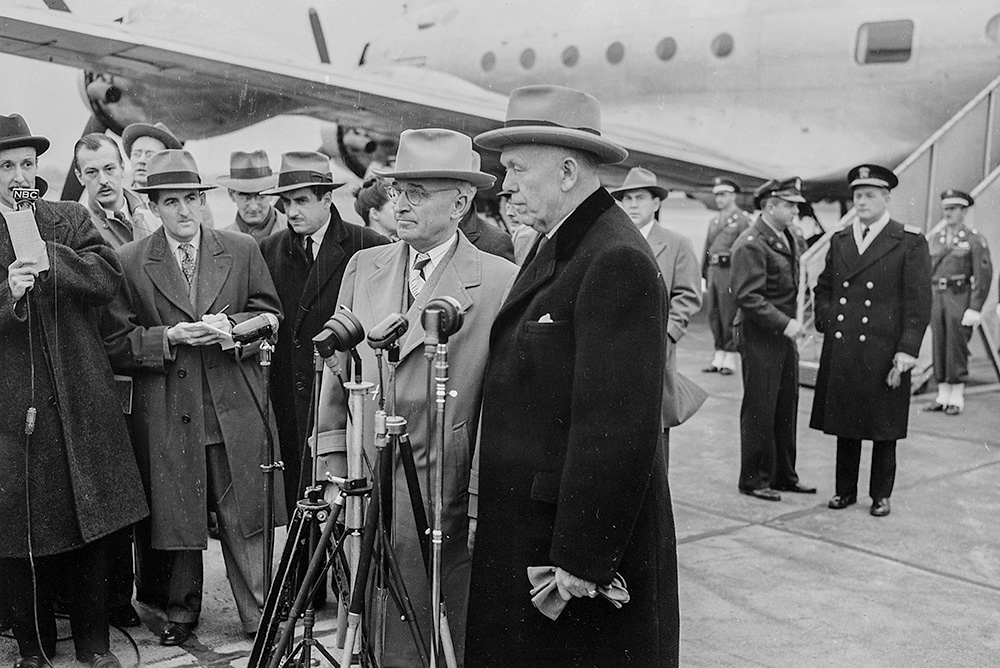
President Harry Truman and Secretary of State George Marshall speak to the press at the National Airport in Washington, D.C., Nov. 20, 1947. (Wikimedia Commons/National Archives and Records Administration)
As Trump spoke of leaving NATO the way any of us might speak of taking off a sweater, Marshall was turning over in his grave. In Poland, where the NATO flag flies alongside the Polish national flag and the flag of the European Union outside most government buildings, they are turning over in their beds, worried that Trump might actually act to break NATO apart.
Good news arrived over the weekend from Hungary where voters turned Prime Minister Viktor Orban's party out of office by a large margin, despite U.S. Vice President JD Vance campaigning for him in the final week of the campaign.
Orban has been a thorn in NATO's side, cozying up to Russia's Vladimir Putin and frustrating coordinated aid to Ukraine. The new prime minister, Peter Magyar, promised: "We will restore institutions that protect democracy. Hungary will once again be the strong ally of the E.U. and NATO." Wouldn't it be nice if other candidates for whom Vance campaigns meet with an electoral fate similar to that of Orban!
I sympathize completely with those voters who, disgusted with today's insufferable elites, voted for Trump precisely because he promised to shake things up. But NATO, like foreign aid, like the social welfare state, like the Constitution, was created by elites who were not insufferable. NATO was the work of Truman and Marshall, of Dean Acheson and George Kennan and Arthur Vandenberg, men of incomparable learning and farsighted concern for the future of democracy. To witness Trump destroying their work like he destroyed the East Wing of the White House is one of the greatest tragedies in the history of American foreign policy.