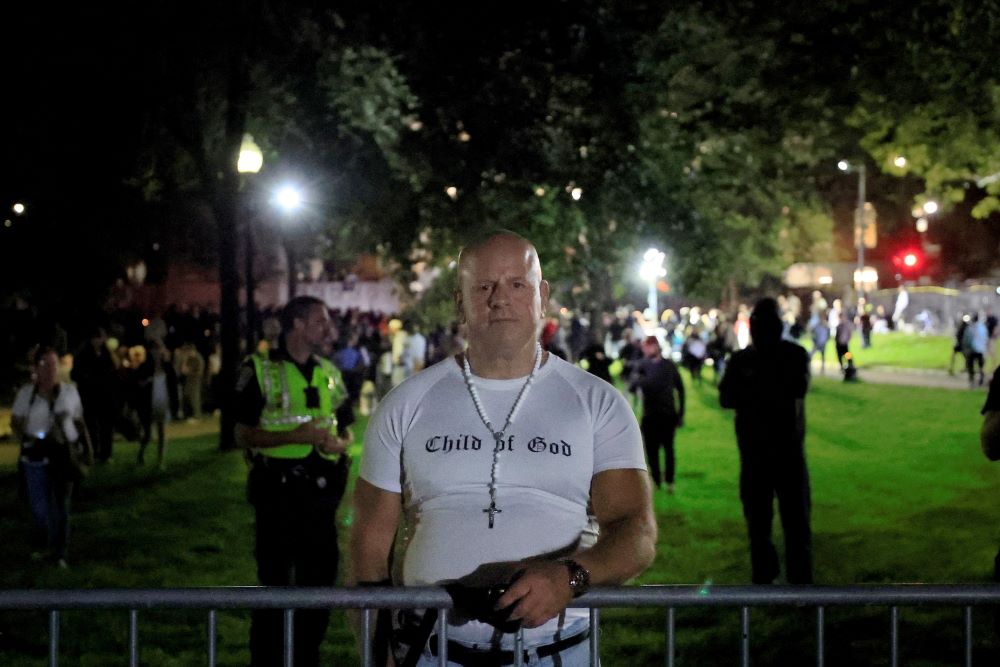
A man wearing a rosary and T-shirt reading "Child of God" attends a prayer vigil for conservative activist Charlie Kirk in Boston Sept. 18, 2025. Kirk, co-founder of Turning Point USA, was fatally shot Sept. 10 during an event at Utah Valley University in Orem. (OSV News photo/Reuters/Brian Snyder)

by Kathleen Bonnette
Join the Conversation
Send your thoughts to Letters to the Editor. Learn more
White supremacy, misogyny and other forms of bigotry are on the rise among young men, including Catholics. Recall the leaked group chat containing thousands of messages among leaders of the young Republican movement, primarily men, containing racial and homophobic slurs, white supremacist and fascist rhetoric, and the glorification of rape and murder. The chat also included discussion "about how devoutly Catholic some chat members are and how often they attend church," Politico reported. More recently, a Washington Post article titled "Bigotry among young conservatives has Republicans on edge" details the prevalence of young men who have been radicalized by right-wing influencers, including those attending a Turning Point conference session on "mobilizing Catholic voters," where antisemitic conspiracy theorist Jack Posobiec was a panelist. At the same time, there is an influx of young men joining the church, many of whom — including Looksmaxxing influencer Clavicular, who's quoted directly by the Post — are attracted to its hierarchical order, in what some are calling a revival.
The Polarization and Extremism Research & Innovation Lab (PERIL) at American University defines "radicalization" as "any process that leads a person to hold extremist beliefs," which maintain that "one group of people is in dire conflict with other groups who don't share the same racial or ethnic, gender or sexual, religious, or political identity … [and] this imagined conflict can only be resolved through separation, domination, or violence between groups." Importantly, PERIL director Cynthia Miller-Idriss has identified misogyny as "an inextricable root of, and an underacknowledged pathway to, violent extremism." Radicalization is exacerbated and facilitated by online spaces where users are exposed to extremist content and involved in extremist relationships. The radicalization trend is also reflective of the normalization of patriarchal white supremacy by the current administration, and the crisis of loneliness.
These toxic lies are a distortion of our faith, which also gives us the tools to resist them.
As the mother of a preteen boy (as well as two daughters), trying to raise my kids in the faith, this terrifies me. I have written previously that higher church attendance correlates with toleration and support for the lies of white supremacy and misogyny that underlie extremism. However, these toxic lies are a distortion of our faith, which also gives us the tools to resist them. As Miller-Idriss puts it, "Taking a closer look at where those beliefs come from and how ubiquitous they are can help shed light on the pathways to violence, including when and how society might best be able to interrupt them."
As we welcome so many new converts, recognizing our shortcomings and acknowledging the danger of radicalization should motivate us all to empower our young people to resist the allure of extremist content, and there are a number of ways the church is particularly well-suited to respond. For example, youth and young adult programs are ideally situated to train and empower young people to recognize and counter radicalization among themselves and their peers.
Those most vulnerable to radicalization are people who exhibit signs of loneliness, isolation and a desire to participate in a bigger sense of purpose. Insofar as the church is a universal community of hope that is rooted in local communities, we are perfectly situated to respond to this need. Indeed, for PERIL, "one of the best ways to create resilience to extremist messaging is to strengthen youth's sense of positive identity and belonging." Across the globe, Catholics are stepping up to empower young people to be peacemakers in ways that intentionally and explicitly counter extremism in this way.
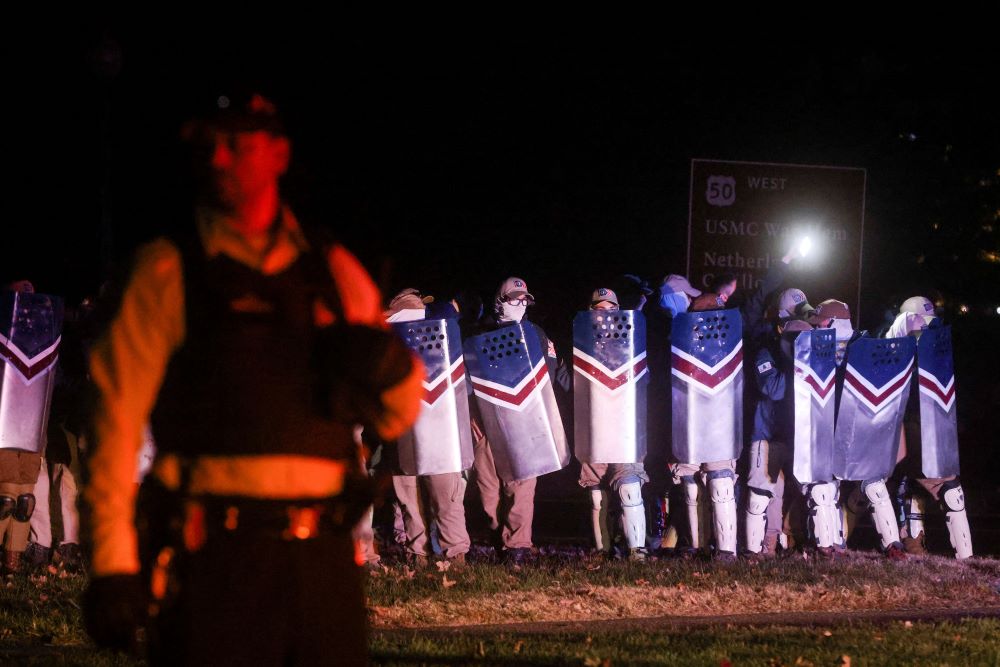
Members of Patriot Front, a white supremacist group, stand with shields in Arlington, Va., as a law enforcement officer stands guard between them, media members and bystanders Dec. 4, 2021. Members of the group held a "reclaim America" rally near the Lincoln Memorial in Washington. (CNS/Reuters/Leah Millis)
In northern Ghana, a region plagued by tensions and extremist violence, Catholic Relief Services and its partners developed a program called The Prevention of Violent Extremism Through Social Accountability to "mobilise and build youth leadership across northern Ghana in an effort to fortify communities against radicalisation and maintain peace." The program includes a two-day training for youth leaders across the region to learn "practical skills in mediation, dialogue, and early warning response." It seeks to train and inspire community members, especially youth, to resist extremism and foster peace in their communities, inviting them into a space of belonging and giving them the tools to create those spaces for their peers. In the United Kingdom, schools are engaged in the PREVENT program, which seeks to educate children in ways that decrease their vulnerability to radicalization. Incorporating anti-extremist religious education focusing on peace and respect helps to prevent radicalization and empower young people with resources to lead their peers away from extremism.
These are programs that can and should be replicated in the United States. Some, although very few, parochial schools in the U.S. offer this kind of teaching, as well as some internet safety resources available through diocesan websites. At a Catholic school in Ohio, for example, students learn safety measures and digital virtue and practice the critical thinking skills to apply those in their digital activity. Currently, these resources are rare, but they offer great examples of how the church could use its vast network of community to counter the extremism children will be exposed to online and build resilience to resist its allure.
I suggest that sustained and engaging programs explicitly designed to empower young people to be peacemakers should be a priority for all catechetical and academic curricula. PERIL offers curriculum guides, as well as resources for faith communities and parents and caregivers hoping to resist the radicalization of young men and encourage their youth to grow into healthy human beings. Their Peacemaker's Toolkit offers some practical advice for implementing these strategies.
Beyond this, all Catholics should be intentional about dismantling extremist worldviews whenever we encounter their iterations: Refuse to laugh at the demeaning joke; reject binary gender norms that suppress authenticity, and embrace the diversity we are called to express; affirm the full humanity of all people; establish networks of support that assure everyone that they belong; host community events; organize local grassroots service projects; and elicit and respond to the ideas and needs of youth. In our prayer and liturgy, we must also find ways to avoid the sexist references that pepper our traditional expressions of faith. Homilies should incorporate explicit rejection of misogynistic, racist or violent worldviews. Catholic men, especially, should begin to challenge one another and hold each other accountable for resisting patriarchal worldviews, which training can equip them to do. At the same time, when they do so, they must receive the support and assurance of belonging that can sustain them in what can be a lonely endeavor.
Advertisement
To do this, however, the church will need to improve its own messaging. I have written before about the ways in which misogyny often taints Catholic moral formation, and eliminating misogynistic frameworks and language from our liturgical and educational content is critical for fostering authentic personhood (including masculinity), building communities of belonging and resisting extremism.
Catholics place their faith in a God who is actively relational — we believe in the reality of dynamic interconnection, not rigidity or separation. Throughout our tradition, we see the call to community and mutual care, and to nonviolent action. We recognize the wisdom of humility and the invitation to be fully ourselves as we share our gifts with one another and the world. This is inherently anti-extremist and should move us to resist ideological radicalization and embody the Gospel's radical love instead.