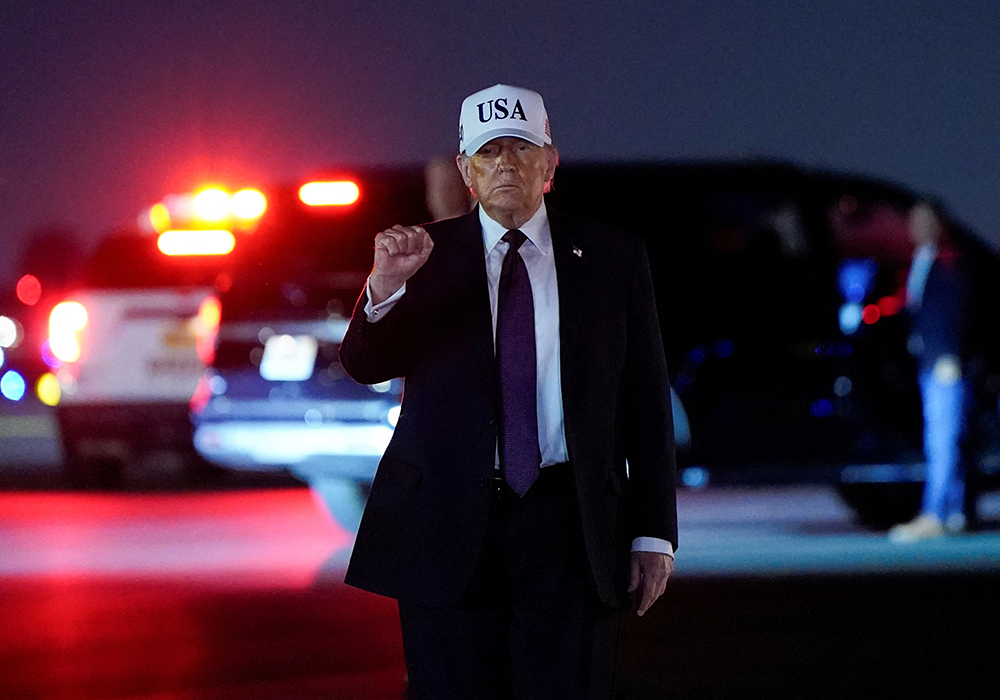
U.S. President Donald Trump pumps his fist after disembarking Air Force One at Palm Beach International Airport in West Palm Beach, Florida, Feb. 27, 2026. (OSV News/Reuters/Elizabeth Frantz)

by Mathew N. Schmalz
Join the Conversation
Send your thoughts to Letters to the Editor. Learn more
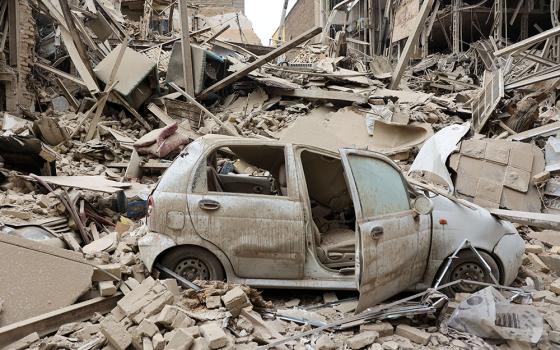
As U.S. and Israeli forces continue their attack against Iran, President Trump justified the killing of Supreme Leader Ayatollah Ali Khamenei as "justice" for the Iranian people.
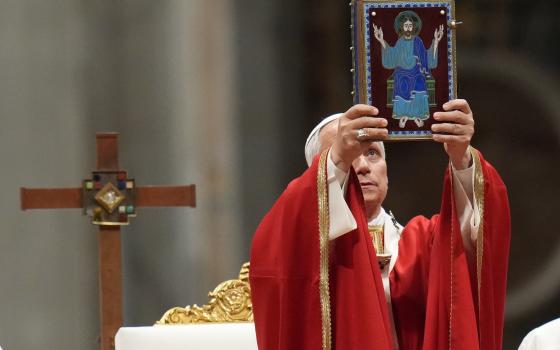
Pope Leo XIV, however, was quite quick to voice his view that diplomacy should prevail and that war with Iran risks opening up an "irreparable abyss" of destruction.
While the U.S. president has a bully pulpit, the U.S.-born pontiff has centuries of ethical reasoning on his side to oppose war with Iran.
Although the Catholic Church has had a pacifist approach to international relations since the Second World War, it still recognizes that war can be waged lawfully if certain conditions are met. Called in Latin jus ad bellum or "right to war," these conditions include legitimate authority, just cause, right intention, probability of success, proportionality and war as a last resort.
All these conditions must be met in order for war to be justified.
Legitimate authority, the first criterion, emphasizes that war cannot ethically be initiated by individuals or non-sovereign groups. Trump is the elected leader of a recognized nation state. But according to the Constitution, authorization to wage war belongs to Congress. That said, this legal safeguard has been routinely ignored by both Republicans and Democrats. Moreover, the president does have "war powers" authority granted by Article II of the Constitution.
In the case of war against Iraq and Afghanistan, Congress did pass "Authorizations of Use of Military Force," which some scholars have argued were legally dubious. Trump recently sent a war powers notification to Congress. But if strikes on Iran are indeed unconstitutional, then they lack legitimate authority.
The second standard is that war must have a just cause — namely a defensive response to a real attack on the common good. Initially, reports surfaced that Iran was not planning preemptive attacks. Secretary of State Marco Rubio pulled back from the implications of this by paradoxically claiming, "We went proactively in a defensive way."
Advertisement
Preemptive war is different from defensive war. Preemption was the justification for invading Iraq in 2003 — hundreds of thousands were killed in the aftermath and no weapons of mass destruction were found. Absent an immediate threat, it is hard to maintain that America's war with Iran is a "defensive response."
The third criterion, right intention, is especially unclear given the administration's changing rationale.
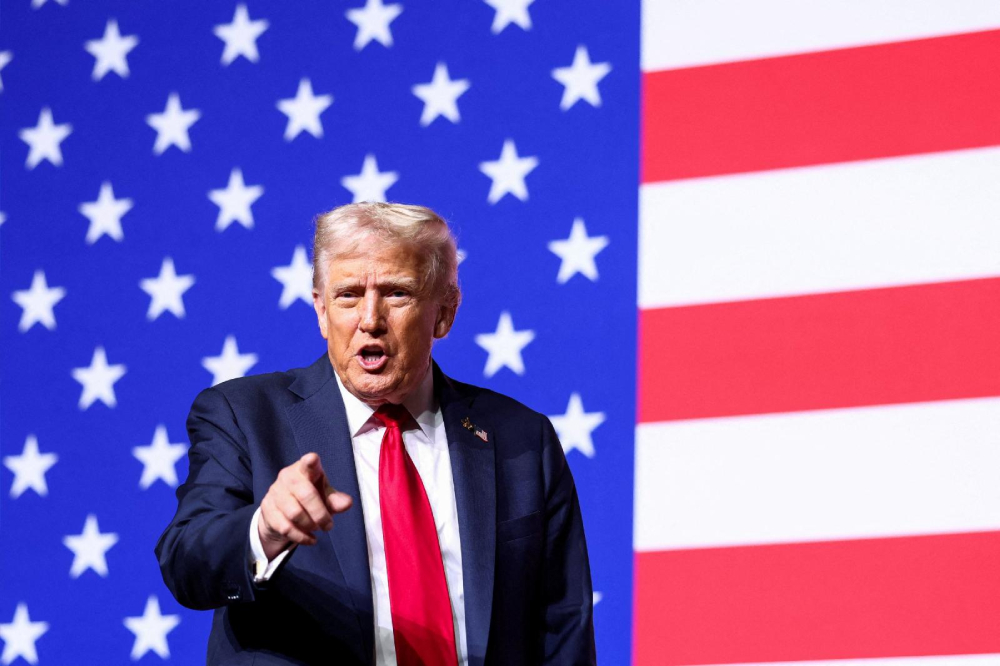
U.S. President Donald Trump gestures after speaking during a meeting of senior military leaders convened by U.S. Defense Secretary Pete Hegseth, at Marine Corps Base Quantico in Virginia Sept. 30, 2025. In an unprecedented gathering, almost 800 generals, admirals and their senior enlisted leaders were ordered into one location from around the world on short notice. (OSV News/Reuters/Kevin Lamarque)
The goal might be "regime change," since Trump has encouraged Iranians to "take over" their government. The people of Iran, however, have good reason to doubt U.S. intentions in this matter. The CIA orchestrated the 1953 overthrow of elected Iranian Prime Minister Mohammad Mossadegh. The CIA and successive American governments also supported the Shah of Iran and his repressive policies, enforced by his secret police, SAVAK. Given this history, securing the freedom of ordinary Iranians would be quite a new policy objective.
Trump has also said that Iran would not "renounce their nuclear ambitions." But the president also claimed that Iran's nuclear potential had been "obliterated" last summer, so at the very least there would need to be new information that should be shared with Congress. Trump also recently claimed that Iran was producing missiles that "could soon reach the American homeland" — an assertion that flies in the face of intelligence assessments.
The goals of the U.S. attack keep shifting, leaving many questions unanswered not just about "right intent" but any coherent "intent" at all.
The fourth standard, probability of success, might seem to be the most straightforward, given America's capabilities. But U.S. hopes of regime change have often been stymied, most recently in Afghanistan and Iraq. A relatively less ambitious goal — like destroying Iran's military — might be achievable, though it does raise the next issue for jus ad bellum.
The goals of the U.S. attack keep shifting, leaving many questions unanswered not just about "right intent" but any coherent "intent" at all.
Warfare must be waged proportionally. War for regime change in Iran opens the door for justifying almost any use of force in order to topple the government, which would certainly mean targeting not just military assets, but also the infrastructure of Iranian civil society. This could lead to bloodshed on an enormous scale. Defense Secretary Hegseth himself bragged that there will be "no stupid rules of engagement" this time. Disproportionate war seems to be the administration's strategy, regardless of the identified threat or goal.
The final condition for jus ad bellum is "last resort." We should not be naive about the Iranian regime. Thousands of Iranian citizens were killed during the last wave of protests. Yet even after ordering strikes, Trump still seemingly left room to negotiate — for some, perhaps, a signal of a willingness to make a deal, for others, an indication that the administration's rationale and end game for war were never really clear.
Leo asks us not to tire of making peace. And the reasoning behind Christian just war theory is precisely that enduring peace in justice should be the final goal. Given the Trump administration's inability to articulate a case for a just war against Iran, it seems as though making peace was never really the intent to begin with.